
Government Watchdog Flags Major Risks in U.S. Air Force’s B-52 Bomber Modernization
A new government report warns that the U.S. Air Force’s ambitious plan to modernize its aging B-52 Stratofortress bomber fleet, a critical component of its long-range strike capabilities, faces substantial risks of cost overruns and further schedule delays. Auditors specifically point to a contentious strategy of beginning engine production before crucial flight tests are complete, a move that could jeopardize the multi-billion-dollar effort to extend the bomber’s service life into the 2050s.
The Government Accountability Office (GAO), the investigative arm of Congress, stated in its report released on July 31 that the Commercial Engine Replacement Program (CERP) is already years behind schedule. Developmental flight testing for the new engines is now not expected to commence until early fiscal year 2029, a four-year delay from initial projections. Consequently, the program’s Initial Operational Capability (IOC), signifying its readiness for deployment, is anticipated in 2033, five years later than originally planned.
A primary concern highlighted by the GAO is the Air Force’s intent to begin engine and subsystem production concurrently with developmental flight testing. This approach, 27 months behind schedule, could lead to a situation where new engines are installed on B-52s before comprehensive testing reveals potential issues. Should modifications be required post-installation, the GAO warns of significant ripple effects, pushing the upgrade further behind schedule and escalating costs.
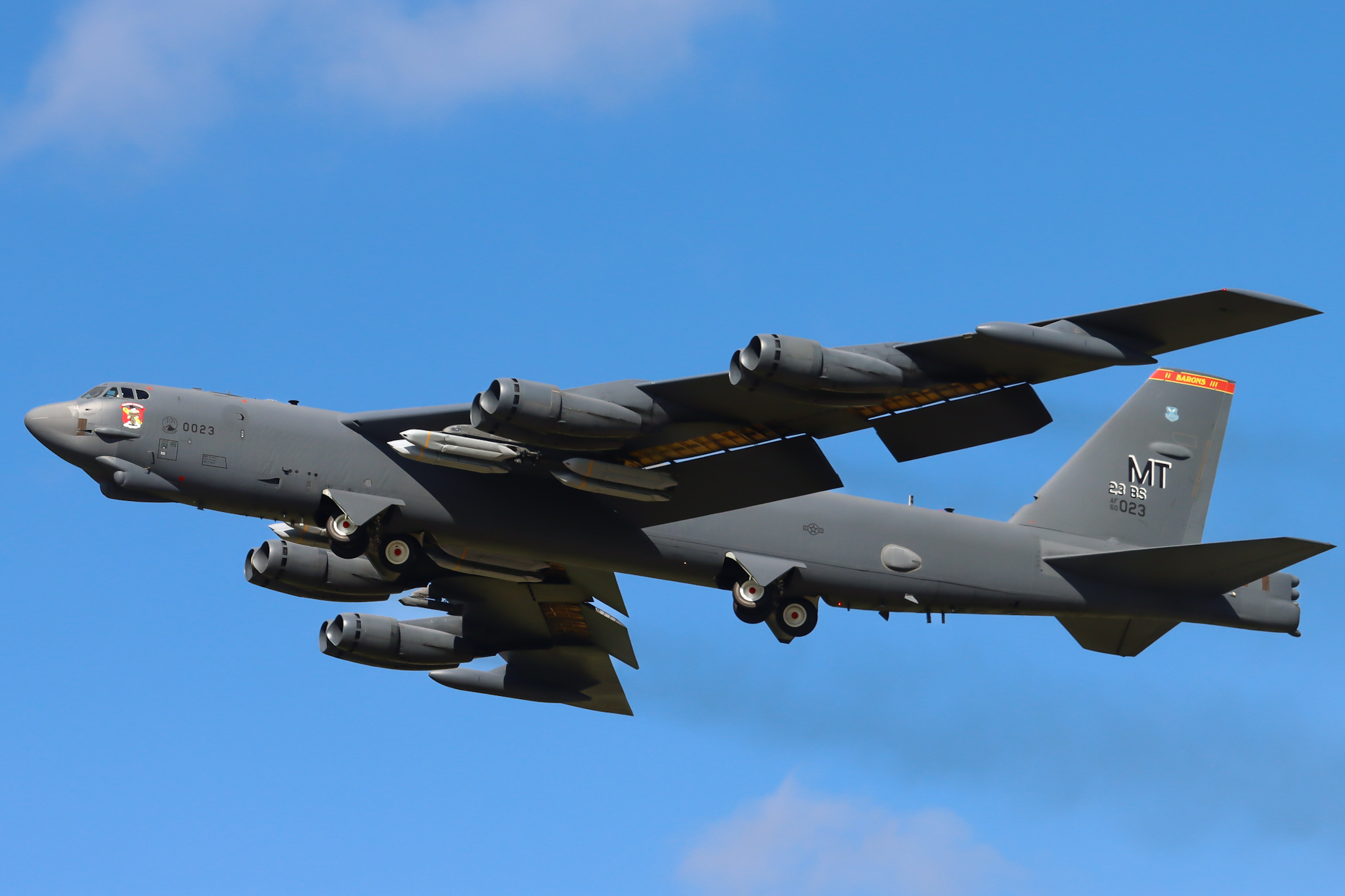
The B-52 Stratofortress, with its fleet of 75 aircraft, boasts an average age of approximately 65 years, with the newest models having entered service in 1962. Despite their vintage, these iconic bombers are slated to remain a cornerstone of the U.S. Air Force (USAF) bomber force for decades to come. While the B-1 and B-2 bombers are projected for retirement in the late 2030s, the B-52 is envisioned as the enduring stand-off bomber, operating alongside the stealth-capable B-21 penetrating bomber.
Such an extended operational lifespan presents unique challenges. The GAO report notes that many B-52 components are increasingly obsolete, with original manufacturers often out of business. This necessitates the difficult process of locating alternative parts or suppliers, and in some instances, parts are still “cannibalized” from retired airframes to keep others flying. This challenge has visibly impacted the B-52’s operational readiness, with its mission capable rate dipping below 54 percent in 2024, the most recent data available from the Air Force. The report further indicates that from fiscal year 2011 to 2021, the B-52 fleet met its readiness goals in only four of those years.
The comprehensive B-52 modernization project, representing an investment of $21 billion, marks the most extensive upgrade in the bomber’s history. This undertaking aims to extend the aircraft’s life well into the 2050s and encompasses 13 distinct upgrades, ranging from engines and communications systems to software, weapons, and radar. Upon completion, the upgraded aircraft will be redesignated as the B-52J.
The CERP alone, which will replace each B-52’s eight Pratt & Whitney TF33 engines with eight new Rolls-Royce F130 engines, is projected to cost over $15.4 billion, accounting for approximately 74 percent of the total modernization budget. This figure represents a more than 38 percent increase since 2018. The absence of a formal cost and schedule baseline, delayed for 32 months, has prevented a congressional notification known as a Nunn-McCurdy breach, which is triggered by significant cost overruns in major defense programs. An affordability study, intended to assess alternatives and confirm cost estimates before development, was not completed by March 2026.
Air Force officials acknowledge the inherent risks of concurrent testing and development but have chosen to accept them to avoid further delays to the program. They informed auditors that their strategy involves implementing multiple decision points throughout the production process, rather than relying on a single production decision. However, the GAO report cautions that, “while having multiple decision points might provide insights into the program’s progress, the initial production decision will turn the supply chain on and, once that begins, it is difficult and inefficient to stop production to address any issues identified at subsequent reviews.”
The Radar Modernization Program (RMP) is also grappling with significant challenges. Projecting a cost of approximately $2.9 billion, the program has experienced a more than 30 percent cost growth, leading to a significant Nunn-McCurdy breach notification in May 2025. Program officials attribute this escalation to substantial design changes, issues with contractor performance, and increased installation complexity. The planned start of production for the new AN/APQ-188 radar has been delayed by more than two years, now slated for the third quarter of fiscal year 2026. Its initial operational capability is anticipated in the third quarter of fiscal year 2030, about three and a half years behind schedule.
Furthermore, the B-52 program office scaled back five of the new radar’s original performance requirements to manage future cost increases, now aiming for 20 performance requirements that officials describe as the “minimum viable product.” The GAO criticized this approach, noting that “leading practices… suggest making trade-off decisions and defining a minimum viable product before awarding a contract,” implying the Air Force will receive less capability despite paying more.
Adding to these difficulties, a B-52 crashed on June 15 at Edwards Air Force Base, California, during a test flight specifically for the new radar. Program officials indicated at the Life Cycle Industry Days conference in Dayton, Ohio, on July 27, that the loss of this critical test bomber would likely cause further delays to the RMP. A second B-52 test aircraft is now undergoing modification with the new radar system.
In light of these challenges, the GAO recommended that the Air Force delay its production decision on CERP until a comprehensive analysis of cost growth and schedule delays is complete. The Air Force, while agreeing on the value of such an analysis, disagreed with delaying the production decision, citing that the decision is still more than two years away, providing ample time to complete the study. The Air Force concurred with the GAO’s other recommendations, which included exploring the benefits of digital engineering for modernization programs and updating repair plans for the B-52 fleet.
Why This Matters
The B-52 Stratofortress is more than just an old bomber; it is a venerable and highly adaptable platform that forms a crucial pillar of the United States’ strategic deterrence and conventional strike capabilities. As the U.S. military pivots towards great power competition, the B-52’s ability to carry a diverse array of conventional and nuclear weapons from stand-off distances makes it indispensable, particularly as other bomber fleets like the B-1 and B-2 are phased out. Its modernization is essential to bridge the gap until the stealthy B-21 Raider is fully operational and to provide a high-capacity bomber for decades to come.
The reported delays, cost overruns, and the Air Force’s decision to accept significant risks in programs like the Commercial Engine Replacement Program (CERP) and the Radar Modernization Program (RMP) raise serious concerns about fiscal responsibility and accountability. With the B-52 modernization project totaling $21 billion, any further escalation in costs directly impacts taxpayer dollars that could otherwise be allocated to other critical defense needs or public services. The GAO’s warnings highlight the importance of robust oversight in large-scale defense acquisitions to ensure that promised capabilities are delivered efficiently and within budget.
Persistent delays in upgrading a vital strategic asset like the B-52 could have tangible implications for national security. An aging fleet, plagued by obsolescence and declining readiness rates, means a less capable and reliable bomber force available for global contingencies. In a rapidly evolving geopolitical landscape, ensuring that strategic assets are modernized on schedule is paramount to maintaining a credible deterrent and projecting power effectively. The trade-offs in radar capability, for instance, mean the B-52J might not achieve its originally envisioned performance, potentially affecting its effectiveness in future conflicts.
This report offers critical lessons for future large-scale military modernization programs. The challenges faced by the B-52 upgrades underscore the complexities of extending the life of decades-old platforms and the importance of thorough planning, realistic cost assessments, and rigorous testing schedules. The GAO’s advocacy for defining “minimum viable products” before contracts are awarded and avoiding concurrent production and testing serves as a blueprint for managing risk and maximizing efficiency in future defense acquisitions. Learning from these experiences will be vital for the successful development and deployment of next-generation defense systems.