
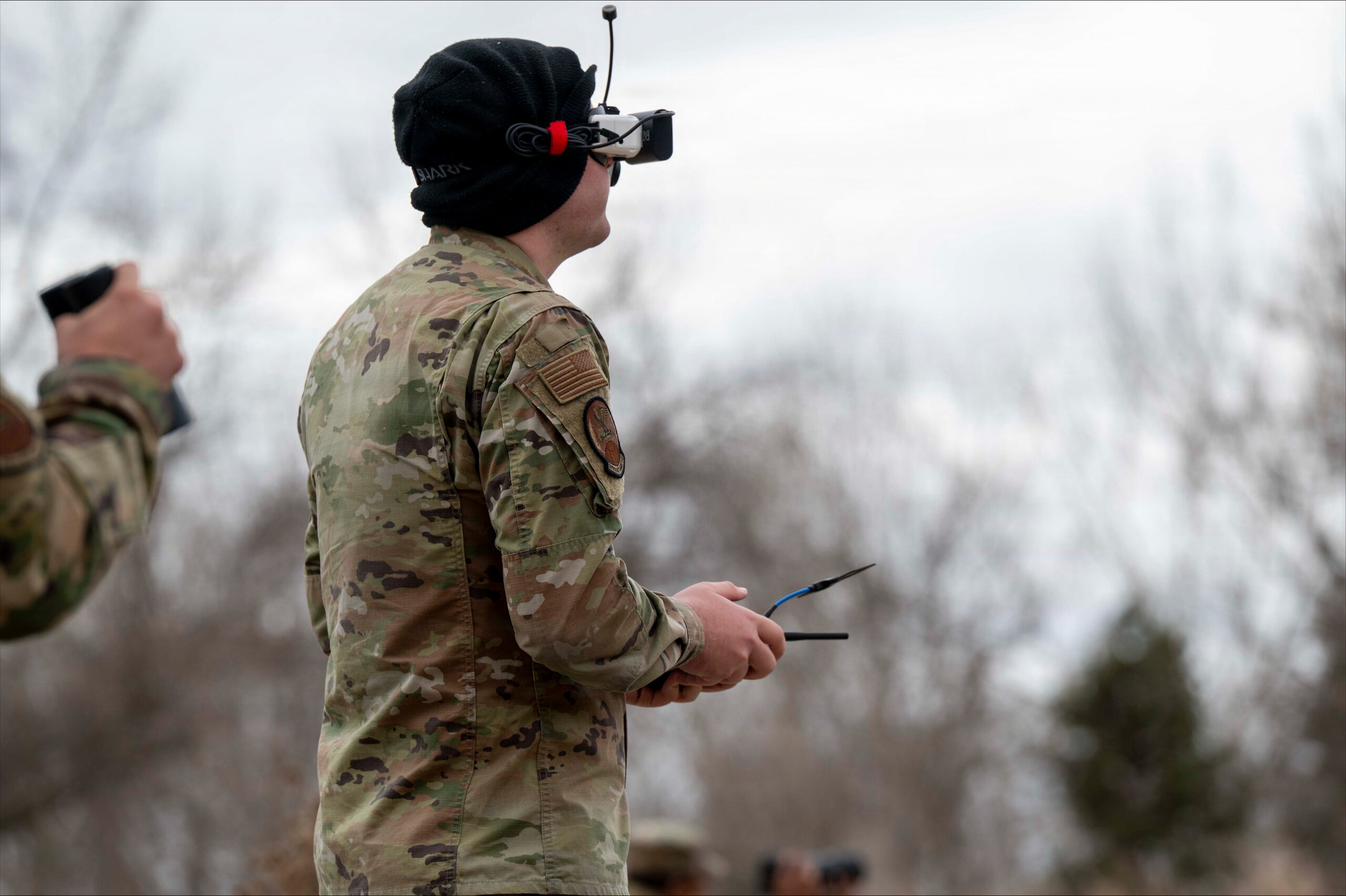
The United States Air Force is actively developing a specialized “Point Defense” force, designed to enhance the protection of air bases against increasingly sophisticated unmanned aerial system (UAS) attacks. However, a recent report from a defense expert suggests that these efforts, while commendable, may not be sufficient to counter the large-scale drone assaults already prevalent in modern conflicts.
The threat posed by attack drones has grown significantly in recent years. U.S. forces in the Middle East have faced a persistent challenge from such systems amidst ongoing tensions. Similarly, drones have become a defining feature of the conflict in Ukraine, with both sides employing them extensively. Notably, recent reports indicate that Ukraine launched drones deep into Russian territory, causing damage to oil refineries, logistics hubs, and a major retail warehouse, underscoring the expanding range and impact of these weapons.
The urgency of this threat has been building for several years. In late 2023, the Air Force faced scrutiny from Congress following multiple days of unidentified drone flights over Langley Air Force Base in Virginia. Subsequent incursions were reported at bases in Ohio, Utah, and the United Kingdom, highlighting a critical vulnerability in existing base defense capabilities.
In response to these challenges, the Air Force introduced new doctrine on the “Point Defense of Air Bases” in April 2025. This updated guidance aims to empower air base commanders with greater autonomy to identify and neutralize threats, utilizing “organic PD capabilities” to secure air operations. The service has also established a dedicated Point Defense Task Force (PDTF) and a Point Defense Battle Lab. These entities are tasked with developing new training protocols, identifying essential equipment, and formulating tactics for this evolving mission.
Furthermore, the Air Force has begun forming its initial point defense flights – specialized units of Airmen trained for rapid deployment to strategic locations like the Pacific and other potential hotspots, with the primary objective of defending remote air bases from drone attacks. Looking ahead, the service is working to create a new job specialty code for base defense, a foundational step in establishing a dedicated career field for this critical mission.
“We’ve seen that the adversary is evolving… and we have to do the same,” stated Michael Sheehy, director of future operations under the Air Force deputy chief of staff for operations, in an interview with Air & Space Forces Magazine. “We’re putting more emphasis into the point defense mission from an organize, train, and equip standpoint. One of the things that I’m driving after, from an organizational perspective, is to professionalize this mission set for our wings and for our deployers.”
However, retired Brig. Gen. Houston Cantwell, a senior fellow with the Mitchell Institute for Aerospace Studies, has raised concerns regarding the current scope and pace of the Air Force’s plans. In a new policy paper released on July 29, he advocates for a more comprehensive strategy to dismantle an adversary’s capacity to launch effective drone attacks on air bases.
While crediting Air Force officials for their initial efforts, General Cantwell observed, “it doesn’t feel like there’s a sense of urgency; It feels like it’s a bureaucratic response to something.” He emphasized that “Point defense is obviously going to be critical to this, but a [purely] defensive strategy is a losing strategy. We have to think beyond point defense.”
General Cantwell’s proposed strategy extends beyond passive defense. He argues that the Air Force must prioritize training and equipping Airmen with advanced technology capable of detecting, identifying, tracking, and destroying enemy drones. This effort, he suggests, must include an expanded network of airborne early-warning sensors. Crucially, Cantwell’s vision also encompasses an offensive strike plan targeting enemy drone manufacturing capabilities. The strategy should further integrate a new, multi-level protective posture, enabling air base personnel to adapt to varying drone threat levels, and empower air base commanders to manage the electromagnetic spectrum within their areas of responsibility.
General Cantwell also stressed the need for adequate funding and personnel. “Congress and the Department of Defense have got to additively resource the Air Force with the personnel and the equipment to defend these air bases,” he stated. “This is an additive mission… and we’ve got to provide those capabilities.” In his paper, he asserts that the “Air Force must focus its efforts, adapt its doctrine and procedures, and develop, integrate, and deploy the technology to counter the proliferating air threat posed by [small unmanned aerial vehicles]. Air base defense is core to the service’s ability to generate airpower and must be prioritized to maximize aircraft generation, even in the face of sUAV attack.”
The Air Force’s Point Defense Task Force (PDTF), part of Air Combat Command, has been actively developing training programs for these new point defense units and conducting exercises to pinpoint future capabilities needed for drone warfare. Colonel Cody Moore, who recently concluded his command of the PDTF and is now the chief of future operations at ACC, described the task force’s work in developing the structure of the new 20-Airman point defense flights. “I’m running as fast as I can to make these solutions, so they come in pieces,” he commented.
Colonel Moore noted the PDTF’s role in shaping policy. “We’ve spent a little over two years working on some of that problem, and now the Air Force has come out and said, ‘hey, this is going to be a flight underneath our operational support squadrons’—that was a recommendation that came out of the Point Defense Task Force,” he explained. “We did tabletop exercises. We did operational rehearsals, real-world experimentation with what kind of Airmen have these skills.”
The new flights will comprise enlisted Airmen with backgrounds in aviation, battle management, and command-and-control. They are scheduled to undergo an approximately three-week training course at the Joint Counter Unmanned Aircraft Systems University, located at Fort Sill, Oklahoma. This training will focus on the proficient use of U.S. military counter-drone technology and defensive tactics against enemy drone attacks. The Air Force is collaborating with the Fort Sill university to develop the formal technical training curriculum for Airmen entering the future base defense specialty code.
However, General Cantwell expressed apprehension regarding the training capacity of the Joint Counter Unmanned Aircraft Systems University. He fears it may be unable to accommodate the training demands of all new base defense Airmen from across the services. “There’s just so much demand on that university that they can’t train all the joint requirements at once,” he stated. As an alternative, Cantwell suggested that the Point Defense Battle Lab at Grand Forks Air Force Base, North Dakota, could be expanded to help meet this training need.
Why This Matters
The ongoing efforts by the U.S. Air Force to establish a “Point Defense” capability for its bases, coupled with the critical analysis from experts like Brig. Gen. Houston Cantwell, highlight a pivotal shift in modern warfare and global security. This issue is significant for several reasons:
Evolving Threat Landscape:The proliferation of unmanned aerial systems (UAS), particularly small, inexpensive, and readily available drones, has fundamentally altered the threat environment for military installations worldwide. These systems offer adversaries asymmetric advantages, enabling attacks with precision, at low cost, and often with reduced risk to personnel. The ability of drones to penetrate airspace undetected and deliver payloads or intelligence poses a significant challenge to traditional air defense doctrines.
National Security and Readiness:The security of air bases is paramount for projecting air power, conducting military operations, and ensuring national defense. If these critical hubs are vulnerable to drone attacks, it can degrade the Air Force’s operational readiness, disrupt supply chains, endanger personnel and high-value assets, and potentially undermine the nation’s ability to respond to crises effectively. The debate over defensive versus offensive strategies reflects a deeper concern about maintaining a decisive military edge.
Technological Race:The development of effective counter-UAS capabilities is an urgent technological race. This includes not only defensive systems to detect, track, and neutralize drones but also offensive measures to disrupt their manufacturing and deployment networks. The ongoing innovation in drone technology necessitates continuous adaptation and investment in advanced sensors, electronic warfare, directed energy weapons, and kinetic interceptors. The discussion around “point defense” versus a “comprehensive strategy” underscores the complexity of this technological challenge.
Resource Allocation and Strategic Priorities:Addressing the drone threat requires significant financial and human resources. Brig. Gen. Cantwell’s call for “additive resources” from Congress and the Department of Defense highlights the need for prioritizing this mission within defense budgets. Decisions made today regarding funding, training, and equipment for base defense will have long-term implications for the Air Force’s structure, personnel, and overall strategic posture in an era of rapidly advancing military technology.
Inter-service Coordination:The mention of the Joint Counter Unmanned Aircraft Systems University at Fort Sill and concerns about its capacity underscore the need for robust inter-service coordination. Drone defense is not solely an Air Force problem; it affects all branches of the military. Effective solutions will require shared training, integrated technologies, and cohesive doctrine across the Department of Defense to ensure a unified and resilient defense against this ubiquitous threat.
Ultimately, how the U.S. Air Force and the broader Department of Defense adapt to the drone threat will define the future security of its operations and its ability to maintain global air superiority in an increasingly contested environment.
The proliferation of small uncrewed aerial systems (sUAS), commonly known as drones, presents a rapidly evolving threat to military installations worldwide. In response, the U.S. Air Force is intensifying its efforts to develop robust point defense capabilities and cultivate a service-wide culture of awareness and readiness against such attacks. These initiatives span training, equipment acquisition, and strategic doctrinal shifts, reflecting a comprehensive approach to a complex challenge.
A central pillar of this response is the Air Force’s Point Defense Task Force (PDTF). This task force has established what is described as an “outpost” of the Joint UAS university, a facility dedicated to advancing understanding and tactics related to uncrewed aircraft. This outpost provides the Air Force with a crucial opportunity to adapt specialized curricula and train its own instructors, thereby creating a cadre of experts dedicated to counter-sUAS operations.
Beyond institutional training, the PDTF has also deployed mobile training teams, with one operating within the U.S. and another abroad. These teams travel to Air Force bases, delivering a two-week intensive course on point defense. According to Moore, an official involved with the PDTF, this training is designed for “anybody that the wing commander deems would be involved with point defense,” ensuring that a broad spectrum of Airmen are prepared for potential drone threats.
Each mobile training team is multidisciplinary, comprising essential personnel whose combined expertise is critical for effective counter-drone operations. These include a command-and-control enlisted battle manager and an air traffic controller. Moore emphasized the importance of their role: “That’s one of the biggest points we hit with this mobile training team is you need airborne command-and-control understanding—how do you deconflict the airspace. Our air traffic controllers are heavily involved in that process.” This highlights the complexity of integrating counter-sUAS measures into existing airspace management protocols. Additionally, the teams include a security forces Airman, crucial for ground defense and rapid response, and an Airman specializing in the maintenance and sustainment of vital air base equipment such as radar and weather systems.
The Air Force’s renewed focus on training Airmen for this emergent mission has garnered support from defense experts. Heather Penney, a former Air Force F-16 pilot and a senior fellow at the Mitchell Institute for Aerospace Studies, commended these steps but underscored the necessity of a broader cultural transformation across the entire service. “This is about everybody needing to have this attitude to defend against and offensively preempt small UAS attack,” Penney stated, advocating for a proactive mindset throughout the Air Force. She also stressed the importance of educating Congress about the necessary resources the Air Force requires to meet these new demands.
Penney further highlighted a perceived disparity in funding, noting that the Air Force has shouldered a significant portion of combat missions over the past three years, citing operations like Midnight Hammer and Epic Fury, yet “is still getting the least funding out of all the services.” She asserted, “It’s time for Congress and the [Pentagon] to provide the resourcing to the Air Force, not only to get healthy, but to begin to expand its mission areas.” Increased resourcing would enable the equipping of more air bases and units with low-cost point defense systems capable of tracking and defeating drones, as well as passive defenses like camouflage to deceive and confuse incoming enemy drones, according to Cantwell, another expert from Mitchell.
Cantwell observed that “there’s an overwhelming amount of capability out there when it comes to point defense,” suggesting that the challenge lies not in the absence of technology but in its strategic acquisition and deployment.

The Air Force’s primary counter-sUAS program of record is the Small Unmanned Air Defense Systems, or SUADS. This system serves as a detection platform, capable of identifying and tracking enemy drones of various sizes. It is also equipped with an electronic warfare effector designed to disable incoming drones. SUADS is available in two configurations: one for fixed air bases and another rapidly deployable variant on an aircraft pallet for expeditionary missions. Congress allocated $51.8 million for SUADS procurement in fiscal year 2026, according to Air Force budget documents.
Moore explained the modular philosophy behind SUADS: “The Air Force’s approach to that is that we own that baseline system, and as we identify those new capabilities… I can go out and buy that high power microwave and plug it into my SUADS. I can go out and buy that kinetic interceptor from company x and connect it to SUADS. If I build that foundational capability with the electronic warfare, the command and control, the detect and track and ID capability—now all I’m building is additional defeat options based on the location that I need to be in.” This approach aims for flexibility and adaptability against evolving threats.
While the Air Force is acquiring additional commercially available systems, tracking these procurements can be challenging as they do not always appear in the service’s proposed fiscal year 2027 budget. Sheehy, who works closely with joint counter-drone initiatives, clarified that funding initially earmarked for the Pentagon’s Replicator 2 counter-drone initiative has been consolidated into the Joint Interagency Task Force 401 (JIATF 401). Established last year, JIATF 401 aims to rapidly develop counter-drone technologies for all military services. “JIATF 401 is a great partner, and we are procuring small UAS sensors, effectors, and C2 systems through that money in JIATF 401,” Sheehy noted. “It doesn’t show up in the Air Force books, but the Air Force is definitely getting its fair share.” Sheehy confirmed the Air Force is acquiring various effectors and command-and-control systems to process sensor data, though specific company names or system details are withheld for operational security.
Cantwell’s research emphasizes the critical role of airborne sensors, such as the MQ-9 Reaper, in providing early warning against inbound enemy drones. “I can’t overemphasize the importance of getting airborne sensors,” Cantwell stressed, pointing to how Russian forces in Ukraine have learned to circumvent fixed-base radars and other static sensors. He argued, “By having airborne persistent sensors, it allows us to… be unpredictable because those sensors can be anywhere on the battle space. A UAV like an MQ-9 is able to persist for 20 to 24 hours and can surveil the battlespace.”
However, Sheehy declined to discuss the potential use of MQ-9s in such a role, citing operational security concerns. In a statement, he reiterated the Air Force’s layered defensive approach: “The U.S. Air Force takes a layered defensive approach to point defense and is not reliant on a single type of radar or sensor. To preserve our tactical advantage and ensure operational security, we will not disclose specific technical capabilities and system configurations.”
Cantwell underscored that point defense alone is insufficient given the exponential growth of the drone threat. He warned that potential adversaries could launch hundreds, or even thousands, of drones against airfields, specifically targeting combat aircraft generation. “We just don’t have the mass arsenal of weapons to be able to stop all these aircraft,” Cantwell stated, highlighting the urgent need for offensive counter-air operations aimed at targeting and destroying enemy drone manufacturing capabilities before they can be deployed. “We have to get that offensive counter air to be able to stop the threat before it becomes an actual threat to the base,” he concluded.
Sheehy concurred with the importance of offensive operations in neutralizing the drone threat, referencing Task Force Scorpion Strike’s deployment of the Low-cost Unmanned Combat System, or Lucas, in combat for the first time during Operation Epic Fury.
Cantwell’s report also offers several key recommendations for further enhancing counter-drone capabilities:
- **Standardized Equipment and Resourcing:** Advocate for increased funding for a standardized suite of equipment that provides airborne early warning, tracking, and identification, alongside both kinetic (physical) and nonkinetic (electronic warfare) effectors to defeat airborne threats from the ground.
- **Cost-Effective Airborne Warning and Defeat:** Emphasize the acquisition of affordable airborne early warning and defeat capabilities for sUAS, ensuring a robust, in-depth defense for air bases.
- **Disciplined Electromagnetic Spectrum Management:** Highlight the necessity for commanders to meticulously manage the electromagnetic spectrum. Drone and counter-drone operations rely heavily on radio frequency energy, GPS, datalinks, jamming, sensing, and communications. Without disciplined spectrum management, friendly systems risk interfering with one another and undermining their intended defenses.
- **Development of “Drone Protection Postures”:** Propose the creation of standardized “Drone Protection Postures” to guide Airmen in generating aircraft sorties. A low threat might require minimal defensive measures, allowing Airmen to focus on primary duties, while higher postures would direct immediate launching of aircraft. These postures must be regularly exercised to ensure Airmen comprehend and can execute the proper procedures under pressure.
Why This Matters
The increasing sophistication and widespread availability of small uncrewed aerial systems (sUAS) represent a fundamental shift in modern warfare, posing a significant and evolving threat to military forces globally. For the U.S. Air Force, effective counter-drone capabilities are not merely an operational necessity but a strategic imperative that impacts national security and global power projection.
Firstly, the proliferation of sUAS has dramatically altered the security landscape for air bases, which are critical nodes for projecting air power. Previously considered relatively safe behind perimeter defenses, airfields are now vulnerable to inexpensive, off-the-shelf drones that can carry out surveillance, targeting, or even direct attacks with explosive payloads. Successful drone attacks can disrupt flight operations, damage high-value aircraft and infrastructure, and pose a direct threat to personnel, thereby degrading a nation’s ability to respond to crises or sustain combat operations. The Air Force’s efforts to enhance point defense directly address this vulnerability, safeguarding the foundational assets of air superiority.
Secondly, the economic asymmetry of drones is a critical factor. A single, inexpensive commercial drone can potentially incapacitate or destroy military assets costing millions or even billions of dollars. This forces military planners to invest in cost-effective counter-measures that can defeat swarms of drones without depleting valuable, high-cost interceptors. The Air Force’s focus on modular systems like SUADS and exploring commercially available options reflects an understanding of this economic challenge and the need for scalable, affordable solutions.
Thirdly, the integration of counter-drone training, technology, and doctrine signifies a cultural and strategic adaptation within the military. The call for a “cultural shift” across the Air Force emphasizes that every Airman, regardless of their primary role, must understand and contribute to drone defense. This holistic approach is vital for creating a resilient defense posture against an adversary that can launch attacks from unexpected vectors and with minimal resources. The emphasis on mobile training teams and a “layered defense” strategy underscores the dynamic nature of this threat and the need for versatile, adaptable responses.
Finally, the discussion around funding and interagency cooperation, particularly with JIATF 401, highlights the broader challenges of defense procurement and resource allocation in a rapidly changing threat environment. Ensuring adequate funding for the Air Force’s evolving missions and streamlining the acquisition of cutting-edge counter-drone technologies are crucial for maintaining a competitive edge. The lessons learned and technologies developed in this domain will have lasting implications for the future of warfare, shaping how militaries protect their forces and maintain operational freedom in an increasingly drone-saturated battlespace.