
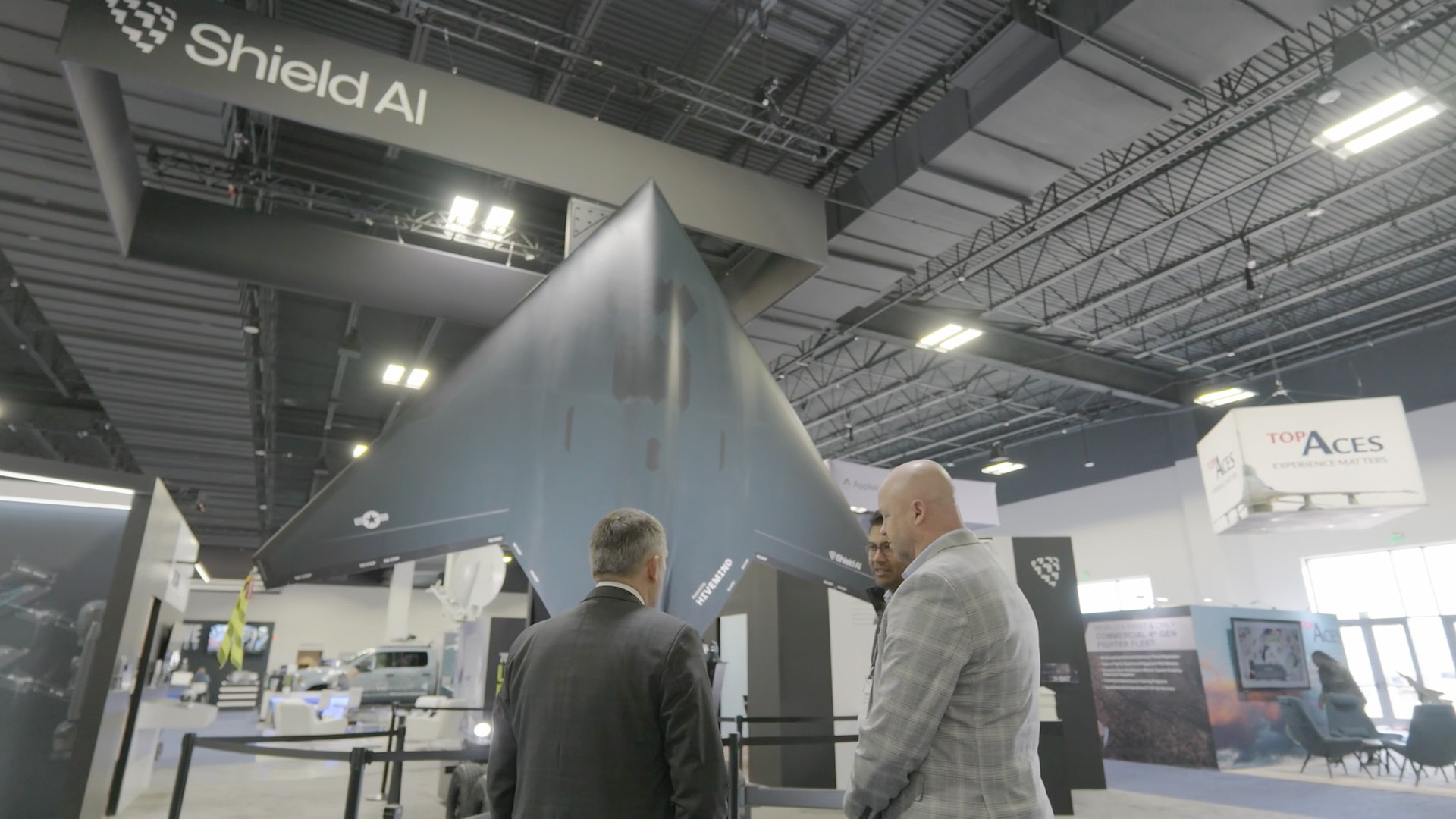
**U.S. Navy and DIU Back Shield AI’s X-BAT VTOL Drone, Air Force Eyes Potential Future Role**
A new contender in advanced autonomous aerial warfare, Shield AI, has secured significant government funding for its innovative X-BAT vertical takeoff and landing (VTOL) drone. The U.S. Navy and the Defense Innovation Unit (DIU) have committed $50 million to the specialist firm, known for its autonomy software, recognizing the intriguing possibilities of a jet designed for runway-independent operations. Notably, the U.S. Air Force (USAF), while actively developing its own Collaborative Combat Aircraft (CCA) program, has not yet directly invested in the X-BAT, choosing instead to monitor its development.
The X-BAT stands out for its unique design, capable of taking off and landing vertically from a mobile trailer, similar to how SpaceX’s reusable rockets execute their precise vertical landings. Powering this capability is the General Electric F-110 engine, the same engine found in the F-16 fighter jet. With an airframe considerably smaller and lighter than the F-16 Viper, this powerful engine generates sufficient thrust for VTOL maneuvers. Shield AI unveiled the X-BAT concept in late 2023, with the company projecting its maiden flight for 2024 and further test flights planned before the end of 2026.
Brandon Tseng, president and cofounder of Shield AI, emphasized the strategic importance of the X-BAT upon its unveiling. “Airpower without runways is the holy grail of deterrence,” Tseng stated, highlighting how such a capability could provide U.S. forces with enhanced persistence, reach, and survivability, thereby extending diplomatic options.
Retired Air Force Gen. James M. “Mike” Holmes, former commander of Air Combat Command, echoed Tseng’s sentiment regarding the value of runway independence. He noted its potential utility for the Air Force, particularly within the framework of “agile combat employment” (ACE). ACE involves deploying small, highly mobile teams of Airmen and aircraft to numerous dispersed locations, making it significantly harder for adversaries to target and neutralize them.
“If the Air Force was going to look into it, it would be… to augment that by complicating an enemy’s targeting problem,” Gen. Holmes explained. “It’s distributing your airpower and making it easier to survive and stay active in future fights.” He suggested that while the X-BAT might not replace large, fixed air bases, it could provide a crucial layer of operational flexibility and resilience in contested environments.
However, both Gen. Holmes and Heather Penney, director of studies and research at the Air & Space Forces Association’s Mitchell Institute for Aerospace Studies, pointed out that achieving true runway independence comes with considerable logistical and operational challenges. “It’s one thing to say, ‘Hey, we’re going to have truck-based X-BATs that can move all around the Philippines and hide in places, and pop up to launch, and then go hide somewhere, and then pop up to recover the system and turn it and do it again,’” Gen. Holmes elaborated. “But you also have to have the capability to get fuel and munitions to those sites and be able to link them up with X-BAT and reload it and redeploy it again.” This “forward logistics” problem is a significant hurdle for ground-based operations.
For the U.S. Navy, the potential benefits of the X-BAT are more immediately apparent, according to both experts. The X-BAT could launch from and return to a wide array of surface combatants, not just large aircraft carriers. This would dramatically expand the Navy’s options for deploying airpower across vast ocean expanses. Furthermore, Navy destroyers and amphibious ships are already equipped to carry munitions and fuel, mitigating many of the logistical challenges that the Air Force would face in its ACE concept of operations. “I’m not surprised that the Navy moved first to take a look at what it offers them,” Gen. Holmes remarked.
The Air Force, meanwhile, is deeply engaged in defining the logistics and operational concepts for its own Collaborative Combat Aircraft (CCA) program. The primary contenders for the CCA initiative are conventional, runway-dependent aircraft. Penney suggested that introducing an entirely new class of aircraft like the X-BAT, and subsequently developing distinct operational concepts for it, would place an undue strain on the Air Force’s already limited resources. “If the Navy is interested in developing this air vehicle, then that could potentially become something in the future… for the Air Force,” she noted. For the present, it appears strategically sound for the naval service to lead the development.
Technological Hurdles
Beyond operational considerations, the technological underpinnings of the X-BAT present significant challenges for any potential customer. Shield AI touts its “Hivemind” autonomy software as “the world’s best AI pilot,” claiming it has already delivered “real battlefield outcomes.” However, Penney cautioned that achieving true mission autonomy—the ability for software to execute complex aerial missions independently—is “a lot harder” than often perceived. This is an area the Air Force is still extensively refining through its own CCA program.
The X-BAT’s signature VTOL capability is also a technically demanding endeavor, even if not entirely unprecedented. While Shield AI has demonstrated VTOL with its smaller, propeller-driven V-BAT aircraft, the X-BAT is scaled to the size of a fighter jet. This larger platform will require immense thrust generation for takeoff and exceptionally precise responsiveness and stability for landing. Gen. Holmes referenced the success of rockets like SpaceX’s Falcon 9, which have proven the feasibility of vertical launch and reuse, noting that such technology is “if not routine, is understood.”
Nevertheless, Penney highlighted a unique challenge for the X-BAT: its wings. As the drone descends for landing, its wings could act like a sail, catching wind and potentially destabilizing the aircraft. “If they actually are able to reliably do this and do it in winds that are greater than like two knots in any direction, it’ll be an amazing technical feat,” Penney stated, underscoring the complexity involved.
Strategic Priorities and Fiscal Constraints
As the Air Force evaluates the X-BAT’s operational and technological merits, a critical question looms: Is it a worthwhile investment given the service’s extensive list of existing procurement priorities? Gen. Holmes and Penney both emphasized that the Air Force is simultaneously pursuing several costly, high-priority programs, including the Collaborative Combat Aircraft, the F-47 next-generation fighter, the B-21 stealth bomber, and the Sentinel intercontinental ballistic missile. Billions more are being spent on acquiring F-35 fighter jets and KC-46 refueling tankers.
While runway independence represents a compelling capability, Gen. Holmes observed that “the Air Force already has more priorities than it has money.” Shield AI estimates the X-BAT will be relatively affordable compared to a manned fighter, projecting a cost of approximately $27 million—a figure that aligns closely with the Air Force’s price target for its CCAs. However, this projected cost could fluctuate significantly throughout the development and production phases.
Given the platform’s current developmental stage, the array of unanswered questions, and the Air Force’s pressing fiscal challenges, experts largely agree that a cautious, observational approach is prudent for the USAF. “If the Navy is willing to and DIU is willing to put funding into it, then let them pay for it,” Penney advised. “If it ends up demonstrating the cost and the business case, then let the Air Force buy it military off the shelf. But given where the Air Force is right now, it doesn’t even have enough resources for current recapitalization programs. Continuing to put pressure on that by adding one more rock in the jar just doesn’t make sense.”
Gen. Holmes concluded, “I understand why the Navy is interested in it. I think it’s an interesting capability for the Air Force to try to free itself from its dependence on airfields. You still have to figure out a way to sustain it in combat… You’ve got to work that [concept of operations] and then you’ve got to decide, what is the best bang for your buck?”
Why This Matters
The development of Shield AI’s X-BAT drone and the U.S. Navy’s investment in it signal a potentially transformative shift in military airpower capabilities. This matters for several critical reasons:
**1. Redefining Global Power Projection and Deterrence:** The X-BAT’s runway-independent VTOL capability offers an unprecedented level of operational flexibility. In future conflicts, particularly in contested regions like the Indo-Pacific, where traditional airfields are vulnerable to precision-guided attacks, systems like the X-BAT could allow forces to operate from vastly dispersed locations—both land-based (from trailers) and sea-based (from various naval vessels). This significantly complicates an adversary’s targeting calculus, enhancing deterrence and ensuring persistent air presence even when fixed infrastructure is compromised. It could fundamentally alter how military forces project power globally.
**2. Evolving Military Doctrine and Inter-Service Collaboration:** The X-BAT pushes the boundaries of existing military doctrines. For the Navy, it could democratize airpower, making advanced aerial support accessible from a wider range of ships beyond supercarriers, thereby increasing the combat utility of smaller surface combatants. For the Air Force, while not yet an investor, the X-BAT embodies the spirit of “Agile Combat Employment” (ACE) by enabling distributed operations and enhancing survivability in a sophisticated threat environment. The Navy’s early investment also highlights a potential pathway for inter-service technology adoption, where one branch can incubate a capability that later benefits others, optimizing defense spending and preventing redundant development efforts.
**3. Advancing Autonomous Systems and Complex Engineering:** At its core, the X-BAT represents a significant leap in both artificial intelligence and aerospace engineering. The performance of Shield AI’s “Hivemind” autonomy software in a combat drone of this size and complexity will be a crucial test case for the maturation of AI pilots. Furthermore, mastering VTOL for a fighter-sized jet, especially with the aerodynamic challenges posed by its wings during landing, pushes the frontiers of aerospace design. Success in these areas could unlock new possibilities for civilian applications, such as cargo delivery or advanced aerial mobility, beyond military uses.
**4. The Future of Defense Spending and Priorities:** The X-BAT’s development underscores the persistent tension between military innovation and fiscal realities. The Air Force’s decision to observe rather than invest reflects the immense financial pressure on defense budgets, forcing difficult choices between funding existing programs and investing in potentially revolutionary but unproven technologies. The X-BAT’s projected cost of $27 million, if it holds, could offer an affordable path to advanced capabilities compared to manned aircraft, potentially influencing future procurement strategies across the Department of Defense. This ongoing debate about “best bang for buck” will shape the composition and capabilities of future U.S. military forces.