
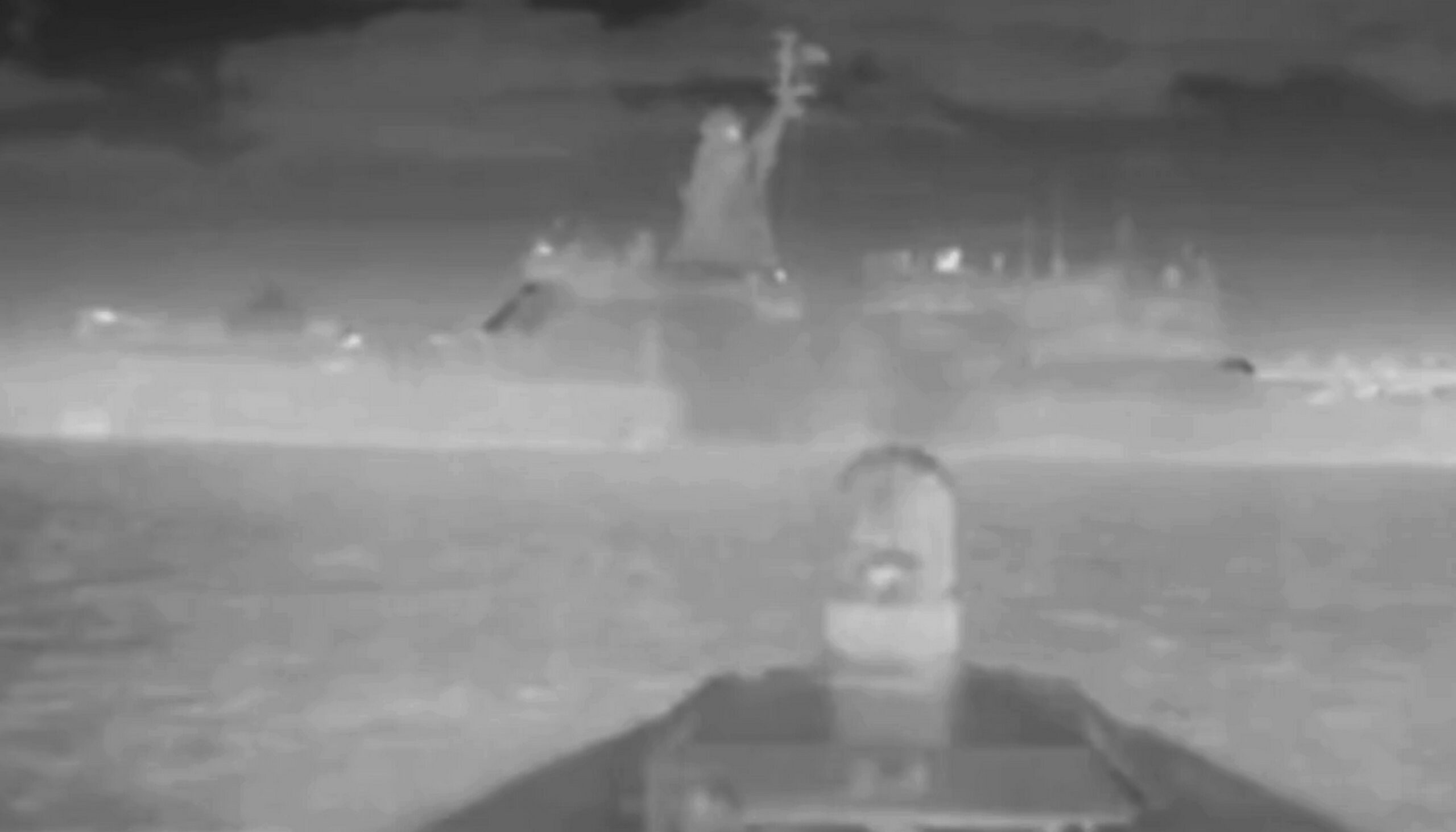
Ukraine Claims Naval Drone Attack Sunk Russian Corvette and Damaged Cargo Ship off Libyan Coast
Ukrainian President Volodymyr Zelensky has claimed that Ukrainian naval drones successfully sank the Russian corvetteMerkuryand damaged the cargo vessel MVAngara, which he stated was being used to transport weapons, in an operation off the coast of Libya.
According to Zelensky, the operation involved seven Ukrainian-made naval drones and was carried out by the Security Service of Ukraine (SBU) and the Defence Forces of Ukraine. Local authorities in Benghazi reported an explosion striking a warship at the city’s naval base early on Sunday morning. The vessel was reportedly docking for fuel and supplies prior to its intended return to Russia.
In a public statement, President Zelensky detailed the alleged attack, asserting that the assigned targets were achieved. He specifically noted the sinking of theMerkury, identifying it as one of Russia’s newest ships, commissioned in 2023 during the ongoing full-scale invasion of Ukraine. Zelensky also claimed that a Ka-27 combat helicopter was destroyed alongside the corvette and that the MVAngara, described as a Russian dry cargo vessel used for weapon transport, was successfully hit. Ukraine has stated its intention to continue such operations in designated waters and develop its indigenous weaponry in response to Russian aggression. As of the time of this report, Russia has not issued an official statement confirming or denying the alleged incident.
TheMerkuryis identified as a modernised Project 20380 corvette. Naval News previously reported that the vessel was launched in March 2020 and formally handed over to the Russian Ministry of Defence in May 2023 for deployment with the Black Sea Fleet. However, due to Turkey’s wartime closure of the Bosporus Strait to warships, theMerkurywas unable to join the Black Sea Fleet. This circumstance explains its presence in the Mediterranean Sea. The corvette is equipped with advanced systems, including the Zaslon multifunction radar, the TK-25-02 electronic warfare system, and the Redut air defence system, capable of guiding up to 16 missiles, making it a significant asset for the Russian navy.
This alleged attack marks a notable extension of Ukraine’s operational reach, targeting Russian assets far from its traditional conflict zones. It follows a series of incidents in the wider Mediterranean region that have been linked to Ukrainian drone activity or Russian assets. In March, the Russian-flagged tankerArctic Metagaz, carrying approximately 61,000 tons of liquefied natural gas, sank after explosions occurred between Libya and Malta. Russia’s Transport Ministry attributed this incident to Ukrainian sea drones launched from the Libyan coast, though all 30 crew members were rescued.
Reports in April by the Associated Press, citing two Libyan officials, suggested that Ukrainian forces, primarily drone specialists, have been operating from an air base in Misrata and from facilities in Tripoli and Zawiya. These operations are reportedly conducted under an arrangement with the internationally recognized Government of National Unity (GNU) in Tripoli. This presence is particularly significant given Libya’s divided political landscape, where eastern Libya, including cities like Benghazi and Tobruk, is under the control of Khalifa Haftar’s Libyan National Army (LNA), which maintains close ties with Moscow.
Further context regarding Russian activities and alleged Ukrainian countermeasures in the region emerged in September. The Maritime Executive reported on a Russian convoy, spearheaded by the Ropucha-class landing shipAleksandr Shabalin, that sailed from Baltiysk in Kaliningrad towards Tobruk, escorting two sanctioned cargo ships reportedly laden with trucks and armoured vehicles. The same report indicated a Ukrainian drone detachment in western Libya was linked to attacks on Russian and ‘shadow fleet’ shipping, including an alleged strike on the Russian military cargo vesselLady Mariiaon September 7.
While distinct from the recent alleged Libya attack, the broader use of uncrewed surface vessels (USVs) in the ongoing conflict has been highlighted in other instances. In October, British Defence Intelligence assessed that a Ukrainian uncrewed surface vessel armed with a mounted gun had destroyed a Russian one-way attack boat in the Black Sea on September 12. The UK Defence Journal reported this event, with British intelligence suggesting it “almost certainly marks the first time a Russian and Ukrainian USV have engaged each other directly,” underscoring the evolving nature of naval warfare in the conflict.
Why This Matters
The alleged Ukrainian naval drone attack on a Russian warship and cargo vessel off the coast of Libya, if confirmed, represents a significant development in the ongoing conflict between Ukraine and Russia, carrying substantial strategic, geopolitical, and technological implications.
Firstly, this incident underscores the **expansion of the conflict’s geographical scope**. Ukraine’s stated ability to strike Russian assets thousands of miles from its borders demonstrates an unprecedented long-range operational capability. This suggests a sophisticated network of intelligence, logistics, and drone deployment that extends far beyond the Black Sea, challenging Russia’s sense of security in regions previously considered distant from the front lines. It also highlights the growing importance of third-party nations, like Libya, as potential staging grounds or areas of influence for warring parties.
Secondly, it marks a **notable evolution in naval warfare and drone technology**. The successful deployment of multiple uncrewed surface vessels (USVs) over such vast distances against modern warships, if verified, showcases the increasing effectiveness and sophistication of Ukraine’s indigenous drone program. USVs offer a cost-effective yet potent asymmetrical weapon against larger, more expensive conventional naval assets, potentially reshaping naval strategies globally. The alleged sinking of a modern corvette like theMerkurywould be a significant loss for the Russian Navy and a major propaganda victory for Ukraine, demonstrating that even advanced vessels are vulnerable.
Thirdly, the incident has **geopolitical ramifications, particularly for Russia’s influence in the Mediterranean and North Africa**. Russia has sought to cultivate ties and exert influence in Libya, especially with the Libyan National Army (LNA) in the east. An attack originating from western Libya, allegedly with the tacit approval or cooperation of the Tripoli-based Government of National Unity, indicates a direct challenge to Russian interests in the region. It could complicate Russia’s logistical support routes, disrupt its strategic presence, and potentially escalate tensions within Libya’s already fractured political landscape. It also raises questions about international maritime law and the sovereignty of coastal states when non-state actors or third-party states are involved in military operations from their territory.
Finally, this event contributes to the ongoing **psychological and material attrition of Russian forces**. While the strategic impact of losing one corvette may not be decisive in the broader conflict, such long-range strikes serve to degrade Russia’s naval capabilities, impose significant costs, and force Moscow to divert resources and attention to defending assets far from Ukraine. It also sends a clear message about Ukraine’s determination and capacity for retaliation, reinforcing the narrative that Russian forces are not safe anywhere they operate in support of the invasion.