
This article’s audio content is presented by the Air & Space Forces Association, commending and backing our Airmen, Guardians, and their families. Discover further details at afa.org
MELBOURNE, Fla—Representatives announced on Feb. 19 that firms Northrop Grumman and Embraer are collaborating to propose a versatile transport plane to the Air Force and U.S. allies. This tactical mobility aircraft, conceived for mid-air tanking and freight conveyance, aims to assist Airmen deploying from isolated landing sites featuring unpaved runways.
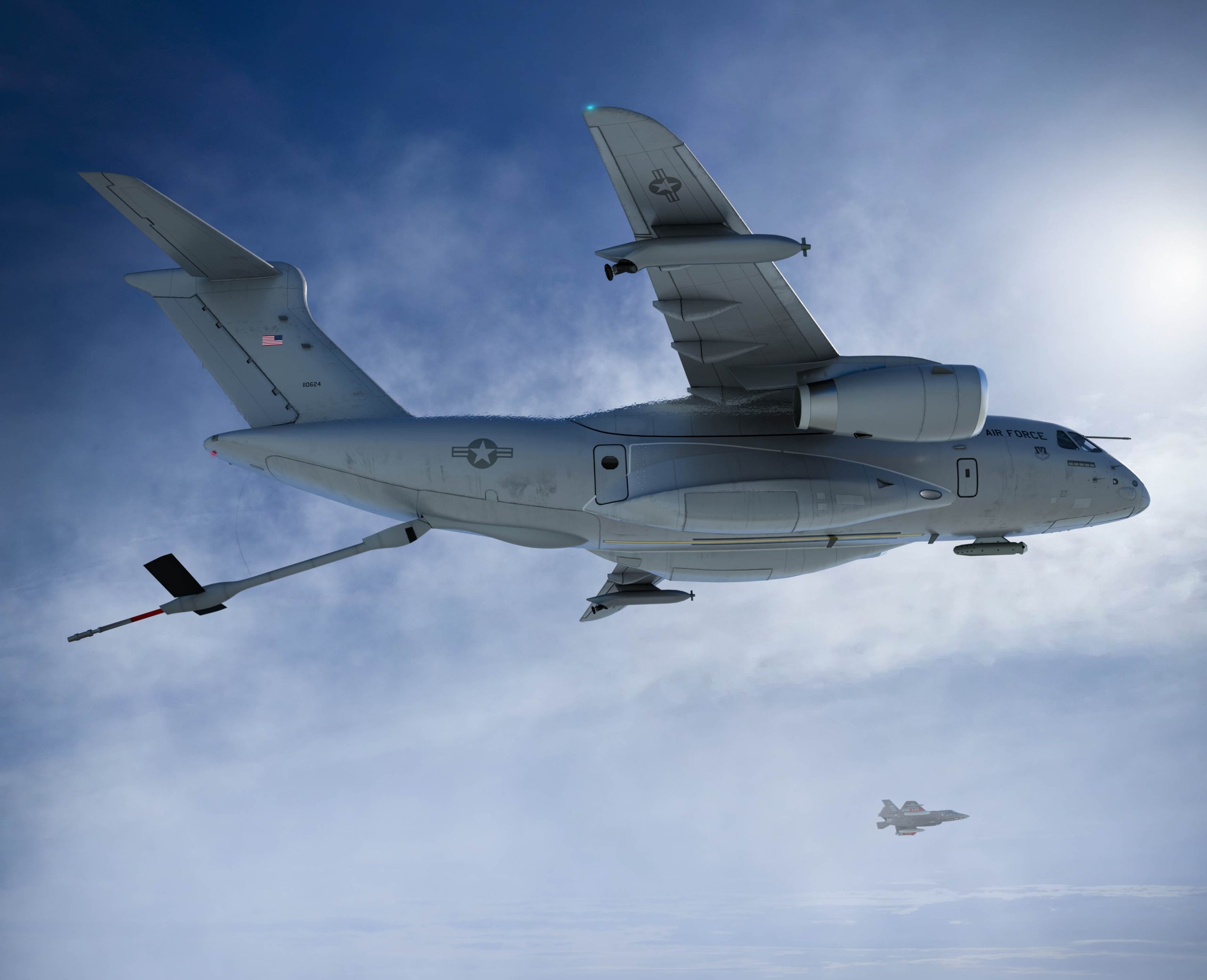
Established through a memorandum of understanding, the collaboration between Northrop and Embraer will concentrate on adapting Embraer’s KC-390 Millennium aircraft. The goal is to enable it to resupply F-35s and other conventional aircraft operated by the U.S. Air Force and allied NATO nations, some of which already possess KC-390s. Within the scope of this alliance, the firms intend to create a self-governing aerial refueling boom for the KC-390, designed to supplement its existing wing-affixed probe-and-drogue fuel transfer mechanism.
Conceived as a versatile aerial platform, the KC-390 is able to transport up to 35 tonnes of fuel—23 in its wing-mounted fuel reservoirs and 12 in supplementary containers within the main freight compartment—over ranges exceeding 4,570 nautical miles. Additionally, it can convey 26 tonnes of freight or 80 travelers.
Spokespersons for Northrop and Embraer state that this alliance is being formed to both fill a void in the aerial transport sector and satisfy client requirements for the KC-390 to exhibit enhanced adaptability.
Tom Jones, president of Northrop Grumman Aeronautics Systems, informed journalists at Northrop’s Melbourne facility that, “Upon examining the commercial arena and the existing fleet among our clientele, the subsequent sensible progression for expansion and fleet modernization undeniably lies within the transport sector, encompassing both freight carriers and mid-air resupply planes.”
On Feb. 18, Aviation Week disclosed that Northrop is proposing the enhanced KC-390 as a component of a three-part “family of systems” to the Air Force. The service is currently soliciting concepts from the industry regarding the evolution of its aerial refueler contingent, under a program named Next-Generation Air Refueling System. According to the publication, Northrop’s envisioned suite would encompass a sizable, integrated-wing aerial tanker, the KC-390 serving as a medium-capacity refueler, and a compact, unmanned aerial refueler.
Northrop Grumman officials refused to corroborate the report.
Presently, the Air Force maintains an aerial refueling contingent comprising approximately 500 aircraft; among which, about 375 are KC-135 Stratotankers that exceed an average age of 63 years. The service persists in acquiring new KC-46 Pegasus tankers, and in July past, it determined to bypass a contest for an “interim refueler” connecting the Pegasus and the presently unspecified NGAS, opting instead to procure additional KC-46s.
Officials from Northrop and Embraer are contending that the medium-category KC-390 would supplement the long-range KC-46. It is presented as an operational aerial tanker and freighter apt for agile combat employment (ACE), which is the Air Force’s approach for positioning compact detachments of personnel to establish temporary landing sites in challenging environments. The KC-390 is fitted with eight wheels to disperse the mass of the aircraft during departures and arrivals on unpaved runways. Embraer officials added that it is also able to perform takeoffs and landings using airstrips scarcely 1,000 feet long.
“This kind of airframe is ideal for agile combat employment, unlike the KC-46,” Jones remarked. He further stated, “One cannot disregard its interchangeability feature, especially when engaged in a geographically spread-out confrontation.”
Frederico Lemos, head of commercial operations for Embraer Defense and Security, indicated that partner nations are recognizing the imperative of decentralized combat maneuvers. He noted that the KC-390 is “presently active, confirmed by partner forces, and in congruence with agile combat employment.”
“Operations are advancing nearer to combat zones and aiding spread-out units across an expanded operational area,” he articulated. “Concurrently, the aging refueler armada encounters numerous difficulties. … They are unsuitable for such an undertaking.”
The duration required to engineer a self-governing aerial refueling mechanism, potentially affixed to the aft section of the KC-390, remains uncertain.
Craig Woolston, VP and GM of Research & Advanced Design at Northrop Grumman Aeronautics, stated, “We acknowledge that the ever-changing conditions inherent to mid-air resupply present a challenge.”
Woolston refused to elaborate on the particulars of the self-governing boom initiatives, but remarked, “We are confident we possess the necessary components for integration. Certainly, we are at the commencement of this endeavor. … I would venture to say we have a funding strategy or a progression roadmap delineated over the next couple of years.”
Jones further stated that Northrop is anticipating, “we will reach demonstrations of the innovative solution, I’d estimate, within a few years.”
Embraer representatives affirm that the KC-390 can be transformed from a freight carrier into an aerial tanker in under five hours. It is powered by IAE V-2500 engines, achieving a maximum velocity of 470 knots or Mach 0.8.
“We engineered the 390 for future adaptability, equipping it with the suitable structural design to accommodate novel integrations and fresh systems that can tackle forthcoming difficulties not yet apparent,” Lemos stated. He added that the aircraft incorporates electronic flight control technology and other self-governing mechanisms in the cockpit “to alleviate the workload of our personnel so that they can concentrate on their objectives.”
“It’s an existing framework whose functionalities we can boost to provide an optimal remedy, contributing capacity, flexibility, and promptness to this military configuration, all while liberating long-range resources to execute the missions they are most adept at,” he concluded.
This marks not Embraer’s initial attempt to penetrate the U.S. market; the company, hailing from Brazil, had earlier collaborated with L3Harris to propose the KC-390 as an operational transport plane, prior to that collaboration concluding. Furthermore, the U.S. Air Force acquired several of its A-29 Super Tucano aircraft within the scope of its Light Attack trial, prompting the company to propose it for the Armed Overwatch program.
This article’s audio content is presented by the Air & Space Forces Association, commending and backing our Airmen, Guardians, and their families. Discover further details at afa.org