
Royal Navy Ships to Participate in Multinational Exercise in South China Sea Amidst Regional Tensions
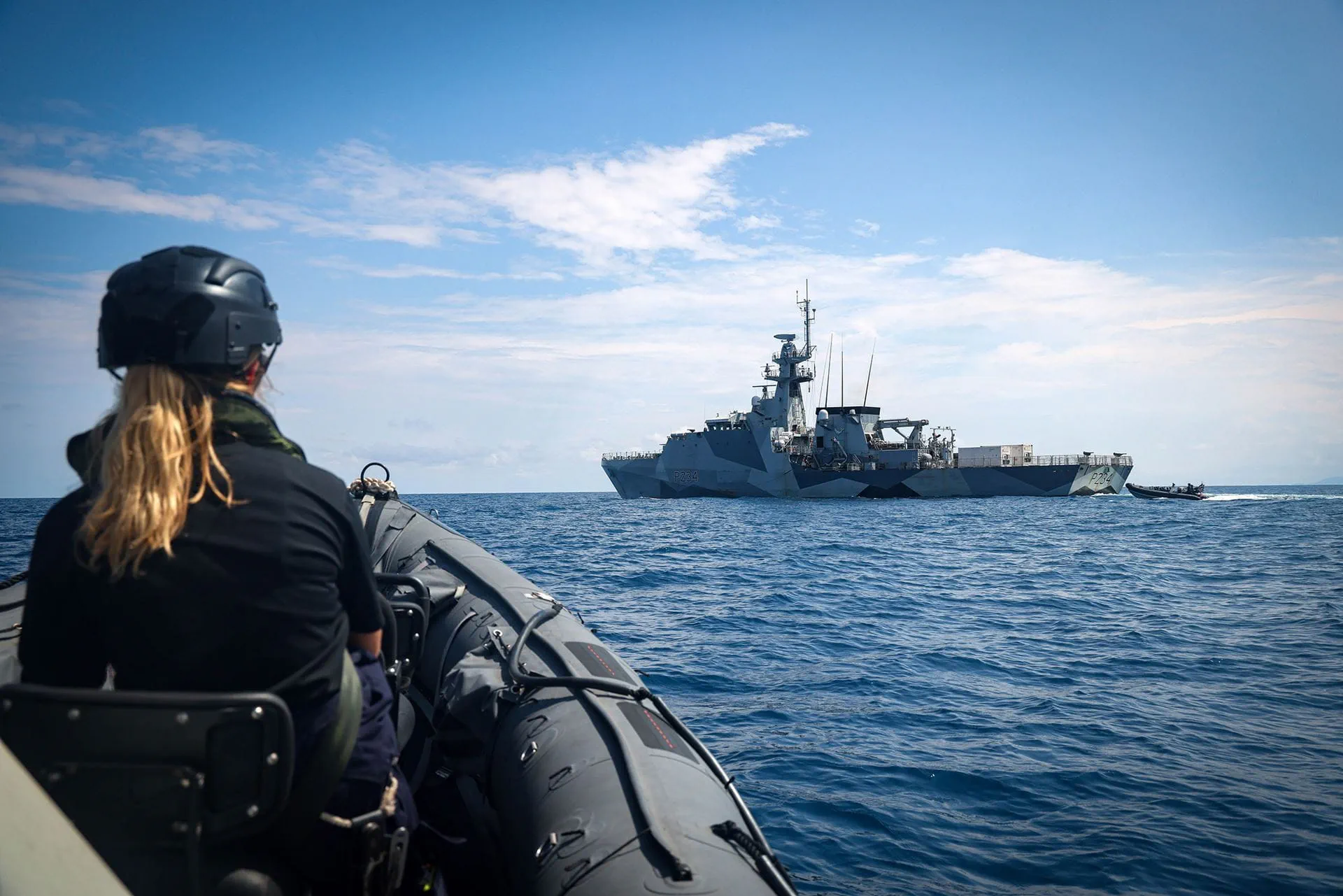
Royal Navy patrol ships HMS Spey and HMS Tamar are slated to enter the South China Sea for a ten-day multinational exercise alongside naval forces from Australia, Malaysia, New Zealand, and Singapore. This deployment continues a sustained British naval presence in waters where Beijing has consistently raised objections to the United Kingdom’s military activities and policy, according to statements from the Royal Navy.
The two vessels, both Batch 2 River-class offshore patrol vessels, will take part in Exercise Bersama Lima 26. This annual tri-service exercise is conducted under the framework of the Five Power Defence Arrangements (FPDA), a longstanding defence pact that links the United Kingdom with Australia, Malaysia, New Zealand, and Singapore. Bersama Lima, a Malay phrase meaning “Together Five,” is designed to foster interoperability and readiness among the member nations.
The exercise is comprehensive, involving a diverse array of ships, aircraft, and ground troops operating across maritime, land, and air domains. Forces committed to the exercise include frigates, patrol vessels, a corvette, a tanker, and a submarine, complemented by specialist divers and boarding teams. A significant air component will also be present, with Australian F-35A Lightning II fighters leading the air element of the exercise.
Planned scenarios for Bersama Lima 26 are varied and challenging, encompassing troops directing naval gunfire, boarding and searching vessels at sea as part of maritime interdiction operations, anti-submarine warfare drills, and naval air defence exercises supported by the participating air forces. These activities are designed to test and enhance the combined capabilities of the FPDA nations in a complex operational environment.
This deployment occurs against a backdrop of persistent geopolitical tensions in the South China Sea. The region is characterized by a long-running dispute between Beijing and several regional governments over territorial and maritime claims, particularly concerning islands, reefs, and associated exclusive economic zones. Furthermore, broader disagreements persist regarding the activities of military forces from countries outside the immediate region, such as the United Kingdom and the United States, which China views as infringements on its sovereignty or regional stability.
China has repeatedly voiced strong criticisms regarding British involvement in the South China Sea. A notable incident occurred in 2018 when Beijing stated it had lodged “stern representations” with the UK after HMS Albion, an amphibious transport dock, sailed close to the Paracel Islands (which China refers to as the Xisha Islands). China asserted that the ship had entered waters it regarded as its territorial sea without permission, a claim that Britain has consistently countered by maintaining the importance of navigational rights under international law, specifically the UN Convention on the Law of the Sea (UNCLOS).
More recently, in 2021, Beijing again objected as the UK increased its naval presence in the Indo-Pacific, specifically accusing Britain of deploying its Carrier Strike Group, led by HMS Queen Elizabeth, to the South China Sea to “flex its naval muscles.” In July 2026, the Chinese Embassy in London issued a strong condemnation of the UK for joining an international statement that supported the 2016 South China Sea arbitration award. The embassy urged Britain to cease what it described as “stirring up trouble” in the region, referring to the international tribunal’s ruling that largely invalidated China’s extensive claims in the South China Sea.
HMS Tamar itself has recently conducted a freedom-of-navigation activity in the South China Sea. In a parliamentary answer published on September 8, the Ministry of Defence confirmed that the patrol ship operated alongside the Royal Australian Navy on September 1. This activity was explicitly part of the UK’s stated commitment to upholding freedom of navigation and overflight, as stipulated under the UN Convention on the Law of the Sea.
The Royal Navy further states that HMS Spey and HMS Tamar have both undertaken freedom-of-navigation missions in disputed waters during their five-year deployment to the Indo-Pacific. These operations have been conducted independently at times and, on other occasions, in conjunction with regional partners, underscoring the UK’s consistent stance on international maritime law.
Prior to the main operational phase of Bersama Lima, personnel from the five participating nations will engage in a familiarization period. This allows them to acquaint themselves with different vessels, equipment, operational procedures, and terminology, fostering a common understanding essential for effective combined operations. Concurrently, senior officers will conduct detailed planning for the live exercise scenarios.
According to a Royal Navy news update, Lieutenant Commander Cheryl Goodwin, HMS Tamar’s Executive Officer, expressed anticipation for the exercise:“We’re looking forward to being a part of Bersama Lima 26 – an exercise which unites some of our closest allies, tests the crew in a traditional war-fighting role, and demonstrates the UK’s resolve to maintain stability in the Indo-Pacific region through supporting our partners.”
Adding another layer of direct integration between the participating forces, HMS Tamar is also carrying a Royal New Zealand Navy boarding team during the exercise. Lieutenant Williams, a Royal New Zealand Navy officer embarked aboard Tamar, highlighted the collaborative spirit:“It’s a first for me and my team, but it’s a well-trodden path which has been established through a deep history of our navies working together.”He added,“We’ve got a lot of experience to share, are always looking to improve and we’re ready to go.”
The Five Power Defence Arrangements were established in 1971, providing a robust framework for defence cooperation between the five member states. Regular exercises under the FPDA umbrella bring together naval, land, and air forces, primarily operating around Malaysia and Singapore, to practice combined operations and develop common procedures. Both British patrol ships have been continuously forward deployed to the Indo-Pacific since 2021 as part of Operation Highwall. Their mission has encompassed a wide range of activities, including multinational exercises, maritime security operations, sanctions enforcement, humanitarian assistance, defence engagement, and freedom-of-navigation activities.
Bersama Lima marks a return to operations for HMS Spey, which spent the summer undergoing essential maintenance in Singapore. HMS Tamar has remained active across the region, participating in the US-led Pacific Partnership humanitarian exercise and conducting a visit to Cambodia before its September activity with the Royal Australian Navy in the South China Sea.
In September, the ships passed five years of continuous deployment to the Indo-Pacific, a significant milestone that makes them the first Royal Navy vessels to maintain such a persistent presence in the region since the handover of Hong Kong in 1997. During Bersama Lima, Spey and Tamar will operate as integral components of the larger multinational force, with the live phase rigorously testing the five FPDA nations across critical areas including maritime interdiction, anti-submarine warfare, and air defence in and around the strategically vital South China Sea.
Why This Matters
The deployment of HMS Spey and HMS Tamar to the South China Sea for Exercise Bersama Lima 26 carries significant geopolitical implications, underscoring several critical themes in international relations and regional security:
1. Reinforcement of Regional Security Alliances:The Five Power Defence Arrangements (FPDA) represent one of the oldest and most enduring defence pacts in Southeast Asia. The consistent execution of exercises like Bersama Lima demonstrates the continued commitment of the UK, Australia, New Zealand, Malaysia, and Singapore to collective security. In an increasingly complex Indo-Pacific, such alliances provide a framework for stability, deterrence, and rapid response to potential threats, reinforcing the principle that regional security is a shared responsibility.
2. Upholding International Law and Freedom of Navigation:The South China Sea is a crucial artery for global trade, with an estimated one-third of the world’s maritime shipping passing through its waters. The UK’s consistent assertion of freedom of navigation and overflight, often in direct challenge to China’s expansive territorial claims, highlights a fundamental principle of international law. By conducting freedom-of-navigation operations (FONOPs) and participating in exercises in these waters, the UK signals its commitment to the UN Convention on the Law of the Sea (UNCLOS) and the right of all nations to navigate international waters freely. This stance is vital for maintaining the rules-based international order, which underpins global commerce and security.
3. UK’s “Indo-Pacific Tilt” and Global Ambitions:This deployment is a tangible manifestation of the UK’s “Indo-Pacific Tilt” strategy, articulated in its integrated review of defence and foreign policy. It signifies Britain’s intent to remain a globally engaged power, extending its influence beyond the Euro-Atlantic. A continuous naval presence, as demonstrated by the five-year deployment of HMS Spey and HMS Tamar, indicates a long-term commitment to the region, seeking to deepen partnerships, promote stability, and contribute to a balance of power in a strategically critical area.
4. Managing Geopolitical Competition:The South China Sea is a flashpoint for geopolitical competition, primarily between China and several ASEAN claimant states, as well as the United States and its allies. China views the presence of non-regional military forces as an infringement on its sovereignty and an attempt to contain its rise. Conversely, the UK and its partners view their presence as essential for ensuring regional stability and preventing any single power from dominating vital international waters. This exercise sends a clear signal that international actors intend to remain engaged in upholding established norms despite Beijing’s objections, contributing to a complex interplay of diplomacy and deterrence.
5. Interoperability and Readiness:Beyond the political messaging, the exercise itself is crucial for military readiness. The opportunity for five different navies, air forces, and armies to train together, familiarize themselves with diverse equipment, and practice complex scenarios like anti-submarine warfare and air defence significantly enhances their collective ability to respond to crises. This interoperability is paramount for effective coalition operations, ensuring that partners can work seamlessly together if called upon to address a real-world security challenge.