
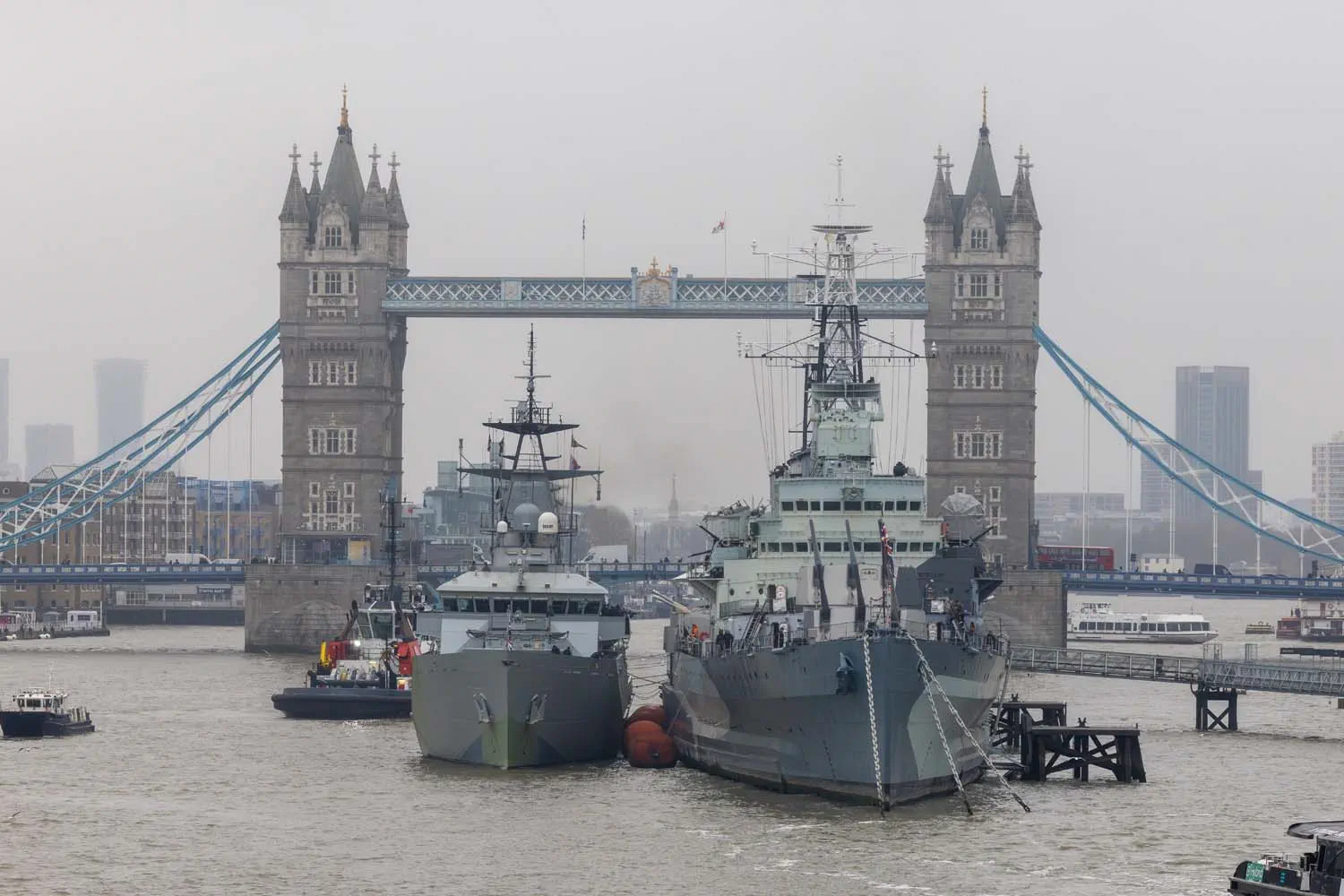
Royal Navy Showcases Autonomous Maritime Capabilities in London, Announces Major Investment in Uncrewed Vehicles
In a significant demonstration of its evolving naval strategy, the offshore patrol vessel HMS Tyne has berthed alongside the historic HMS Belfast in London. The visit serves to showcase the Royal Navy’s commitment to integrating crewed and uncrewed systems, displaying advanced autonomous technology to government ministers, industry leaders, academics, and parliamentary audiences. Among the cutting-edge equipment presented were a Kraken K3 Scout uncrewed boat from the 1st Autonomous Squadron and various drones operated by the 700X Naval Air Squadron.
The event underscores the Royal Navy’s vision for a “Hybrid Navy,” a concept that combines traditional warships with a diverse array of autonomous platforms to enhance operational effectiveness, extend reach, and reduce risk to personnel. The deployment of HMS Tyne, a vessel that has recently been active in protecting UK waters and monitoring Russian ship movements in the English Channel, highlights the immediate relevance and operational application of these emerging technologies.
Lieutenant Commander Sam Fields, Commanding Officer of HMS Tyne, emphasized the strategic importance of the demonstration. “HMS Tyne is proud to demonstrate how the Royal Navy is evolving to meet future threats and showcase how emerging technologies and autonomous systems can work alongside our people to create a more capable, resilient and adaptable navy,” he stated. This perspective reflects the Navy’s broader objective of leveraging technological advancements to maintain a competitive edge in a complex global security environment.
The 1st Autonomous Squadron, officially commissioned earlier this month, plays a pivotal role in accelerating the transition of autonomous technologies from experimental stages into active operational service. This squadron is tasked with combining advanced autonomous platforms with the expertise of naval personnel to significantly increase situational awareness, extend operational persistence, and broaden geographical reach, all while minimizing the exposure of human operators to hazardous environments. Its establishment signals a definitive shift in naval operations, moving towards more distributed and technologically-enabled maritime presence.
Further solidifying the Royal Navy’s investment in autonomous capabilities, the event on HMS Tyne also served as the platform for announcing a substantial £142 million investment. This funding will procure REMUS 620 uncrewed underwater vehicles (UUVs) from HII, a global leader in marine technology. These highly capable UUVs are designed to locate and assist in the disposal of sea mines, a critical function for maintaining open and safe maritime trade routes. The REMUS 620 vehicles boast impressive specifications, including the ability to travel at speeds up to eight knots, dive to depths of 600 meters, and operate autonomously for up to 110 hours. They will integrate seamlessly with the UK-developed SeeByte SeeTrack and Neptune software, which is already in use by the Royal Navy, ensuring compatibility and operational efficiency. This contract represents HII’s largest international agreement of its kind and is expected to support jobs within the United Kingdom, particularly in areas such as Portchester.
Defence Secretary Wes Streeting commented on the strategic rationale behind this significant investment. “This investment strengthens our ability to protect freedom of navigation, which is critical to our security and our economy,” he said. The Defence Secretary highlighted that this funding is part of the largest sustained increase in defence spending since the Cold War, aimed at equipping sailors with cutting-edge technology. He further articulated that these advancements are intended to remove personnel from harm’s way, while simultaneously providing them with the necessary tools to safeguard vital shipping routes, thereby contributing to global stability in an increasingly volatile world.
Throughout the week, HMS Tyne is hosting a diverse range of stakeholders, including representatives from various government departments, parliamentary members, academics specializing in defence and technology, and industry partners involved in maritime innovation. The vessel is also facilitating STEM (Science, Technology, Engineering, and Mathematics) visits for young people, aiming to inspire the next generation of engineers and naval personnel and foster future talent within the defence sector.
The Royal Navy’s current surface fleet comprises 49 vessels, a figure recently released in Parliament. Ministers have consistently emphasized that the integration of autonomous systems, central to the “Hybrid Navy” concept, is designed to significantly enhance the lethality, resilience, and adaptability of this fleet. This strategic direction aims to ensure that the Royal Navy remains a formidable and relevant force in defending British interests and contributing to international security.
Why This Matters
The Royal Navy’s showcase of autonomous technology and its substantial investment in uncrewed underwater vehicles represents a critical juncture in modern naval strategy, carrying wide-ranging implications for national security, economic stability, and the future of defence. This initiative signifies a proactive adaptation to evolving global threats and technological advancements.
Strategic Military Transformation:The move towards a “Hybrid Navy” is more than an incremental upgrade; it is a fundamental shift in military doctrine. By integrating autonomous systems like uncrewed surface vessels (USVs), uncrewed underwater vehicles (UUVs), and aerial drones with traditional warships, the Royal Navy aims to achieve unprecedented levels of reach, persistence, and situational awareness. This allows for continuous surveillance over vast maritime areas, enables operations in environments too dangerous for human personnel (such as mine countermeasures), and reduces the overall risk to life. It also allows for more agile and distributed naval operations, complicating potential adversaries’ planning and increasing the Royal Navy’s strategic flexibility.
Enhanced Maritime Security and Economic Protection:Freedom of navigation is paramount for global trade and economic prosperity. The investment in REMUS 620 UUVs specifically targets the threat of sea mines, which can cripple shipping lanes and have devastating economic consequences. By effectively clearing these threats, the Royal Navy directly safeguards international trade routes, ensuring the free flow of goods and energy supplies. This capability is particularly vital in contested waters or during times of geopolitical tension, contributing directly to UK and global economic stability.
Advancement of UK Defence Industry and Innovation:The £142 million contract for HII’s UUVs, while awarded to an international company, explicitly supports UK jobs and integrates with UK-developed software (SeeByte SeeTrack and Neptune). This demonstrates a commitment to fostering a robust domestic defence industrial base and encouraging innovation. Furthermore, by actively experimenting with and integrating new technologies, the Royal Navy stimulates research and development within the broader UK technology sector, positioning the UK as a leader in autonomous systems.
Response to Evolving Geopolitical Landscape:The context of HMS Tyne’s recent monitoring of Russian ship movements underscores the pressing need for advanced surveillance and defensive capabilities. In an increasingly complex and unpredictable world, marked by rising naval competition and hybrid warfare tactics, autonomous systems provide a cost-effective and low-risk means to maintain persistent presence, gather intelligence, and deter aggression. This technological edge is crucial for the UK to project influence and uphold its security interests.
Future Talent and Public Engagement:The hosting of government officials, industry leaders, academics, and young people for STEM visits highlights a multi-faceted approach. Engaging ministers and parliamentarians ensures political support and sustained funding. Collaborating with industry and academia fosters a symbiotic relationship for continuous innovation. Crucially, inspiring young people through STEM initiatives ensures a pipeline of skilled individuals to operate, maintain, and develop these sophisticated systems in the future, securing the long-term viability of the Royal Navy’s technological advantage.