
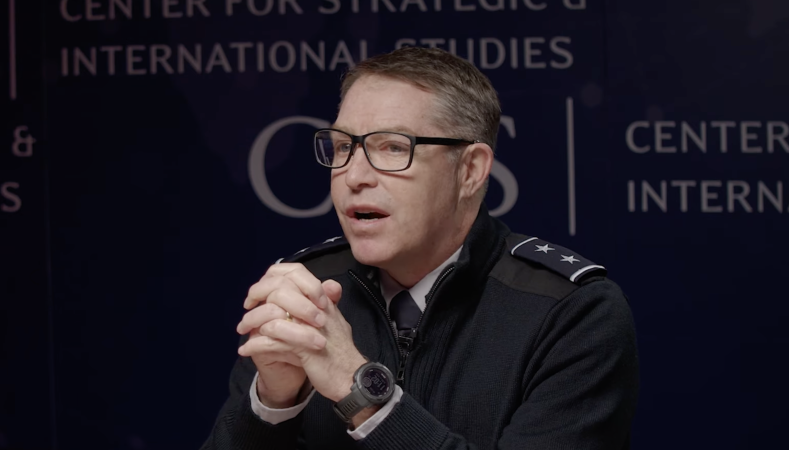
The U.S. Space Force has played a critical, though often unpublicized, role in U.S. operations related to the conflict with Iran, according to remarks made on July 17 by Lt. Gen. Gregory J. Gagnon, head of the service’s Combat Forces Command. Speaking at a virtual event hosted by AFA’s Mitchell Institute for Aerospace Studies, General Gagnon highlighted the Space Force’s contributions across various domains, particularly emphasizing its activity within the electromagnetic spectrum. The general underscored that U.S. operations in the region demonstrate not only highly proficient space operations but also exceptionally well-executed joint military efforts involving multiple branches of the armed forces.
While the specific combat contributions of the Space Force frequently remain classified, U.S. defense officials have gradually provided more insights into these endeavors in recent months. Gen. Dan Caine, Chairman of the Joint Chiefs, previously identified space forces as among the “first movers” in Operation Epic Fury. Similarly, Adm. Brad Cooper, who leads U.S. Central Command, has stated that the U.S. achieved “space superiority” in the conflict. Chief of Space Operations Gen. B. Chance Saltzman further reinforced these statements, noting that Guardians – the personnel of the Space Force – are providing a “continuous application of space effects into the joint force.” General Gagnon’s recent comments offered some of the most detailed accounts to date, suggesting that there is “more that we can say than people properly appreciate” regarding the Space Force’s operational impact.
General Gagnon elaborated on several key areas where the Space Force provides essential support. These include traditional missions such as missile warning, which detects and tracks incoming threats, and providing precision for long-range weapons, enabling accurate targeting. A particularly significant and evolving role highlighted by Gagnon is the provision of satellite communications (SATCOM) for the rapidly expanding domain of drone warfare. He explained that any drone operating beyond line of sight, requiring control and data transmission, inherently relies on SATCOM infrastructure. “If you’re using SATCOM to change the way warfare is today, you’re using the United States Space Force,” Gagnon stated, underscoring the service’s integral role in modern unmanned aerial and naval operations.
While missile warning, position, navigation, and timing (PNT) services, and general SATCOM are well-established Space Force responsibilities, the specific emphasis on SATCOM for drone warfare marks a notable development. This particular aspect is gaining increased importance given the extensive deployment of various types of drones by the U.S. in the conflict, including innovative one-way aerial and naval attack drones. These systems critically depend on robust and reliable satellite links for command, control, and data relay, directly linking their operational effectiveness to the Space Force’s capabilities.
However, it was the mission of spectrum warfare, a domain within the broader electromagnetic spectrum, that General Gagnon stressed the most. He asserted, “What you are seeing in Central Command today, and in U.S. joint operations, is a return to U.S. spectrum dominance.” Gagnon reminded the moderator, retired Gen. Kevin P. Chilton, that during Chilton’s active-duty career, the U.S. military placed a high strategic priority on spectrum warfare as a necessary countermeasure against the capabilities of the Soviet Union. This focus, however, diminished during the Global War on Terror, primarily because the adversaries in those conflicts possessed limited or no significant electromagnetic spectrum capabilities.
General Gagnon indicated that this strategic pendulum is now swinging back. He observed, “What I am seeing in this conflict is the space forces are delivering not just on the need for space superiority, because they have checked that block.” Beyond achieving superiority in space, he noted that the Space Force is also “delivering effects inside the joint formation, in a contested electromagnetic environment.” Gagnon emphasized that Space Force personnel, known as Guardians, are not merely proficient space officers but also senior experts highly astute in radio frequency (RF) operations, counter-command and control (C2) warfare, and the broader concept of spectrum dominance. This re-emerging expertise, he suggested, represents a significant return for the U.S. military in its strategic approach to modern conflict.
Resiliency
Beyond the immediate operational contributions in the conflict with Iran, General Gagnon also addressed the Space Force’s future strategic planning, particularly in light of a substantial budget increase projected for 2027. The service’s proposed budget request for that year is slated to more than double its allocation from 2026. A significant portion of these additional funds, Gagnon explained, will be directed towards enhancing the resiliency of the service’s satellite constellations. The concept of resiliency has been a central focus for the Space Force over the past five years, driven by a strategic imperative to transition away from reliance on a small number of large, highly sophisticated satellites, which are inherently vulnerable to attack and offer limited backup options.
This sustained focus on resiliency, Gagnon suggested, is now yielding tangible results. He observed, “That type of thinking about adding resiliency into core capabilities the joint force needs—that was an uphill argument four years ago.” He added that this argument is no longer necessary, as stakeholders now proactively inquire about resilience. “Everyone’s like, you tell them the bill, and then they say, ‘Is that resilient?’ You’re like, ‘Yes, we designed that.’ … So the climate’s changed quite a bit inside the resource world,” he noted, indicating a widespread acceptance of resiliency as a fundamental requirement in space system design.
For many, satellite constellation resiliency often implies deploying a greater number of smaller, less expensive satellites. This “disaggregated” approach aims to ensure that the loss of a few individual satellites does not cripple an entire constellation’s functionality. However, Gagnon clarified that resiliency will also encompass other strategies, including maintaining additional satellites in storage, ready for rapid deployment. This necessitates investing in spare spacecraft, a practice not traditionally common for space assets but one the Space Force is now actively pursuing. “I assume losses, because that’s war,” Gagnon stated, acknowledging the reality of potential conflict in space. Retired General Chilton interjected, noting, “We do that with airplanes.” Gagnon concluded, “We do it with everything except space. So we’re fixing that. It’s going to take time, but that is part of those budget numbers.”
Why This Matters
The detailed insights provided by Lt. Gen. Gregory J. Gagnon regarding the U.S. Space Force’s role in the conflict with Iran highlight several critical aspects of modern warfare and national security. Firstly, it underscores the indispensable and pervasive nature of space-based capabilities in contemporary military operations. From early missile warning to enabling drone warfare through satellite communications, the Space Force acts as a vital, though often unseen, enabler for all other military branches. This signifies that conflicts on Earth are increasingly reliant on capabilities orbiting hundreds or thousands of miles above it, making space a critical warfighting domain.
Secondly, the emphasis on electromagnetic spectrum dominance marks a significant strategic shift. After decades focused on asymmetric warfare against adversaries with limited advanced capabilities, the U.S. military is re-prioritizing the complex and contested environment of the electromagnetic spectrum. This reflects an acknowledgment of evolving threats from near-peer competitors who possess sophisticated electronic warfare capabilities. The Space Force’s leadership in this area suggests that future conflicts will heavily involve a battle for control over the invisible waves that transmit critical information, command, and control signals.
Finally, the substantial projected budget increase for the Space Force, particularly for enhancing satellite resiliency, reveals a forward-looking strategy that anticipates potential conflict in space itself. The move away from “exquisite” but vulnerable satellites towards more numerous, adaptable, and quickly replaceable systems demonstrates a recognition that space assets are no longer sanctuaries but potential targets. This investment in resiliency, including maintaining “satellites in storage,” indicates a proactive effort to ensure continuity of critical space services even under attack. For U.S. national security, this means safeguarding the technological backbone that underpins everything from GPS navigation for civilians to precision-guided munitions for the military, thereby impacting global stability and the future conduct of warfare.