
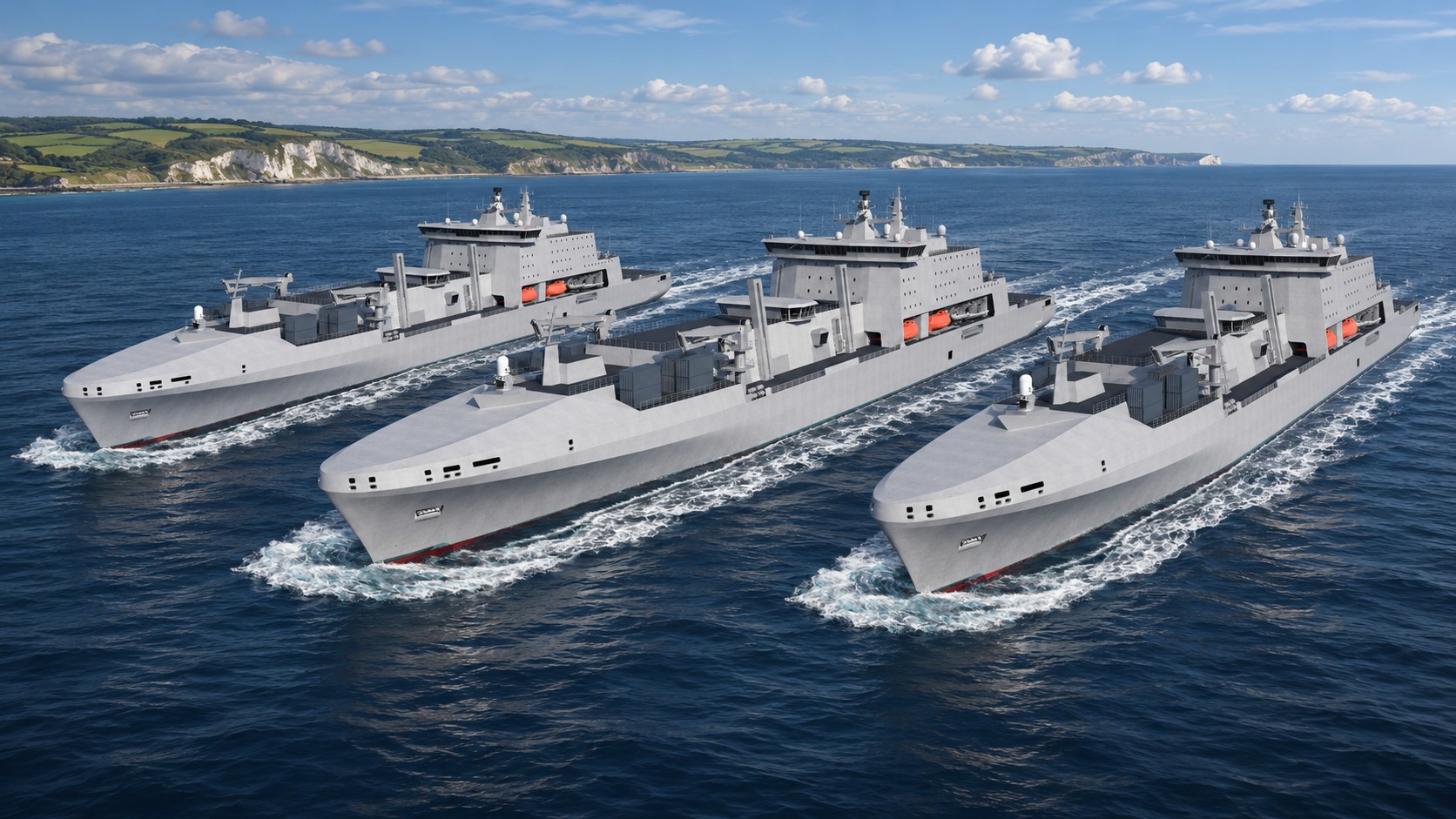
UK’s Fleet Solid Support Ship Program Advances On Schedule with Major Infrastructure Investment in Belfast
The UK Ministry of Defence (MOD) has confirmed that the construction of the three new Fleet Solid Support (FSS) ships for the Royal Fleet Auxiliary (RFA) is progressing as planned and within its allocated budget. These vital vessels, intended to resupply Royal Navy task groups at sea, are anticipated to enter service sequentially in the early 2030s. This update coincides with a significant industrial development in Belfast, where Navantia UK, the prime contractor for the program, officially opened its new “Resurgent Hall” fabrication facility.
The Fleet Solid Support ship program represents a substantial investment of £1.6 billion, aimed at bolstering the Royal Navy’s logistical capabilities. The three ships, named RFA Resurgent, RFA Reliant, and RFA Resourceful, are designed to carry solid stores, including ammunition, food, and spare parts, directly to warships and other support vessels while at sea. This capability is crucial for extending the endurance and operational reach of the UK’s naval forces, enabling them to sustain prolonged deployments across global oceans without frequent returns to port. Navantia UK, a subsidiary of the Spanish state-owned shipbuilding company Navantia, is leading the fabrication and final assembly of these complex vessels, acting as the primary contractor.
The inauguration of the Resurgent Hall in Belfast marks a significant expansion of the UK’s shipbuilding infrastructure. This state-of-the-art facility adds 5,000 square metres of advanced fabrication space to Navantia UK’s operations. Equipped with modern cranes, robotic plasma cutting technology, and a mechanised panel line, the new hall is set to enhance efficiency, precision, and capacity in the construction process. The investment by Navantia UK, totaling £157 million across its UK yards, underscores a commitment to developing local shipbuilding capabilities and supporting regional industrial growth.
Luke Pollard, the Minister for Defence Readiness and Industry, highlighted the historical and contemporary significance of the development. Speaking at the opening, he remarked, “Few sights in the UK are more evocative of our industrial heritage than the Samson and Goliath cranes, and it’s fitting that this new hall sits on the shoulders of these iconic giants. Belfast continues with its proud shipbuilding history by building the modern shipbuilding capability the country needs today, with this new fabrication hall at the heart of it. Navantia’s £157 million investment across its UK yards shows what sustained investment in shipbuilding delivers: good jobs, growing skills, and the support ships our Navy needs.” His comments emphasized the dual benefit of industrial revival and the provision of essential naval assets.
Keith Bethell, Maritime Director for the National Armaments Director Group, echoed this sentiment, stating, “The opening of the Resurgent Fabrication Hall is a clear sign that growth in UK shipbuilding is happening right now, in Belfast. This investment is renewing our industrial capability, creating skilled jobs and apprenticeships, and strengthening the supply chains that underpin our national resilience. It gives us the modern capability we need to deliver the Fleet Solid Support ships for the Royal Fleet Auxiliary and lays the foundations for Belfast to compete for future UK naval and maritime programmes.” These statements collectively highlight the strategic importance of the investment for both national defense and economic development, projecting Belfast as a future hub for naval construction.
The FSS program has seen some strategic adjustments to its delivery plan since its inception. In March 2025, then-defence minister Maria Eagle indicated that the first ship was expected in service by 2031. At that time, the broader impact of Navantia UK’s takeover of Harland & Wolff, a move that consolidated a significant portion of the UK’s shipbuilding capacity under foreign ownership, was still under assessment. By September of the same year, Minister Pollard confirmed that evaluations of the impact on approved costs and in-service dates were ongoing, with efforts focused on mitigating any potential delays.
To ensure the project remained on track, a decision was made in late 2025 to reallocate some fabrication work. Minister Pollard informed the Defence Committee in November 2025 that part of the first ship’s fabrication had been moved to Spain to prevent schedule slippage. In return, a commitment was made for more significant UK work on the second and third ships, balancing workload and maintaining program momentum. He also affirmed that the contract for the FSS ships is fixed-price, a mechanism designed to transfer cost overrun risks from the taxpayer to the prime contractor.
Key construction milestones have been achieved in recent months. Steel cutting for the first FSS ship commenced at the Appledore shipyard in December 2025, marking the official start of physical construction. Subsequently, the keel of RFA Resurgent was laid in September, a ceremonial and significant step in the shipbuilding process, signifying the beginning of the hull’s assembly.
Why This Matters
The progress on the Fleet Solid Support ship program, coupled with Navantia UK’s substantial investment in new fabrication facilities, carries significant implications across several critical domains:
Enhanced Defence Capability and Global Reach:These three FSS ships are more than just transport vessels; they are crucial enablers of the Royal Navy’s global operational capability. By providing essential logistics – including ammunition, food, water, and spare parts – directly at sea, they allow task groups to remain deployed for extended periods without needing to return to port for resupply. This capability is fundamental for projecting power, conducting humanitarian operations, and participating in international exercises and alliances like NATO. In an era of evolving geopolitical challenges, the ability to sustain naval forces far from home waters is a cornerstone of national security and international influence. Without effective solid support, the operational endurance of the UK’s aircraft carriers, destroyers, and frigates would be severely constrained, limiting their effectiveness and strategic impact.
Economic Revitalization and Industrial Strategy:Navantia UK’s £157 million investment, particularly in Belfast, signals a significant boost for the UK’s shipbuilding sector. This capital injection, alongside the FSS program itself, translates directly into job creation – both highly skilled roles and apprenticeships – and skills development, reversing decades of decline in parts of the UK’s maritime industrial base. The new Resurgent Hall, with its advanced robotic and mechanized capabilities, represents a modernization of UK shipbuilding infrastructure, enhancing efficiency and competitiveness. This strategic investment helps to foster a resilient domestic supply chain, reducing reliance on overseas manufacturing for critical defence assets. It also positions regions like Belfast to compete for future naval and maritime contracts, aligning with the government’s broader industrial strategy to “level up” and strengthen key manufacturing sectors across the country.
National Resilience and Supply Chain Security:The FSS program and the associated industrial development contribute directly to national resilience. By investing in and modernizing domestic shipbuilding capacity, the UK reduces its vulnerability to disruptions in international supply chains for critical defence components and vessels. The ability to build, maintain, and sustain its own naval assets is a strategic imperative, particularly in times of global instability. Furthermore, strengthening the supply chains that underpin this industrial capability ensures a robust ecosystem of specialized suppliers, contributing to broader economic stability and security. The fixed-price nature of the contract also offers a degree of financial resilience, protecting the taxpayer from potential cost overruns, which is a common concern in large defence procurement projects.
Geopolitical Implications and International Partnerships:While Navantia UK is a foreign-owned entity, its role as prime contractor for a core UK defence asset highlights the complex nature of modern international defence procurement and industrial partnerships. It demonstrates a pragmatic approach to leveraging international expertise and investment while ensuring significant work content and capability development remain within the UK. This model can be seen as a way to access best practices and advanced technologies from global leaders while still fostering domestic industrial growth. It underscores the interconnectedness of global defence industries and the strategic considerations involved in balancing national control with international collaboration to achieve specific defence outcomes. The successful delivery of these ships will reinforce the UK’s reputation as a credible maritime power, capable of projecting and sustaining its forces globally, often in concert with international allies.