
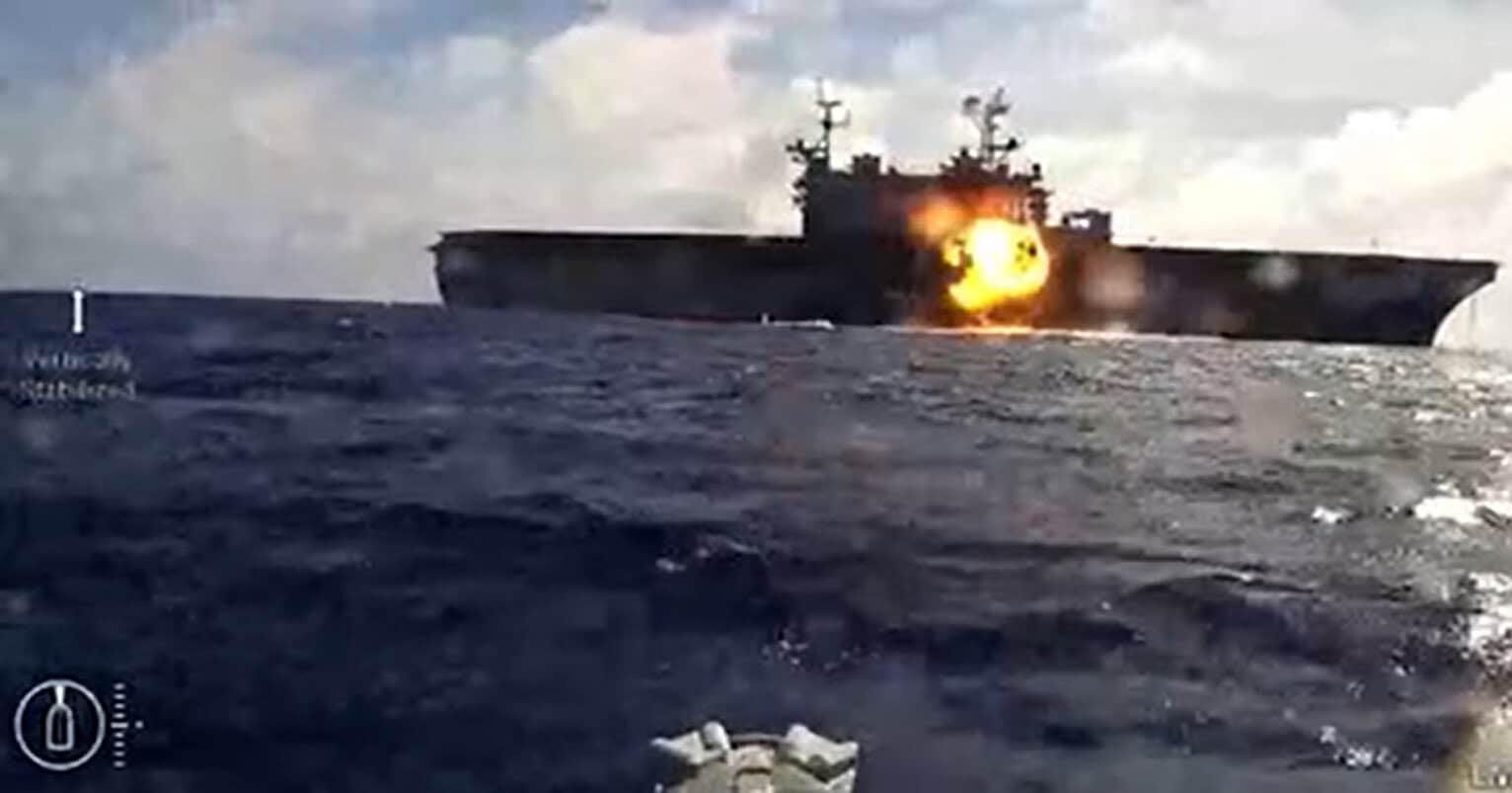
International Forces Sink Decommissioned U.S. Warships in Major Pacific Exercise
Two former United States Navy warships, the amphibious assault ship USS Peleliu (LHA 5) and the guided-missile cruiser USS Mobile Bay (CG 53), were intentionally sunk in the Pacific Ocean in July as part of Exercise Rim of the Pacific (RIMPAC) 2026. These “sinking exercises,” known as SINKEXs, allowed naval forces from 30 nations to test advanced weaponry and refine tactics against full-sized targets in a controlled, live-fire environment.
The USS Peleliu, a Tarawa-class amphibious assault ship, was targeted on July 17. Footage released by the U.S. 3rd Fleet showed unmanned surface vessels (USVs) participating in the engagement, marking a notable integration of autonomous technology into the exercise. The Peleliu was also struck by two UGM-84 Harpoon anti-ship missiles fired from the Los Angeles-class fast-attack submarine USS Columbia. Following the exercise, the Peleliu, which had served for over 35 years, came to rest approximately 15,000 feet deep on the Pacific seafloor, more than 50 nautical miles off the northern coast of Kauai, Hawaii.
SINKEXs are a regular and integral feature of RIMPAC and other major international naval exercises. They serve a dual purpose: providing participating navies with invaluable opportunities to test and refine weapon systems, sensors, and targeting capabilities against realistic, full-sized targets, and offering an environmentally regulated method for disposing of decommissioned hulls. During these exercises, a single target can be engaged by a diverse array of platforms, including surface ships, aircraft, and submarines, employing various armaments such as missiles, torpedoes, and naval gunfire. This comprehensive approach allows for the assessment of interoperability among allied forces and the effectiveness of integrated strike capabilities across multiple domains.
In adherence to stringent U.S. environmental regulations, SINKEXs must be conducted in waters at least 6,000 feet (approximately 1,829 meters) deep and a minimum of 50 nautical miles (approximately 92.6 kilometers) from any landmass. Furthermore, vessels designated for sinking undergo a meticulous cleaning process to remove all hazardous materials, including fuels, lubricants, and polychlorinated biphenyls (PCBs), before the exercise. These measures are designed to minimize any potential environmental impact on marine ecosystems.
The USS Peleliu (LHA 5) had a distinguished career spanning from 1980 to 2015. With a full load displacement of nearly 40,000 tons, the ship was a critical asset for projecting power and humanitarian aid, capable of operating a variety of helicopters and vertical/short takeoff and landing (V/STOL) aircraft from its expansive flight deck. Amphibious warfare ships of the LHA class are among the largest in the U.S. Navy’s inventory, resembling small aircraft carriers and serving as crucial platforms for conducting combat operations and humanitarian missions across half the globe. Named after the pivotal 1944 Battle of Peleliu, the ship was the last of the Tarawa-class to be decommissioned.
RIMPAC 2026, described by the U.S. Navy as the world’s largest international maritime exercise, is a biennial event designed to foster cooperative relationships, enhance collective readiness, and improve the safety of sea lanes among participant nations. This year’s exercise, the 30th in a series that commenced in 1971, involves an impressive contingent of 30 nations, 30 ships, five submarines, 15 national land forces, more than 190 aircraft, and over 30,000 personnel. Operating in and around the Hawaiian Islands from June 24 to July 31, RIMPAC provides a complex and challenging training environment that underscores the importance of multinational maritime security and interoperability.
The sinking of the USS Peleliu was the second of two SINKEXs conducted during RIMPAC 2026. Five days earlier, on July 12, the decommissioned Ticonderoga-class guided-missile cruiser USS Mobile Bay (CG 53) met a similar fate in the same general area of the Pacific Ocean. During these two live-fire exercises, units from a broad international coalition, including Australia, Canada, Italy, Japan, New Zealand, and Spain, participated in targeting and firing alongside forces from the U.S. Navy, Air Force, and Army. This extensive collaboration demonstrated the depth of international partnerships and the ability of diverse forces to operate together effectively.
The USS Mobile Bay (CG 53) entered service in 1987 and was decommissioned in 2023. Throughout its 36-year career, it deployed extensively to the Pacific, contributing to humanitarian and peacekeeping missions and providing crucial support for operations in Iraq. These deployments highlight the multi-role capabilities of Ticonderoga-class cruisers, which are renowned for their advanced Aegis combat system, enabling them to simultaneously engage multiple threats with sophisticated air defense and strike capabilities.
Officials involved in RIMPAC 2026 emphasized the strategic importance of these collaborative exercises. Rear Admiral Inho Kim of the Republic of Korea Navy, who served as the RIMPAC 2026 Combined Force Maritime Component Commander, stated in a U.S. Navy release, “The successful execution of multiple SINKEXs highlights the unbreakable bond and growing capability of our coalition.” Echoing this sentiment, U.S. Navy Vice Admiral Jeff Jablon, the exercise’s Combined Task Force commander, remarked, “SINKEXs are a prime example of the strength and readiness our partnerships create.”
Why This Matters
The sinking exercises conducted during RIMPAC 2026 represent more than just the end of service for two U.S. Navy ships; they are critical indicators of the evolving landscape of global naval power, technological integration, and international security cooperation. Their significance extends across several key areas:
Firstly, these exercises underscore the enduring commitment of the United States and its allies and partners to maintaining maritime security and stability, particularly in the strategically vital Indo-Pacific region. By bringing together forces from 30 nations, RIMPAC demonstrates a collective resolve to protect vital sea lanes, respond to humanitarian crises, and deter potential adversaries through a unified, interoperable force. The sheer scale of RIMPAC, involving tens of thousands of personnel, hundreds of aircraft, and dozens of ships and submarines, highlights the immense logistical and command-and-control capabilities required for multilateral operations in a vast and complex operational environment.
Secondly, the SINKEXs provide an unparalleled opportunity for testing advanced naval technologies and tactics in a realistic, unconstrained combat environment. The engagement of the USS Peleliu by unmanned surface vessels (USVs) is particularly noteworthy. This demonstrates a growing integration of autonomous systems into naval warfare strategies, offering crucial insights into their effectiveness, command structures, and potential roles in future conflicts. The successful use of USVs, combined with traditional armaments like Harpoon missiles launched from a submarine, showcases a multi-layered approach to targeting that reflects modern naval doctrine. Such tests are vital for developing and refining the next generation of naval capabilities and ensuring that allied forces remain at the forefront of defense technology.
Furthermore, the collaboration among diverse naval forces from countries like Australia, Canada, Japan, and Spain, alongside the U.S., during these live-fire events is crucial for enhancing interoperability. True interoperability extends beyond simply communicating; it involves the ability of different nations’ military units to operate together seamlessly, using compatible equipment, tactics, and procedures. SINKEXs, where multiple nations contribute to a coordinated strike, build this essential capability, ensuring that in a real-world scenario—whether it be disaster relief, anti-piracy operations, or high-intensity conflict—these forces can act as a cohesive and effective unit. The positive remarks from senior commanders about “unbreakable bonds” and “growing capability” reflect the deep trust and shared objectives forged through such complex joint training.
Finally, the responsible disposal of decommissioned naval vessels through SINKEXs, under strict environmental guidelines, also reflects a commitment to environmental stewardship even within military operations. While the primary goal is military readiness, the adherence to deep-water and distance-from-land requirements, coupled with thorough hazardous material removal, demonstrates a recognition of ecological impact. This aspect, though often overshadowed by the tactical elements, is an important consideration in modern military practices, balancing operational necessity with environmental responsibility. The regular occurrence of SINKEXs during RIMPAC underscores a continuous cycle of fleet modernization, tactical refinement, and multinational cooperation that is vital for global maritime security and collective defense.