
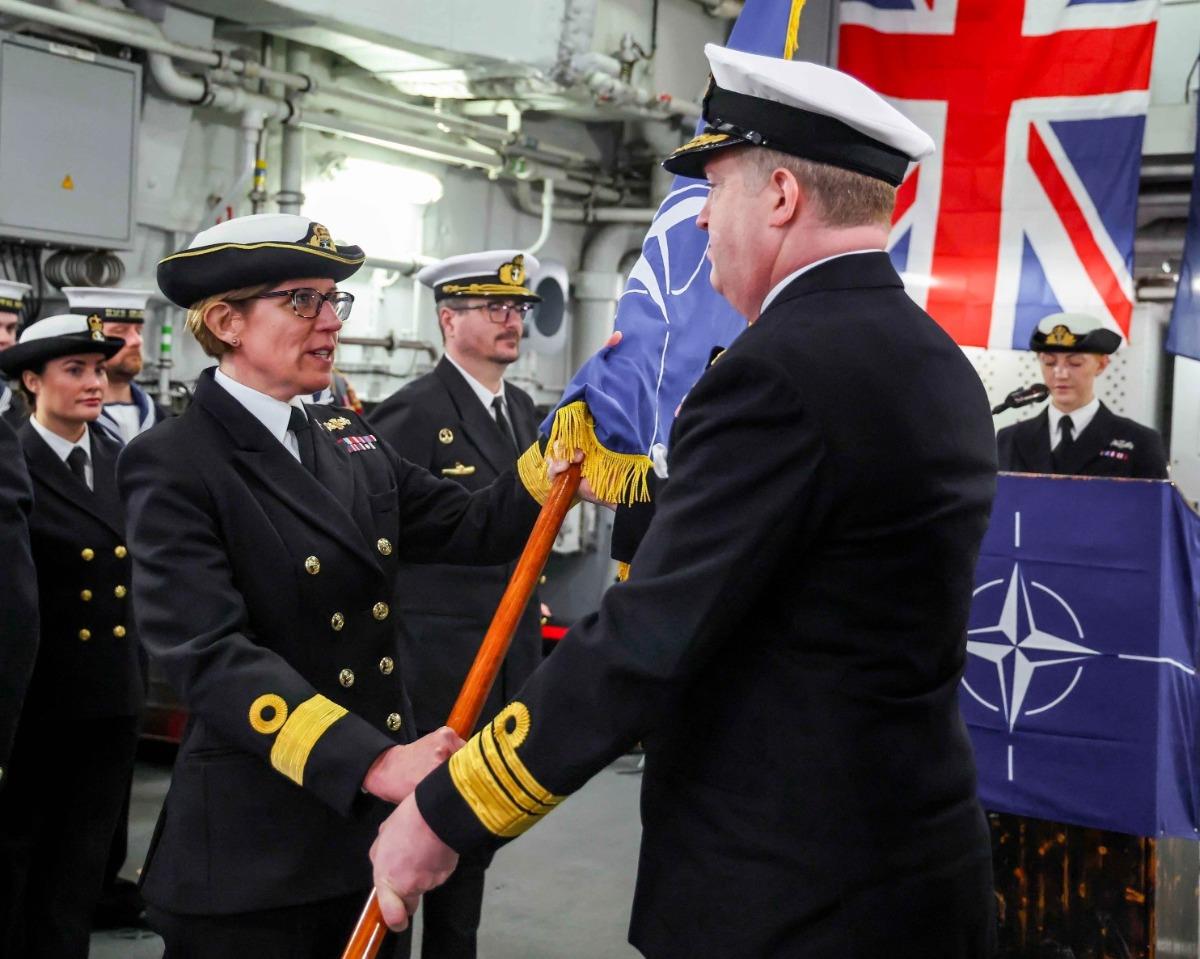
The Royal Navy has assumed command of Standing NATO Maritime Group 1 following a handover ceremony at Portsmouth Naval Base.
In a significant transition underscoring NATO’s commitment to collective maritime security, the Royal Navy has taken command of Standing NATO Maritime Group 1 (SNMG1). The formal handover ceremony, held on April 10 at Portsmouth Naval Base, saw Commodore Maryla Ingham of the United Kingdom’s Royal Navy assume leadership of the multinational task group from Spanish Navy Rear Admiral Joaquín Ruiz Escagedo.
The ceremony was presided over by Royal Navy Vice Admiral Robert Pedre, who serves as the Commander of Allied Maritime Command (MARCOM), NATO’s central maritime command. This change of command signifies the rotating nature of leadership within NATO’s standing forces, ensuring a diverse range of national expertise contributes to the alliance’s readiness and operational effectiveness.
Rear Admiral Escagedo’s four-month tenure as commander of SNMG1 was characterized by a period of sustained operational activity and strategic expansion. Under Spanish leadership, SNMG1 conducted extensive operations across the Baltic Sea and, notably, embarked on its first-ever deployment to the Arctic region. These deployments were crucial for maintaining a robust and visible NATO presence in strategically vital areas.
During its time under Spanish command, SNMG1 played a pivotal role in “Baltic Sentry,” a mission focused on maintaining a persistent naval presence in the Baltic Sea. This initiative is designed to monitor critical sea lanes, which are essential for international trade and connectivity, and to safeguard vulnerable undersea infrastructure, including vital pipelines and communication cables. The protection of such infrastructure has gained increased importance in recent years due to heightened geopolitical tensions and incidents raising concerns about sabotage.
The task group also extended its reach into the High North, deploying in support of “Arctic Sentry.” This high-vigilance mission marked a significant milestone for SNMG1, underscoring NATO’s evolving focus on the Arctic as a region of increasing strategic importance. The Arctic, with its melting ice caps and potential for new shipping routes and resource exploration, is becoming a new frontier for international security considerations.
Throughout the Spanish-led deployment, SNMG1 actively participated in several major NATO exercises, designed to test and enhance the interoperability and combat readiness of allied forces. These included Dynamic Mariner 2026, Steadfast Dart 2026, Cold Response, and Arctic Dolphin. These exercises covered a broad spectrum of modern naval warfare capabilities, including integrated air and missile defence, anti-submarine warfare (ASW), live-fire serials, and complex support for amphibious operations. Forces from France, Germany, and Spain worked alongside other allied nations, operating in both temperate and extreme cold-weather conditions, demonstrating their collective ability to operate effectively in diverse and challenging environments.
Reflecting on his command, Rear Admiral Escagedo emphasized the critical importance of multinational cooperation. He stated,“Collaboration between our nations is essential to ensure regional stability, strengthen NATO’s deterrence, and maintain security across the Baltic and Arctic regions.”He further added,“The Spanish Navy, through its active participation in SNMG1, plays a key role in these efforts, contributing to maritime security, reinforcing NATO’s deterrence posture, and demonstrating our firm commitment to collective defence in the region.”His remarks highlight the shared responsibility and common purpose that underpin NATO’s operational philosophy.
As Commodore Ingham assumes command, she will lead the task group from the German frigate FGS Sachsen. This arrangement exemplifies the principle of multinational integration within NATO, pairing British maritime leadership with one of the German Navy’s most technologically advanced air defence vessels. The FGS Sachsen, a formidable warship, provides robust command and control capabilities along with sophisticated sensor and weapon systems crucial for modern maritime operations.
Commodore Ingham expressed her enthusiasm for the new role, stating,“I am delighted to formally assume command of the task force. Embarking with the Royal Navy Battle Staff in Sachsen, we look forward to working closely alongside our Allies to support our common goals.”Her statement reinforces the continuity of SNMG1’s mission and the enduring spirit of collaboration among NATO members.
SNMG1 is one of four standing NATO maritime groups, which collectively provide the alliance with a continuous naval presence and a high state of readiness across the full spectrum of operations—from peacetime surveillance and training to crisis response and conflict. These groups are core components of NATO’s Very High Readiness Joint Task Force (VJTF), capable of deploying rapidly anywhere the alliance requires, serving as a constant deterrent and a credible defensive force.
Why This Matters
The assumption of command of Standing NATO Maritime Group 1 (SNMG1) by the Royal Navy is more than a routine procedural change; it signifies the ongoing adaptability and unwavering commitment of the NATO alliance in a rapidly evolving global security landscape. This handover carries significant implications for regional stability, collective defense, and the strategic posture of Western nations.
Firstly, the operational areas covered by SNMG1 – the Baltic Sea and the Arctic – are at the forefront of contemporary geopolitical tensions. The Baltic Sea, bordering several NATO members and Russia, is a critical maritime domain where freedom of navigation and the protection of vital undersea infrastructure are paramount. Incidents involving critical infrastructure, such as pipelines and data cables, have underscored their vulnerability and the potential for disruption to economies and societies. SNMG1’s persistent presence in this region directly contributes to deterring potential adversaries and ensuring the security of these essential arteries.
Secondly, the expansion of SNMG1’s operations into the Arctic marks a pivotal shift in NATO’s strategic focus. As climate change opens new maritime routes and access to resources, the Arctic is rapidly becoming a region of increased military and economic competition. Russia has significantly bolstered its military presence in the High North, making NATO’s counterbalancing presence, through missions like “Arctic Sentry,” crucial for maintaining regional stability and safeguarding the interests of allied nations. This deployment demonstrates NATO’s understanding of the changing geopolitical environment and its proactive approach to new challenges.
Thirdly, SNMG1 serves as a tangible manifestation of NATO’s collective defense principle, enshrined in Article 5 of its founding treaty. The group’s multinational composition, with a British commander on a German frigate leading a diverse staff, highlights the seamless interoperability and cohesion among allied navies. This ability to operate as a unified force, conducting complex exercises like anti-submarine warfare, air defense, and amphibious operations in various extreme conditions, sends a powerful message of deterrence. It reassures NATO members that the alliance is prepared and capable of defending its territory and interests against any aggression.
Finally, the continued high readiness and robust presence of SNMG1 contribute significantly to global maritime security. By safeguarding international sea lanes and critical infrastructure, the group supports stable international trade and communication, which are foundational to global economic prosperity and stability. In an era marked by increasing unpredictability and a return to great power competition, strong, integrated multinational forces like SNMG1 are indispensable for projecting stability, deterring aggression, and ensuring the continued security and defense of the alliance.