
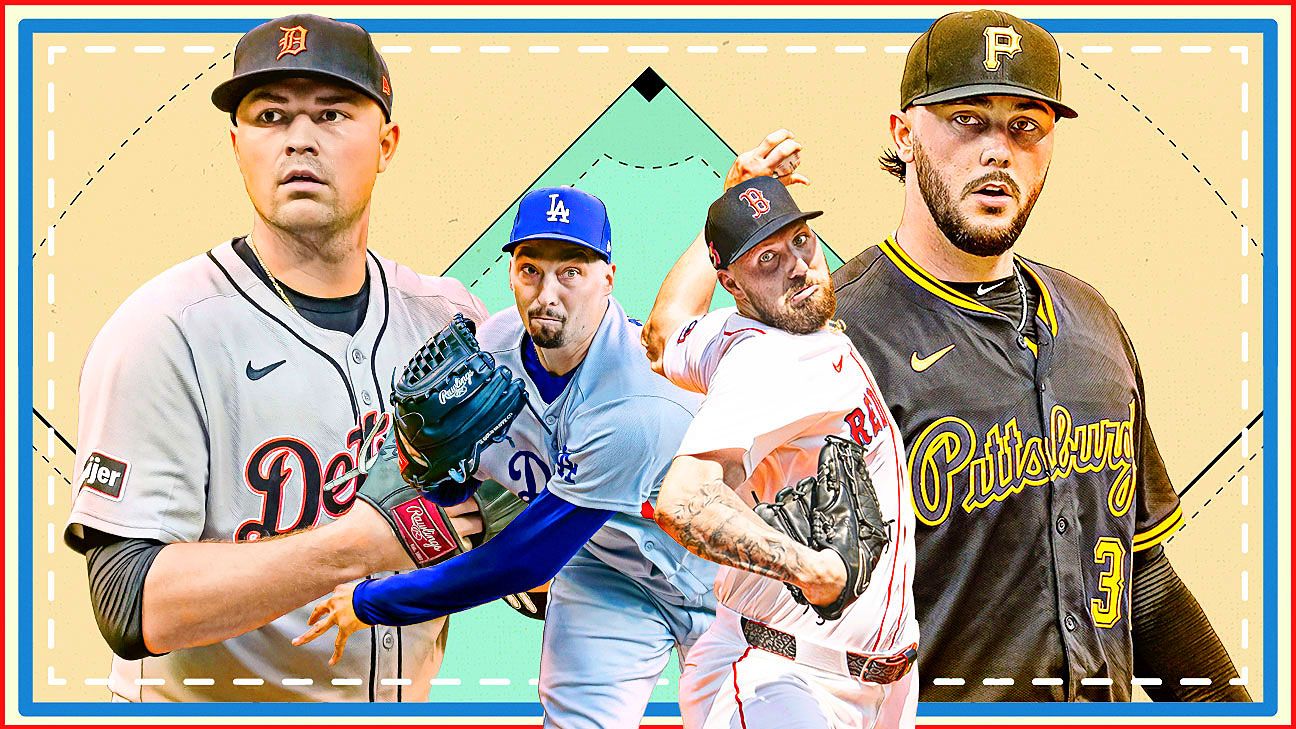
Pre-season practice sessions have commenced, signifying an opportune moment to assess the current condition of baseball. Within our comprehensive 2026 MLB season preview, Buster Olney of ESPN questioned individuals across the sector to aid in compiling a list of the top ten athletes for each role as a component of his yearly series on player standings by position.
The primary goal of this endeavor is to pinpoint the leading players for the upcoming 2026 season, rather than forecasting future stars or lifetime achievements. We plan to unveil one position daily throughout the ensuing fortnight. Beginning with starting hurlers, the subsequent lineup is as follows: relievers (2/17), catchers (2/18), first basemen (2/19), second basemen (2/20), third basemen (2/23), shortstops (2/24), corner outfielders (2/25), center fielders (2/26), designated hitters (2/27).
Which athletes are currently at the pinnacle? Discover those featured on the roster for each role.
The inquiry is straightforward: Who stands as the premier hurler globally, Tarik Skubal or Paul Skenes?
However, the preliminary reactions from Major League Baseball experts indicate significant mental bewilderment.
“Oh, wow …”
“C’mon …”
“You’re asking me?”
“Are you f—ing kidding me with that?”
Among our yearly compilations of the top ten athletes in every role, several excellent — and engaging — discussions arise. Which athlete would you favor in right field, Juan Soto or Aaron Judge? Considering Mookie Betts’ remarkably superb defensive performance last season, where should he be positioned among shortstops? Does Patrick Bailey, widely acknowledged as the finest defensive catcher, feature within the top three for his role? Has Nick Kurtz already outshone long-standing luminaries like Bryce Harper and Freddie Freeman among first basemen?
However, the choice between Skubal and Skenes for baseball’s premier starting hurler has perplexed experts more profoundly than any other deliberation, compelling them to delve extensively to distinguish the pair of transcendent talents.
One might consider ERA+: Skenes concluded the previous year with a 217, while Skubal registered 187. Should one favor strikeout percentage to gauge sheer superiority, Skubal would emerge as the favored choice, having fanned 32.2% of opposing hitters he encountered last year; Skenes, conversely, retired 29.5% of batters via strikeout.
Should one prioritize control, Skubal’s walk rate registered a miniscule 4.4% — whereas Skenes was comparable with 5.7%. An expert suggested that Skenes might be the superior option due to his greater proficiency in controlling base runners — indeed, Skubal was pitching when Josh Naylor successfully stole a base during a crucial juncture in Game 5 of the American League Division Series. Yet, across the last two standard campaigns, Skubal has permitted merely six stolen bases from 13 tries, whereas Skenes permitted just 10 stolen bases in 13 attempts, an astonishingly low figure for a towering, right-handed hurler.
An American League coach, whose squad has competed against both hurlers, observed that upon hitters’ return to the dugout after encountering Skenes or Skubal, a complete absence of swagger, whether simulated or genuine, is evident; they remain silent, perhaps sensing themselves outclassed at the plate.
“You’re often presented with pitches to attack against many other competitors,” commented the coach, referring to the other hurlers on the top-10 roster. “They could test you with a heater, or leave a breaking ball vulnerable. However, facing [Skubal and Skenes] is simply unlike any other experience.”
This explains their position atop this ranking. Yet, which premier pitcher secures the leading position?
Foremost 10 Starting Hurlers

1. Tarik Skubal, Detroit Tigers
Should you believe Skenes merits this placement, numerous individuals within Major League Baseball would concur. Nevertheless, Skubal holds this position for a pair of justifications.
Primarily, he’s a southpaw, as one manager stated, “Given equivalent skills, a left-handed pitcher is often favored.”
Secondly, Skubal has maintained a prominent standing for a longer duration than Skenes, whose major league career commenced in early 2024. Furthermore, Skubal boasts consecutive Cy Young accolades, a feat an American League hurler hadn’t achieved in approximately twenty-five years. Only Greg Maddux (1993-95) and Randy Johnson (1999-2002) have claimed a minimum of three successive Cy Young trophies, an accomplishment Skubal aims for this season prior to becoming a free agent after the 2026 campaign.
Skubal’s fastball possesses such remarkable quality, a team member noted, that even when batters foresee the offering, they still fail to make contact — and naturally, this heater is enhanced by Skubal’s exceptional changeup.

2. Paul Skenes, Pittsburgh Pirates
Certain experts who favored Skenes for the top position on this ranking contend he has endured fewer difficult outings. During the previous season, he surrendered three or more earned runs in just six of his 32 appearances, and permitted five earned runs on merely one occasion — versus the St. Louis Cardinals on April 8.
Nonetheless, Skubal similarly performed admirably against this criterion — he gave up three or more earned runs in 10 of his 31 appearances, and, mirroring Skenes, had but a single outing where he conceded five earned runs, occurring against the Boston Red Sox on May 14.
Skenes’s offensive line against him is marginally superior to Skubal’s: Opponents managed only .199/.250/.307 versus Skenes in 2025, whereas Skubal’s corresponding figures were .199/.240/.319.

3. Yoshinobu Yamamoto, Los Angeles Dodgers
A strong statistical case exists for Yamamoto’s inclusion at or near the summit of this ranking, considering his exceptional performance in the postseason and World Series. Moreover, he stands comparably well against Skenes and Skubal regarding opposing batters’ outcomes: Batters managed merely a .183 average versus Yamamoto, alongside a .283 slugging percentage.
To contextualize that final figure, among 154 batters who accumulated sufficient plate appearances to contend for the batting crown last year, Ke’Bryan Hayes recorded the lowest slugging percentage, at .306.Everybatter, as a group, performed less effectively against Yamamoto than the individual with the lowest slugging percentage in professional baseball.
However, Yamamoto pitched considerably fewer innings during the regular season compared to Skenes or Skubal attributable to the Dodgers’ strategy of preserving their hurlers’ peak condition for the playoffs. While the fifth-ranked pitcher on this roster achieved 8.0 WAR in the standard season, Yamamoto concluded with 5.0 WAR, ranking him ninth among eligible starting hurlers. It is challenging to envision the Dodgers
enabling Yamamoto to manage a substantial regular-season pitching burden, much like an individual such as Logan Webb does for the San Francisco Giants.

4. Garrett Crochet, Boston Red Sox
Boston’s expectations were fully met by the southpaw after orchestrating a significant trade agreement with the Chicago White Sox and inking Crochet to a six-year, $170 million pact. Crochet topped the AL in innings (205⅓) and opposing batters encountered (814), also finishing first among all major league pitchers in strikeouts (255). His punchout percentage stood at 31.3% and his ground ball ratio was 48.3%; hurlers found limited opportunities to connect.

5. Cristopher Sanchez, Philadelphia Phillies
In the initial stages of last March’s spring training, at that time, the Orioles’ skipper Brandon Hyde initiated a discussion alongside a few journalists who were present by bringing up Sanchez’s name. “Has he caught your eye this spring?” Hyde inquired, prior to elaborating on Sanchez’s notable increase in fastball speed.
Hyde’s assessment proved prescient; Sanchez emerged as the major leagues’ standout hurler of 2025, combining his elusive changeup with his heater and fanning 212 batters across 202 frames. At 29 years of age, the Phillies maintain his services under contract extending until 2030, encompassing optional seasons in 2029 and 2030, stemming from a four-year, $22.5 million agreement he inked during the 2024 season’s midpoint.

6. Hunter Brown, Houston Astros
During the previous campaign, Houston’s flamethrower recorded an adjusted ERA of 172, while restricting opposing batters to a meager .201 batting average.

7. Max Fried, New York Yankees
Fried boasts a career adjusted ERA of 141, placing him 19th historically. He shares that distinction with Chris Sale, outranking Roy Halladay, Whitey Ford, and his revered idol from youth, Sandy Koufax.

8. Logan Webb, San Francisco Giants
Webb represents the archetype of a durable starting pitcher who is growing exceptionally uncommon in Major League Baseball. During an era where scant hurlers achieve the 200-inning benchmark, Webb values that accomplishment, concerning initiating games and maintaining his presence deep into them. He has accumulated 627⅔ frames throughout the last three campaigns and topped the major leagues in games started in each of the two preceding years.

9. Chris Sale, Atlanta Braves
Sale’s 2024 Cy Young Award-winning campaign was succeeded by a 2.58 ERA across 21 outings prior to sustaining an injury in 2025. His argument for Cooperstown will closely mirror Jacob deGrom’s, ultimately, featuring stellar campaigns interspersed with prolonged injury spells.

10. Jacob deGrom, Texas Rangers
DeGrom limited opposing batters to a .196 average across 30 outings during the previous season, representing his finest display in a long time. His eventual enshrinement into Cooperstown now appears certain, given the current inclination where voters honor contenders for their career zeniths. His career adjusted ERA stands at 151, ranking sixth historically, trailing Clayton Kershaw and Pedro Martinez, both level at 154.
Noteworthy mentions
Blake Snell, Dodgers:In every season, there are periods during which he performs as the premier hurler in Major League Baseball; across his final eight outings of 2025, he recorded a 2.09 earned run average. However, he has been sidelined for extended periods — he has accumulated 31 games started throughout the last two campaigns, and during the previous year, he pitched only 61⅓ frames.
Zack Wheeler, Phillies, and Gerrit Cole, Yankees:The Phillies state that Wheeler’s rehabilitation from thoracic outlet syndrome is progressing favorably and anticipate his return comparatively early in the campaign. The Yankees are optimistic that Cole might pitch again during the initial segment of the season. Furthermore, once both these eventualities materialize, there is ample justification to expect the duo to re-enter the top 10 rankings.
Freddy Peralta, New York Mets:He secured the fifth position in the National League Cy Young ballot during the previous season, subsequent to registering a 2.70 ERA across 33 games started.
Bryan Woo, Seattle Mariners:He emerged as the unofficial lead pitcher for Seattle’s pitching staff during the previous campaign.
Dylan Cease, Toronto Blue Jays:Toronto secured him with a seven-year, $210 million agreement last winter owing to his formidable repertoire — having recorded 1,106 punchouts across the last five campaigns.
Andrew Abbott, Cincinnati Reds:He generated 5.6 bWAR for Cincinnati during the previous year, registering a 2.87 ERA in 29 games started. His fellow player Hunter Greene likewise possesses the capacity to enter the top 10 considering his dominant pitches; nonetheless, he has been restricted to 370 frames throughout the past three campaigns.
Carlos Rodon, Yankees:He surrendered merely 132 base knocks across 195⅓ frames during the previous season.
Kevin Gausman, Blue Jays:Remarkably steady throughout the last five campaigns.
Cole Ragans, Kansas City Royals:Kansas City’s exchange with the Rangers involving Ragans — in return for soon-to-be free agent Aroldis Chapman — stands as one of the most astute transactions of the preceding decade.