
MILAN — Who asserts physical altercations are nonexistent in ice hockey during the Olympic Games?
Tom Wilson evidently disregards that such conduct is discouraged in global competitions.
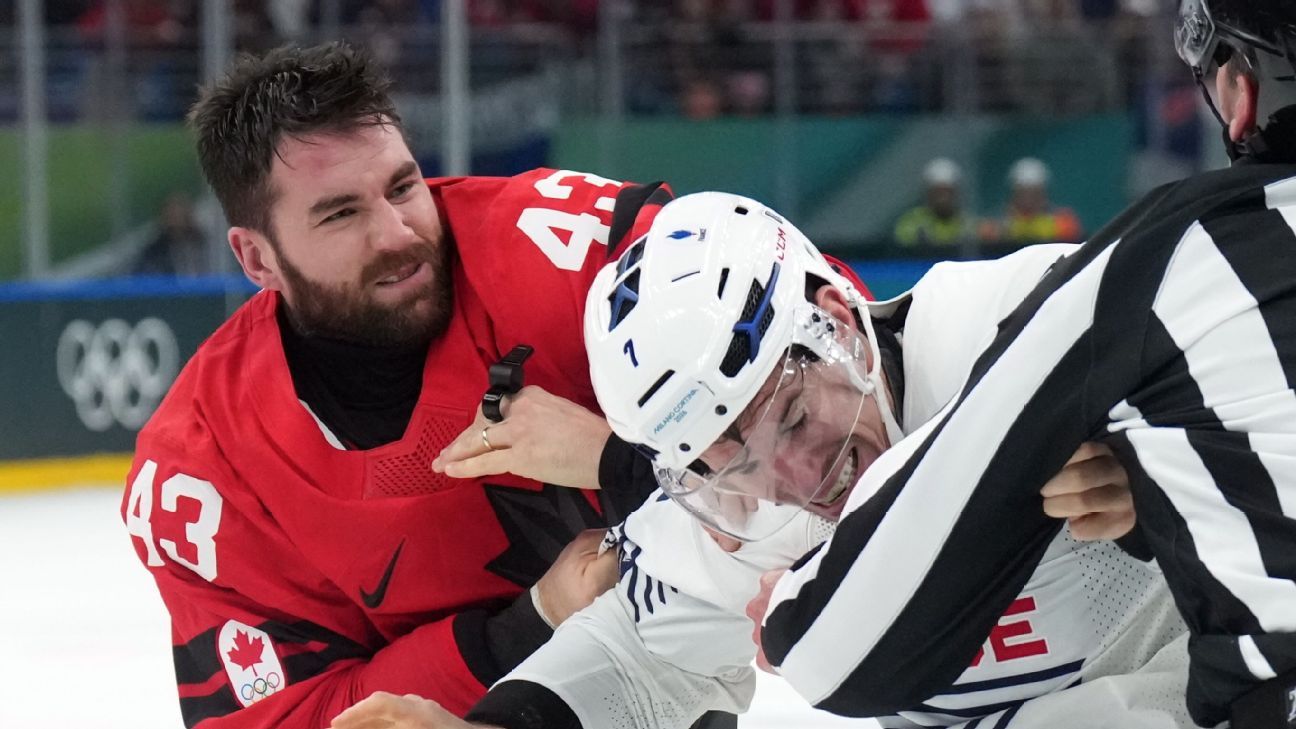
Wilson initiated a physical confrontation late in Canada’s dominant 10-2 victory over France on Sunday, pursuing the opponent who landed a forceful forearm to the head of fellow player Nathan MacKinnon a few moments prior.
“Evidently, fisticuffs are not a prominent aspect of these games, but when a guy targets one of our key players aggressively, that’s characteristic of Willy’s actions,” stated three-time Olympian Drew Doughty. “He contributes far more extensively than that, yet it was commendable to witness his intervention.”
Wilson grappled with Pierre Crinon, who was assessed a minor two-minute infraction and expressed regret to MacKinnon following the impact in the third period. A goal netted 25 seconds into the subsequent power play did not suffice as adequate retribution from the perspective of the Canadian squad.
“We disapproved of the impact; it was perceived as delayed and elevated,” explained the competition’s top point-getter, Connor McDavid. “Willy simply completes a bodycheck, and the opponent assails him, so Willy is merely defending himself. He could do no more. That’s the kind of individual he is, the sort of compatriot he embodies. Only admiration for his character.”
In contrast to the National Hockey League, where a five-minute major infraction is issued, physical altercations result in a game expulsion according to International Ice Hockey Federation statutes, so Wilson and Crinon were removed from play. The result had been definitively settled much earlier, and Wilson was absent only for the concluding seven minutes of the game.
“We’re accustomed to far more intense occurrences than that, so it was rather innocuous considering the overall context,” coach Jon Cooper remarked. “Defending his fellow players—that comes naturally to him.”
Wilson additionally registered a tally and a helper, with the altercation earning him what is termed in ice hockey as a “Gordie Howe hat trick.”
The 31-year-old forward is among a handful of fresh faces for Canada who was not involved at the 4 Nations Face-Off the previous year, when three brawls erupted within the initial nine seconds of the squad’s opening match against the U.S.
Wilson’s altercation occurred precisely a year subsequent to those incidents, when Canada’s Brandon Hagel, Sam Bennett and Colton Parayko clashed with American players Matthew Tkachuk, Brady Tkachuk and J.T. Miller.
“Honestly, I don’t think we can complete this competition without witnessing such an event,” Hagel stated, smiling. “It was likely a major topic surrounding his inclusion in the games. But that is simply Willy’s modus operandi: He defends his fellow players.”
MacKinnon, who was hesitant to rise and rested momentarily on the sidelines prior to rejoining the play, valued Wilson’s act of defending him.
“That guy plainly had no desire to confront Tom,” MacKinnon commented. “He merely intended to grapple. I wouldn’t wish to engage Tom in a brawl myself.”
Wilson was an undisputed selection due to his robust presence and knack for recovering the disc, along with performing with great efficacy on his home continent with the Washington Capitals. He is their foremost point-getter with a tally of 49 points across 50 matches this campaign.
He’s expected to assume the captaincy of the Capitals upon Alex Ovechkin’s retirement, and Cooper lauded Wilson as “exceptional within the dressing room.” Engaging in an altercation at the Olympic Games only gives Wilson, who declined to address the press post-game, enhanced credibility among his fellow players.
“We know Willy supports us unconditionally,” Bennett said. “He will safeguard all our players and provide the impetus. We appreciate that quality in Willy. He will undertake any measure for our squad.”
Spirited netminder Jordan Binnington, who is apt to prod an opponent with his catching glove when he feels discontent, similarly approved.
“I was certainly not astonished,” Binnington said. “Such is the nature of ice hockey, isn’t it? That’s the sport.”