
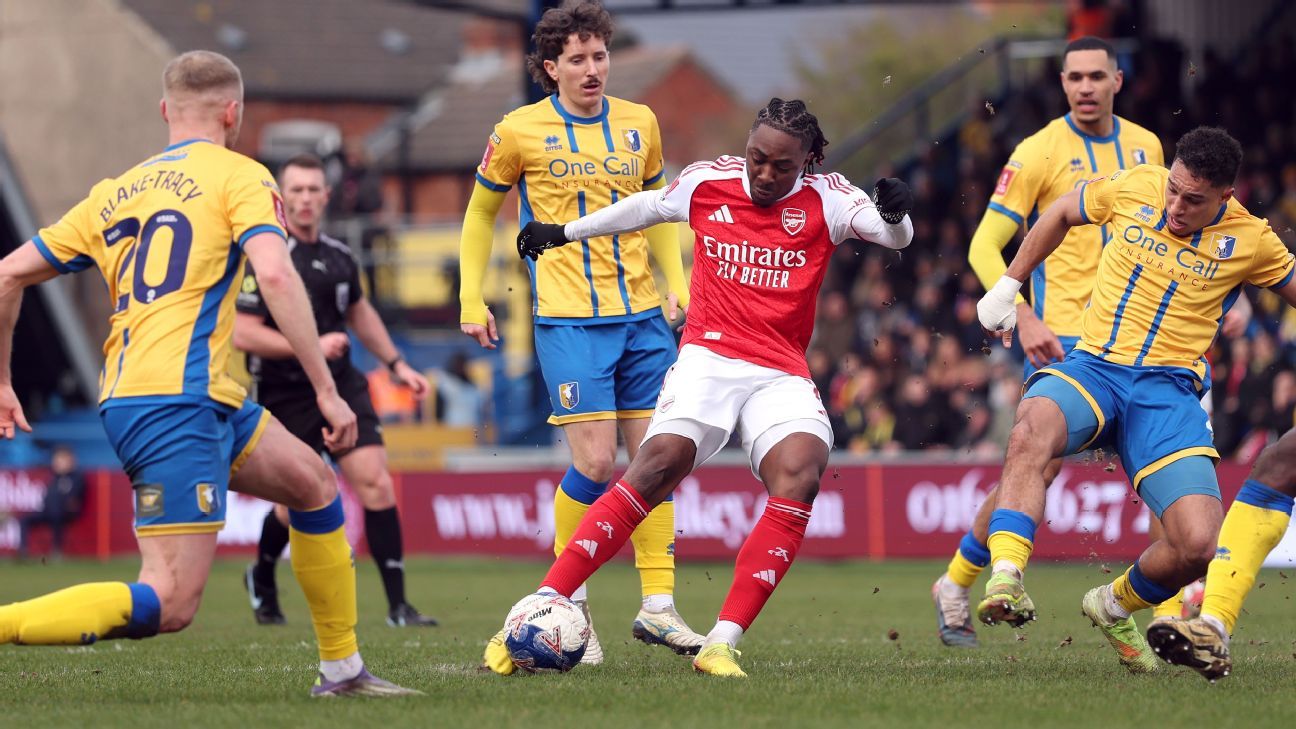
Mikel Arteta has previously alluded to his struggle in perfecting squad rotation, despite having put together one of Arsenal’s most formidable teams. The significant fright Mansfield Town delivered to the Gunners in Saturday’s FA Cup fifth-round tie at One Call Stadium serves as an indication that this is a skill he is still acquiring.
Ultimately, Arsenal remain in contention for an unparalleled quadruple, thanks to a 2-1 victory secured by substitute Eberechi Eze’s magnificent 66th-minute strike, which he blasted high into the netting.
They fielded a pair of 16-year-olds — Marli Salmon and Max Dowman, who set a record as Arsenal’s youngest FA Cup starter at 16 years and 66 days old — and this represented their 35th triumph across all tournaments, already surpassing any previous tally during Arteta’s tenure, even with a quarter of the season still remaining.
Arsenal might play up to 19 more matches should they progress fully in both domestic and international competitions, and the prevailing belief is that Arteta must utilize his squad more effectively to maintain their current trajectory.
Arteta has faced criticism for relying excessively on crucial individuals, so extensive alterations were a reasonable reaction given the brief interval between Wednesday night’s win at Brighton and Saturday’s journey to League One opposition. However, the adjustments those newly introduced players had to make on a challenging playing surface against unknown adversaries were exacerbated by Arteta’s choice to adopt a three-man defense for the first time in 246 matches.
They previously deployed a three-at-the-back formation in August 2021 when suffering a 5-0 defeat at Manchester City. Arsenal appeared disjointed and unpersuasive before Leandro Trossard’s injury compelled Arteta to make an alteration on 38 minutes.
He introduced defender Piero Hincapié, abandoned the three-man defense, and Noni Madueke netted the initial goal three minutes later, marking their century of goals this season across all tournaments. Therefore, what was the rationale behind the initial tactical shift?
“The accessible players,” Arteta stated afterwards. “And if we want to handle the workload and particular problems confronting our squad, you have to adjust accordingly. Sometimes it’s less than optimal with just one day for preparation. But it also posed a test for everyone to gauge our adaptability, which I anticipated under arduous conditions.”
With a single day of complete practice after their match at Brighton and before journeying to Mansfield, Arteta was asked the frequency with which they had practiced that formation: “Yes, once, [for] 10 minutes.”
Arsenal fundamentally depended on their superior individual talent to progress, and that ultimately bore fruit. Mansfield, reaching this round of the tournament for the first time since 1974 and up against an opponent 59 positions above them in the English football hierarchy, closed that disparity for significant stretches through sheer exertion and diligence.
Mansfield CEO Carolyn Radford had mentioned beforehand the urgent painting tasks and repairing faulty faucets to prepare Mansfield for their significant occasion. They also heavily irrigated the playing field to impede Arsenal’s ball distribution as much as possible, and their courageousness in pushing players upfield contributed to unsettling Arsenal.
Merely five minutes following the interval, Salmon delivered an underpowered pass to Cristhian Mosquera, who retreated meekly and gave Will Evans an opportunity to attack Arsenal’s defensive formation.
Evans maneuvered into the penalty area and struck the ball low beyond Kepa Arrizabalaga to momentarily equalize for Mansfield, but Arteta countered by introducing Jurriën Timber and Eze, with Eze making his impact merely four minutes post-substitution.
Arteta’s deployment of Eze sparks further disagreement among numerous observers. Many advocate for him to be afforded extended playing time in the squad, with freedom to express his peak creativity, but his time at Arsenal remains intermittent. This decisive goal provides a fresh chance for advancement.
Dowman remained on the field for 77 minutes until Bukayo Saka took his place. It is challenging to reconcile the necessary developmental room for a young adolescent with showcasing an individual as talented as Dowman during his senior team appearances.
Certain individuals advocate for Arteta to deploy Dowman more frequently — and his participation on this field against adversaries prone to countering his finesse with sheer power was debatable — yet the orchestrator moved fluidly across the imperfect ground, maneuvering with a grace that justifiably stirs anticipation for his future capabilities.
His recent recovery from an ankle ailment presents a captivating choice for the closing stages of the season.
“Max, I believe he was extraordinary,” Arteta said. “When the sphere is unpredictably erratic and opponents are pressing from behind, his management of temporal and spatial elements, along with his ball control, is truly astonishing. Particularly given the swiftness with which he executes those maneuvers. But that truly demonstrates our inherent ability.”
Arteta’s current assignment involves leveraging that ability to propel the Arsenal powerhouse onward. The setbacks sustained by Trossard and Riccardo Calafiori will undoubtedly raise apprehension prior to their midweek Champions League excursion to Bayer Leverkusen.
“I think all individuals feel integrated,” Arteta said. “Our aspiration is that, match after match, we can draw nearer to realizing our objectives.”