
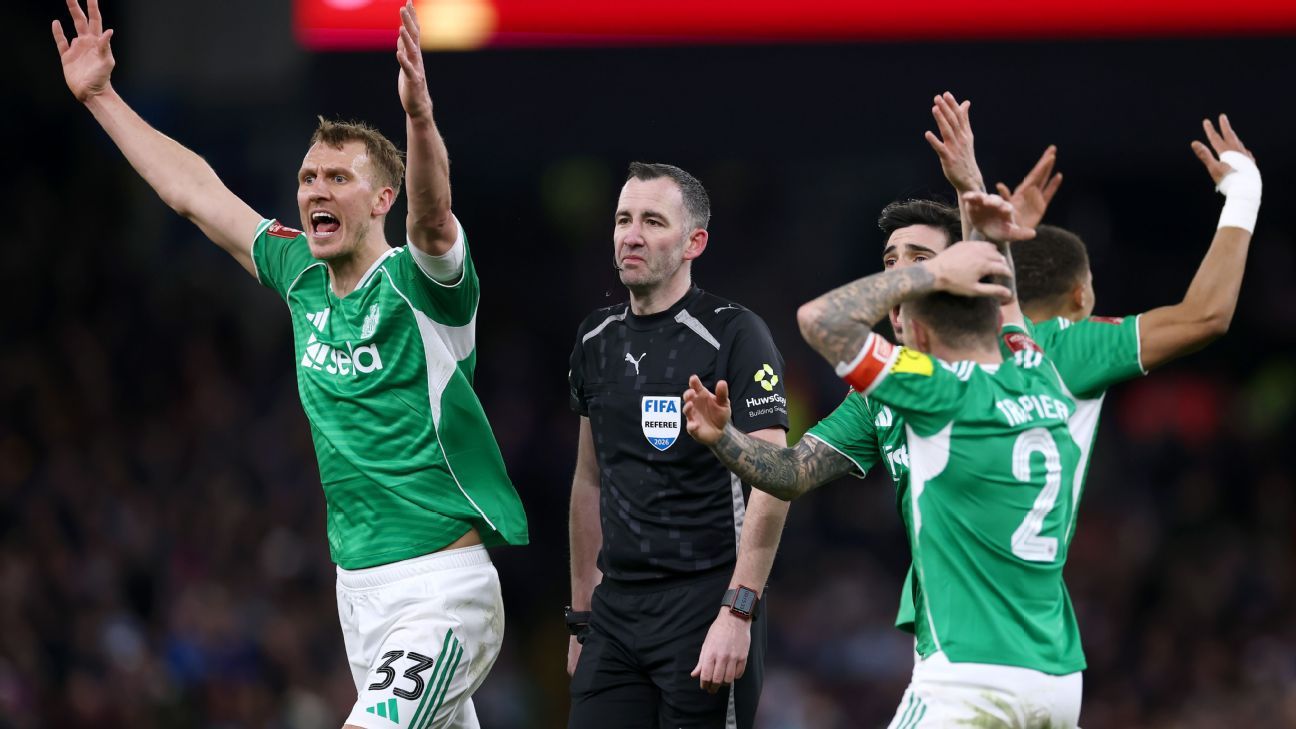
Think back to the FA Cup’s third round from the prior month. Do you recall the “invigorating” experience of observing top-tier football in the absence of VAR? That was the consensus among numerous players, coaches, supporters, and commentators. One could truly “savor the moment.” A multitude of voices echoed the same conviction: Football simply thrived without VAR.
Nevertheless, this past weekend’s FA Cup fourth round elicited an entirely contrary reaction.
Annually, the intermediate stages of the FA Cup evoke memories of a bygone era of premier football devoid of VAR – given that its implementation begins solely from the fifth round forward. However, as this weekend demonstrated, it does not imply that disagreements over officiating vanish.
In a single match alone – Newcastle United’s journey to Aston Villa on Saturday – there was a missed expulsion, a penalty not awarded, and an offside score erroneously permitted. Even during a weekend that commenced with Barcelona pausing eight minutes for VAR to nullify a goal against Atlético Madrid, the FA Cup fourth round served as an endorsement for its initial adoption.
The stark difference between the FA Cup’s third and fourth rounds perfectly illustrates football’s dilemma: Regarding VAR, it remains undecided on its preferences. It believes it comprehends its desires, yet it truly does not.
VAR diminishes some of the spontaneity from the game, but it introduces a level of precision that elite-level football has grown accustomed to.
Bearing that in mind, in this week’s “VAR Assessment” column, we will examine the principal occurrences and ponder: How might VAR have intervened?
Andy Davies (@andydaviesref) is a former Select Group official, with over 12 campaigns on the elite roster, officiating across the Premier League and Championship. With extensive proficiency at the top echelon, he has operated within the VAR domain in the Premier League and furnishes a distinctive perspective into the procedures, reasoning, and guidelines implemented on a Premier League matchday.

Official: Chris Kavanagh
VAR: No VAR
Duration: 14th minute
Incident: Tammy Abraham goal
What transpired: Aston Villa midfielder Douglas Luiz lofted his close-range free kick over the Newcastle United defensive wall. He located the dash of forward Abraham, who brought the ball down with his chest and smoothly placed it past goalkeeper Aaron Ramsdale.
Official’s ruling:Goal
Conclusion: This was precisely the sort of score that would be so readily invalidated in the Premier League. Replays indicate that the striker occupied a clear offside position when the quick-witted Luiz deftly chipped his free kick over Newcastle defenders. It constituted a factual inaccuracy that would have been swiftly identified by semi-automated offside technology (SAOT) in the Premier League, resulting in the goal’s disallowance.
However, without the aid of technology, it is not an uncomplicated judgment for the assistant official to render. To begin with, it transpires at match speed, and it is noteworthy that Villa defender Victor Lindelöf coincidentally obstructs the assistant’s field of vision.
Duration: 42nd minute
Incident: Lucas Digne challenge on Jacob Murphy
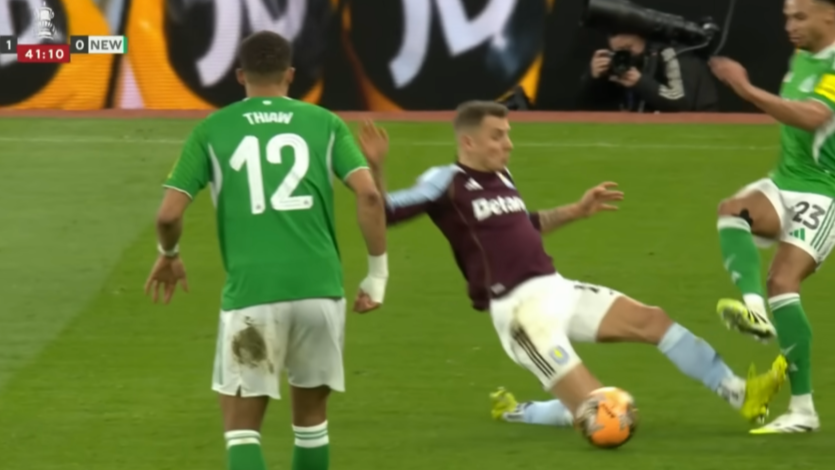
What transpired: Aston Villa defender Digne lunged in at high velocity with a sliding tackle on Newcastle winger Murphy, connecting with his shin without making contact with the ball.
Official’s ruling:Yellow card
Conclusion: Both the assistant official and fourth official were positioned credibly to assess this judgment, and official Kavanagh would have conferred with them prior to issuing the yellow card. Nevertheless, the velocity, force, and lack of control from Digne warranted a red card.
Undoubtedly, this tackle would have been highlighted at the VAR control hub in Stockley Park, and an on-field review would assuredly have ensued. It would have afforded Kavanagh another chance to evaluate the tackle and, ideally, revise his judgment.
However, without the protective mechanism of VAR, the initial on-field judgment stood as final.
Duration: 61 minutes
Incident: Digne handball
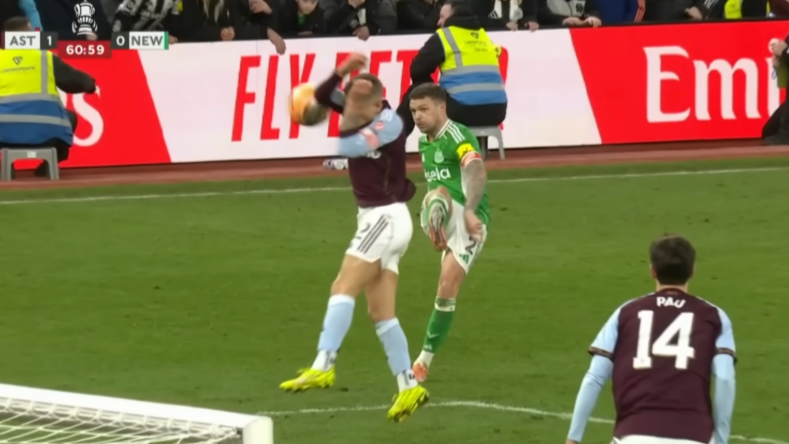
What transpired: Newcastle right-back Kieran Trippier delivered a cross into the Villa penalty area, but Digne intercepted it just inside the 18-yard box with his arm, which was clearly raised above his head.
Official’s ruling:Free-kick awarded due to handball (not a penalty)
Conclusion: The officiating team granted a free-kick rather than a penalty, believing the infraction had occurred beyond the 18-yard box. Official Kavanagh’s concentration evidently shifted from the contact point of Trippier’s boot to the central area of the penalty box, rendering him susceptible to overlooking such a transgression. His reliance in this instance rested with his assistant. Yet, jointly, they must ascertain the location of any defender capable of committing an offense, thereby compelling them to make a crucial determination. At the elite tier, this is fundamental knowledge. Both ultimately bear responsibility.
This was a judgment where VAR, once more, would have served as a straightforward safeguard. It could have factually reversed the initial outcome and granted a penalty without necessitating the official’s trip to the on-field monitor.
Kavanagh will likely feel disappointed by his crew during the critical junctures of this match. Nevertheless, his name is at the forefront, and he will shoulder the ultimate accountability. Such is the reality of being a top-tier official: irrespective of how smoothly the remainder of the game proceeds, one is judged on the pivotal instances. Without VAR, and without substantial assistance from the rest of his crew, a challenging scenario emerged.



Official:Matt Donohue
VAR:No VAR
Duration:22nd minute
Incident:Omar Marmoush disallowed goal
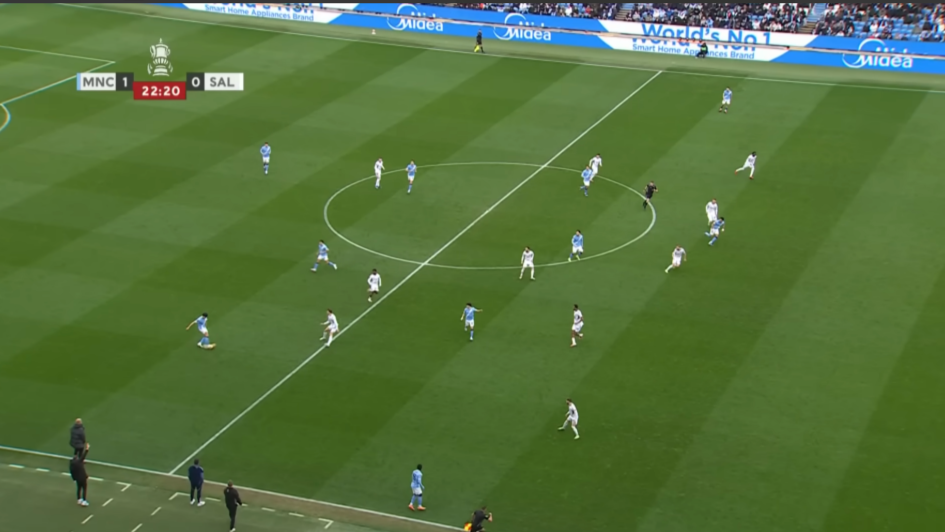
What transpired:Manchester City forward Marmoush was sent clear towards goal before powerfully striking the ball into the upper-left corner, a score that would have given City a 2-0 advantage. However, it was called back for offside.
Official’s ruling:Offside
Conclusion:Initially, the decision to nullify Marmoush’s goal for offside appears to be an erroneous judgment, but further scrutiny is not as definitive. It is crucial to remember that these kinds of situations often mislead the unaided eye, given the camera’s perspective. The optimal course of action here to resolve any ambiguity would have been a VAR verification. Alas, that must await the subsequent round.