
Each season presents its distinct essence, and the 2025-26 collegiate men’s ice hockey season has witnessed the firm establishment of dominance across the Midwestern and Western regions.
The NCHC and Big Ten held sway at the apex of the national standings throughout nearly the entire campaign, with Michigan securing its position at the summit as the nation’s premier squad and the leading overall seed in the NCAA tournament.
The Wolverines are not the sole Big Ten representative in the 16-squad competition; Michigan State, the victor of the conference’s regular-season championship, likewise secured a top seed. Penn State and Wisconsin, which each appeared in the top five of the national polls, also gained entry into the competition.
In the NCHC, North Dakota and Western Michigan, the reigning national titleholder, secured top seeds but failed to reach the conference tournament championship match. This set up a clash between Denver and Minnesota Duluth — both participants in the NCAA tournament — where the Pioneers emerged victorious 4-3 after two extra periods.
•Each match of the NCAA men’s hockey tournament is available for viewing on the ESPN networks and will be broadcast live on the ESPN App.
Teams from the NCHC and Big Ten comprised seven of the leading nine teams according to NPI, the system employed for establishing the NCAA participants and their seeding. And the top teams from the East were not the customary dominant forces. Dartmouth, champion of the ECAC, No. 6 in NPI, qualified for the NCAA tournament for the first time since 1980, and No. 7 Providence clinched its inaugural Hockey East regular-season championship prior to its elimination in the tournament quarterfinals by Merrimack, an 8-seed. Merrimack, as the Hockey East champions, represents the most significant unexpected entry in the competition.
What implications does this hold for the NCAA tournament, set to commence with regional matches on Thursday and Friday? We asked ESPN college hockey analysts Andrew Raycroft and Sean Ritchlin for their perspectives on anticipated outcomes, encompassing the teams considered formidable, individuals deserving attention, and their selections for reaching the Frozen Four in Las Vegas on April 9 and 11.
To what extent do you believe a top-seeded team — Michigan, North Dakota, Michigan State and Western Michigan — will secure the national title?
Andrew Raycroft:My conviction is that a top seed will claim the national championship this campaign. These squads have stood as the premier four throughout the season and are anticipated to be exceptionally difficult to eliminate. Nevertheless, Denver, Minnesota Duluth, and Dartmouth must not be disregarded.
Sean Ritchlin:In historical context, the NCAA hockey tournament often favors the higher-ranked teams, where first and second seeds usually secure the national championship. This year’s leading seeds boast considerable depth, equilibrium, and formidable goaltending, factors that consistently contribute to triumph in single-elimination matches. Denver is not a top seed, and I can readily envision the Pioneers clinching the tournament, thus my assurance that one of the top four will prevail is not excessive.
Which team from the lower half of the bracket will be the most challenging opponent to eliminate?
Raycroft:Quinnipiac. Facing Providence in the initial round presents a favorable matchup for the Bobcats. Both squads employ comparable approaches and have had over a week’s hiatus. Ethan Wyttenbach, the nation’s leading scorer, spearheads Rand Pecknold’s contingent, and their average of 4.13 goals per contest ranks second nationwide.
Ritchlin:Penn State. Throughout periods this year, the Nittany Lions have ranked among college hockey’s most potent offensive units. Their play is characterized by speed, and they can swiftly create scoring opportunities. Furthermore, they feature a seasoned roster that advanced significantly in last year’s tournament, and such seasoned performance is crucial during this period of the season. Possessing elite talent such as Gavin McKenna, projected as the top pick in June’s NHL draft, coupled with their scoring prowess, renders them a perilous opponent in a single-game elimination structure, and a squad that higher seeds would prefer to avoid encountering in their regional bracket.
What player is the most crucial for his squad’s triumph?
Raycroft:Michigan State goalie Trey Augustine. During single-elimination playoff contests, goaltenders consistently prove indispensable, and Augustine stands as the premier netminder in this competition. This top-10 Hobey Baker finalist and probable Richter Award recipient possesses the capability to independently lead the Spartans to a championship.
Ritchlin:Should one focus on a solitary player in these competitions, a goaltender is invariably the choice, and recently, Johnny Hicks of Denver has been that individual. Hicks recently delivered an astonishing 41-save performance, earning him the designation of most outstanding player in the Frozen Faceoff tournament, and guiding his squad to the NCHC championship. Should he sustain the .958 save percentage and 1.14 goals-against average he achieved in the conference tournament, Denver undeniably possesses the potential to claim overall victory.
Who will prevail from a crowded field to win the Hobey Baker Award?
Raycroft:Minnesota Duluth’s Max Plante is my selection. He ranks fifth in both goals and points, logging over 21 minutes each evening within the exceptionally challenging NCHC. The Detroit Red Wings’ second-round selection has recorded 14 multi-point performances this season.
Ritchlin:This year presents no obvious favorite, and the final tally could prove to be among the tightest in recent recollection. Hayden Stavroff’s achievement of 29 goals in 34 matches is commendable, and he was instrumental in guiding Dartmouth’s return to the tournament after several decades. T.J. Hughes has maintained unparalleled consistency in collegiate hockey for Michigan over the past four years, and earned the Big Ten Player of the Year title while playing for the nation’s top-ranked squad. Eric Pohlkamp has been a commanding presence on Denver’s defensive line, netting 17 goals and topping the team in scoring. Numerous other individuals are also deserving, such as Quinnipiac freshman Ethan Wyttenbach, who spearheaded national scoring with 58 points. I anticipate Hughes will emerge victorious, given his status as the premier player on the nation’s top-ranked team.
Who do you predict will advance to Vegas for the Frozen Four?
RAYCROFT
North Dakota:The Hawks were allocated a favorable bracket, and their average of 3.84 goals per contest will prove advantageous when facing teams with limited offense.
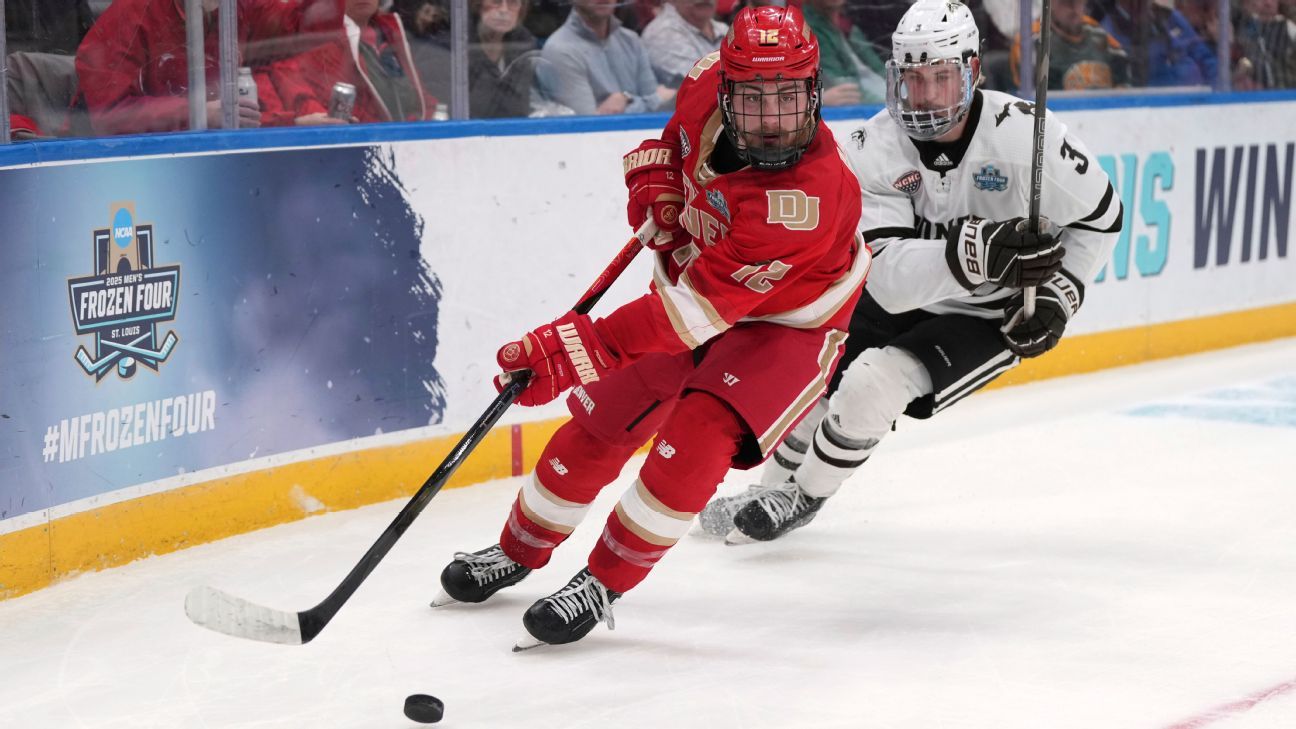
Denver:With their regional in nearby Loveland, Colorado, Denver is anticipating another monumental clash in the regional finals against Western Michigan. David Carle and the Pios claimed the NCHC title and are prepared for a further NCAA advancement.
Michigan State:The Spartans possess the premier goaltender in the tournament in Augustine, who concedes merely two goals per match. Michigan State presents a formidable challenge to opponents and has 15 NHL draft picks.
Minnesota Duluth:The Bulldogs were defeated by Denver in the conference final after two overtimes, following their 5-1 victory over North Dakota in the semifinals. I believe UMD possesses the skill and organizational framework to overcome top-ranked Michigan in the regional finals, however, it will not be a simple task.
RITCHLIN
North Dakota:Competing near their home base in Sioux Falls and possessing an advantageous bracket will aid the Fighting Hawks in progressing to Vegas.
Denver:Fresh from their NCHC triumph, the Pios are performing with considerable assurance and have demonstrated their proficiency in securing close contests under Carle’s guidance.
Michigan State:The Spartans possess considerable depth and engage in a physically disciplined style of play, supported by a world-class goaltender. They will be prepared, having endured a challenging match last year in Toledo where they fell to Cornell in the opening round.
Michigan:The Wolverines have exhibited unwavering consistency throughout the year, coupled with significant depth, and have shown substantial defensive improvement this season, factors that ought to assist them in securing their passage to Vegas. The Albany bracket, nonetheless, poses a severe challenge.