
Myron Medcalf
Close
Myron Medcalf
ESPN Staff Writer
- Covers college basketball
- Joined ESPN.com in 2011
- Graduate of Minnesota State University, Mankato

Multiple Authors
The 2026 iteration of the men’s NCAA tournament has delivered all the excitement that defines March, featuring initial-stage surprises, last-second shots, and a few glorious triumphs.
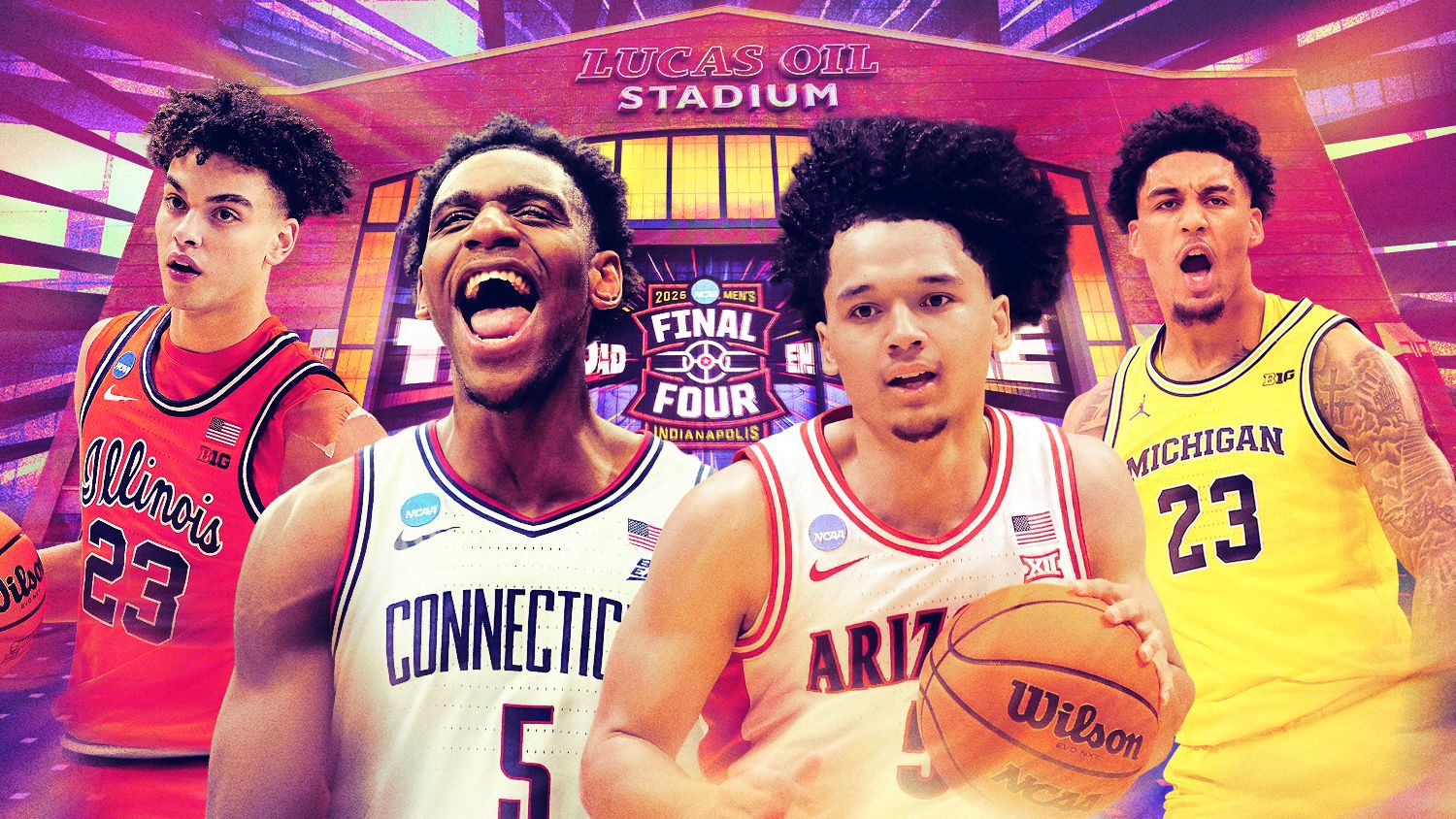
The journey culminates in Indianapolis, as four teams seeded among the top three will clash in Saturday’s Final Four, vying for an opportunity to progress to Monday’s country-wide title match.
ESPN’s college basketball correspondents, Jeff Borzello and Myron Medcalf, have been monitoring these teams throughout the season. They highlight the elements they believe will determine the outcomes of UConn-Illinois and Arizona-Michigan.

6:09 p.m. ET, Saturday

Key insights regarding UConn
How the Huskies advanced to the Final Four:
Round of 64:82-71 vs. No. 15 Furman
Round of 32:73-57 vs. No. 7 UCLA
Sweet 16:67-63 vs. No. 3 Michigan State
Elite Eight:73-72 vs. No. 1 Duke
Primary determinant in UConn’s journey to the Final Four:Tarris Reed Jr. and the veteran poise to sustain the composure the Huskies required to contend with a Duke team that held a 19-point lead in the first half has propelled them forward. Three players in the initial lineup have been part of coach Dan Hurley’s system for a minimum of two years, an uncommon occurrence in the contemporary environment. Illinois stands as the sole team in Indianapolis capable of replicating that level of tenure.
Hurley is as proficient in recruitment as he is in player retention. Freshman Braylon Mullins has experienced an inconsistent season, appearing to struggle with consistent form, yet he was a five-star recruit with good cause. When Hurley called upon Mullins, he sank the most crucial three-point shot of his career with 0.4 seconds remaining to propel UConn once more to the Final Four.
The Huskies also limited Duke to an average of 100 points per 100 possessions in the second half, following the Blue Devils having accumulated 147 points per 100 possessions in the first half. UConn persisted in their effort and emerged victorious.
Player who must elevate his performance:Solo Ball
Ball has experienced a period of inconsistent output over the past month. The 6-foot-4 guard has experienced a scoring slump, with an average of 8.5 points per game in March, a decrease from his 14.1 figure between November and February. When Ball functions as a facilitator, however, the Huskies become a more formidable squad. He tallied 15 points when UConn vanquished Illinois 74-61 in November. He registered 17 and 19 points, respectively, against ranked Kansas and Florida teams in December. The Huskies are a transformed unit when he is connecting on his attempts; a revival could alter their prospects in Indianapolis.
Possible critical vulnerability:UConn generates fewer free throw chances for themselves than for their adversaries.
Dan Hurley’s team is among the nation’s least effective when it comes to allowing adversaries free throw attempts, standing at 307th position among 365 squads on KenPom. It is also one of the least proficient teams at creating their own free throw chances (306th). In the Huskies’ five defeats, they had 80 free throw attempts in total, whereas their opponents had 128. This is significant for this specific confrontation because no team in America allows fewer free throws to rivalslessoften than Illinois — the premier team in defensive free throw allowance — and it is also positioned 14th across the country with a 78% conversion percentage from the foul line.
UConn will win if:Illinois has been the top-tier offensive squad in the country, but it also demonstrated superior defensive capabilities against Houston in the Sweet 16 and Iowa in the Elite Eight. UConn will have to address this challenge. The Huskies possess the stature enabling them to employ a confining zone defense that has suppressed rivals. Houston and Iowa both converted less than 40% of their shots inside the arc against Illinois, so UConn’s strategy must commence with Reed, who has tallied a minimum of 20 points in three of his past four games. The Huskies’ big man was commanding against Duke, and he will need to be highly effective in the low block so the Fighting Illini cannot settle into that zone. The Huskies also will have to capitalize on the weaknesses in Illinois’ defense; Reed’s output will be crucial for realizing that goal.
On defense, it begins with containing Keaton Wagler. The Huskies have several guards they can assign to the 6-foot-5 anticipated NBA draft lottery selection. UConn must prevent the freshman from accumulating substantial statistics.— Medcalf

Key insights regarding Illinois
How the Fighting Illini advanced to the Final Four:
Round of 64:105-70 vs. No. 14 Pennsylvania
Round of 32:76-55 vs. No. 11 VCU
Sweet 16:65-55 vs. No. 2 Houston
Elite Eight:71-59 vs. No. 9 Iowa
Primary determinant in Illinois’ progression to the Final Four:The Illini’s offense is one of the most highly effective in KenPom history, but it was their defense that ignited this surge to Indianapolis. They restricted VCU to 55 points and 0.83 points per possession in the round of 32, Houston to 55 points and 0.94 points per possession in the Sweet 16, and Iowa to 59 points and 1.08 points per possession in the Elite Eight. They have defended the basket and the interior with exceptional proficiency, confining all three previously mentioned adversaries to less than 48% shooting from within the arc. (Iowa managed just seven two-point field goals on Saturday.)
It represents a significant enhancement from their defensive showings towards the end of the regular season, when the Illini witnessed six of their last nine opponents tally at least 1.17 points per possession, incurring five of their eight defeats during that period. Their offense hasn’t faltered, but their defense abruptly resembling a top-tier defensive squad has been a transformative event for the season for coach Brad Underwood’s team.
Player who must elevate his performance:David Mirkovic.
Illinois evidently requires Keaton Wagler to perform exceptionally to secure victory in this match, but Mirkovic’s contributions on both offense and defense will be crucial. UConn forward Alex Karaban presented a defensive weakness in the first half against Duke, incapable of guarding Cameron Boozer (and occasionally Patrick Ngongba II) in the interior. Can Mirkovic convert points against Karaban in the painted area? Synergy data indicates that almost 44% of Mirkovic’s shots this season originated at the rim, comprising 141 layup or dunk endeavors.
Defensively, Mirkovic
has to relentlessly pursue Karaban through a myriad of screens and off-ball movements, ensuring he doesn’t ignite his offensive output. When Karaban is successfully landing shots, as he demonstrated in the initial three rounds of the NCAA tournament, UConn’s performance reaches an elevated standard on that end of the court.
Potential Achilles’ heel:Dependence on perimeter shooting.
Given its inclination for launching treys, Illinois can become heavily reliant on shots from the arc — and if these aren’t falling, that would provide a significant advantage for UConn. In their victories this season, the Illini are making almost 36% of their 3-pointers; in their defeats, that figure plummets to 31.8%. It’s noteworthy that they have hit double-digit 3-pointers in a game only once since March 3, after achieving this feat in 18 of their preceding 22 contests. They converted a mere 3 of 17 attempts from deep in the Elite Eight against Iowa, yet still accumulated nearly 1.30 points per possession.
Illinois will triumph if:The paramount objective will be to restrict Reed — or to get him into foul trouble. Reed has emerged as one of the most dominant frontcourt players in this NCAA tournament, and his proficiency at scoring near the basket against single coverage has often compensated for the Huskies’ inconsistent long-range shooting. However, with center Eric Reibe performing far less effectively than he did earlier in the season, UConn experiences a substantial setback on both ends of the floor whenever Reed is sidelined.
The other crucial element will be the 3-point contest. The Huskies have netted ten or more 3-pointers only once since February 18, but they haven’t conceded double-digit made 3s over the same timeframe. Illinois attempts 3s at a higher frequency than almost any other team nationwide, while UConn’s designated shooters — Karaban, Ball, and Mullins — have exhibited variability. The Illini might outshoot the Huskies.
Illinois’ defensive improvement also needs to persist. The Illini have boasted a top-10 defense since the commencement of the NCAA tournament, but they were ranked outside the top 25 in adjusted defensive efficiency prior to that point. They were prone to some truly poor showings against potent offensive squads, even during February and early March. UConn, despite its perimeter inconsistencies, was the most efficient offensive unit in the Big East.— Borzello
UConn vs. Illinois Prognostications
Borzello’s forecast:UConn, 74-72
Medcalf’s forecast:UConn, 77-73
8:49 p.m. ET, Saturday

Insights regarding Arizona
How the Wildcats advanced to the Final Four:
First Round:92-58 vs. No. 16 Long Island
Second Round:78-66 vs. No. 9 Utah State
Regional Semifinals:109-88 vs. No. 4 Arkansas
Regional Finals:79-64 vs. No. 2 Purdue
Primary contributing factor:The Wildcats’ relentless drive in the paint has been unparalleled, and this carried them when it truly mattered during the NCAA tournament.
Throughout the season, Arizona held the fifth national ranking in paint points, averaging over 42. It also led the country in free throw attempts, tallying nearly 20 points per game from the foul line. Facing another formidable interior team in Arkansas during the Sweet 16, Arizona delivered arguably the most efficient inside performance ever witnessed in March: The Wildcats amassed 60 paint points and 30 points from free throws, marking the highest combined points in an NCAA tournament game over the past two decades. Subsequently, after Purdue matched their low-post intensity in the first half of their Elite Eight confrontation, the Wildcats played with heightened urgency and asserted their dominance in the second half. Arizona concluded the game with 40 paint points and 20 points from the free throw line, outscoring the Boilermakers by a total of 28 points in these categories.
It’s not solely the post scoring from Koa Peat and Motiejus Krivas or the offensive boards grabbed by Tobe Awaka; it’s also the persistent attacking from Jaden Bradley, Brayden Burries, and Ivan Kharchenkov. Coach Tommy Lloyd emphasizes paint points, and this philosophy is evident in every facet of his team’s offense.
Player requiring an elevated performance:Kharchenkov.
While Burries and Peat attract the majority of attention, it is the third freshman in Arizona’s starting five who will be pivotal in this matchup. Kharchenkov has been outstanding in the NCAA tournament, averaging 14.0 points and 6.5 rebounds, including an 18-point, eight-rebound effort against Purdue in the Elite Eight. His physical prowess and offensive glass aggression provide a boost for Arizona. He also stands as one of the nation’s premier defensive players. He will likely serve as the primary defender on Yaxel Lendeborg, which will arguably be Kharchenkov’s most demanding challenge yet. Can Kharchenkov prevent Lendeborg from securing offensive rebounds, limit his impact in transition, and curtail his effectiveness off the dribble — all while Kharchenkov delivers his customary energy on the offensive end? He will need to rise to the occasion.
Potential fatal flaw:Deficiency in 3-point shooting.
This has been Arizona’s distinct vulnerability since the start of the season. Thus, yes, one could argue it hasn’t mattered thus far, but the Wildcats represent a significant anomaly in recent history concerning 3-point volume. They rank No. 363 nationally in 3-point attempt rate and No. 361 in the proportion of points derived from 3s, and they have recorded double-digit 3-pointers only four times all season (and just once since December 13). Their excellence in the paint and on the defensive end allows them to still dominate. However, the Wildcats’ offense didn’t truly ignite against Purdue until they connected on a few perimeter shots to disrupt the Boilermakers’ defense in the second half of the Elite Eight. Sinking even six or seven 3-pointers could prove essential for Tommy Lloyd’s squad.
Arizona will prevail if:This will undoubtedly be the ultimate clash of strengths in the paint, but Arizona is more dependent — and superior — at dominating the boards and finishing at the rim. That is the decisive factor here. The Wildcats are among the top five nationally in paint points per game and offensive rebound percentage, and they lead the country in free throw attempts per game. Michigan, conversely, ranks in the top five in 2-point defense, block rate, and average 2-point attempt distance defensively. The Wolverines also minimize their fouling. Can Arizona maintain control of the paint against a team that can match its size and physicality?
The identical scenario unfolds at the other end of the court. Michigan shoots better than 61% inside the arc and ranks in the top 20 for paint points and second-chance points per game. Arizona will be compelled to win the interior battle on both offense and defense.
The Wildcats also need to curtail Michigan’s fast-break opportunities. Tennessee is as proficient as any team in college basketball at defensive transition — yet the Wolverines devastated the Volunteers. Michigan scores over 13 fast-break points per game in wins, according to CBB Analytics, and more than seven per game in losses. They are incredibly efficient offensively. However, the Wolverines don’t necessarily possess many players capable of dissecting defenses in late-clock and late-game situations; if Arizona can force them to play almost exclusively in the half court, that will be advantageous.— Borzello

Michigan Insights: What You Should Grasp
The Wolverines’ Journey to the Final Four:
Initial Round (of 64):101-80 against 16th-seeded Howard
Second Round (of 32):95-72 versus 9th-ranked Saint Louis
Sweet 16 Stage:90-77 triumph over 4th-seeded Alabama
Elite Eight Contest:95-62 domination of 6th-ranked Tennessee
Primary Element Propelling Michigan to the Final Four:The Wolverines possess the capability to rapidly transition and achieve a performance standard that few other squads can rival. Their victory against Tennessee in the Elite Eight was arguably the most comprehensive display witnessed from any participant in the NCAA tournament. Michigan surpassed the Volunteers’ score 48-26 during the initial half, limiting them to merely 85 points per 100 possessions. At the 10:52 mark in the first half, Tennessee held a 16-15 advantage over Michigan; subsequently, the Wolverines initiated a 33-10 surge to conclude the half. Rick Barnes, Tennessee’s coach, appeared utterly bewildered. How can any opponent contend when Michigan performs at such a caliber?
The Wolverines are imposing, boast star talents, and exhibit formidable defense — and when it’s time to assert their dominance and engage in conflict, no team surpasses them. This is precisely why Michigan advanced to Indianapolis.
Player Requiring Elevated Performance:Morez Johnson Jr.
Johnson has been exceptional this season, including throughout the NCAA tournament, but he will need to demonstrate versatile defensive skills against an Arizona squad utilizing an eight-man rotation in this particular matchup. Arizona managed to orchestrate its comeback versus Purdue partly due to the Wildcats’ proficiency in generating mismatches. Peat effectively scored against smaller defenders. Burries sank a 3-pointer while the larger Oscar Cluff attempted to keep pace. Bradley drove aggressively through the lane, compelling the Boilermakers to dispatch additional defenders. Defensive pairings are never static when facing Arizona, therefore Johnson will, at times, have to operate like a free safety, traversing the court wherever defensive support is required.
Potential Critical Weakness:Offensive deficiencies when perimeter shots are not connecting.
Michigan appears almost flawless statistically. The Wolverines feature three former centers in their starting lineup — each anticipated to be a first-round NBA draft selection — and they have suffered only three defeats. Nevertheless, a consistent theme connects these losses: the teams that bested Michigan showcased exceptional perimeter defense. No team in the nation can prevent this Michigan frontcourt from making an impact inside the paint. However, in their losses, Michigan converted only 21-of-74 (28%) of their 3-point attempts in those contests. Should the Wildcats be able to exert pressure on Michigan’s backcourt and hinder their capacity to alter the game with successful long-range shooting, that could sway the outcome.
Michigan Will Prevail If:The Wolverines must compel the Wildcats to attempt shots outside the painted area and neutralize all avenues to the basket. Arizona is a truly challenging opponent to compete against when they can drive downhill, penetrate, and assault teams in the lane. The Wildcats rank among the top 10 nationally in drawing fouls and earning free throws; this has been their core strategy, and they execute this tactic more effectively than any other team in Indianapolis.
On offense, Michigan needs to stretch Arizona’s defense by demonstrating strong 3-point shooting. The Wildcats’ four NCAA tournament adversaries struggled from beyond the arc, but the Wolverines have converted 40% of their 3-pointers since March 1. If Arizona is compelled to concentrate on Michigan’s perimeter actions, this will generate additional space for Michigan’s Lendeborg, Johnson, and Aday Mara to operate within the lane.
Even so, against an Arizona team of this caliber, Michigan might require Lendeborg to deliver a standout, high-level performance akin to his 27-point contribution against Tennessee in the Elite Eight.— Medcalf
Arizona vs. Michigan Projections
Borzello’s Forecast:Arizona, 82-80
Medcalf’s Prediction:Michigan, 78-76