
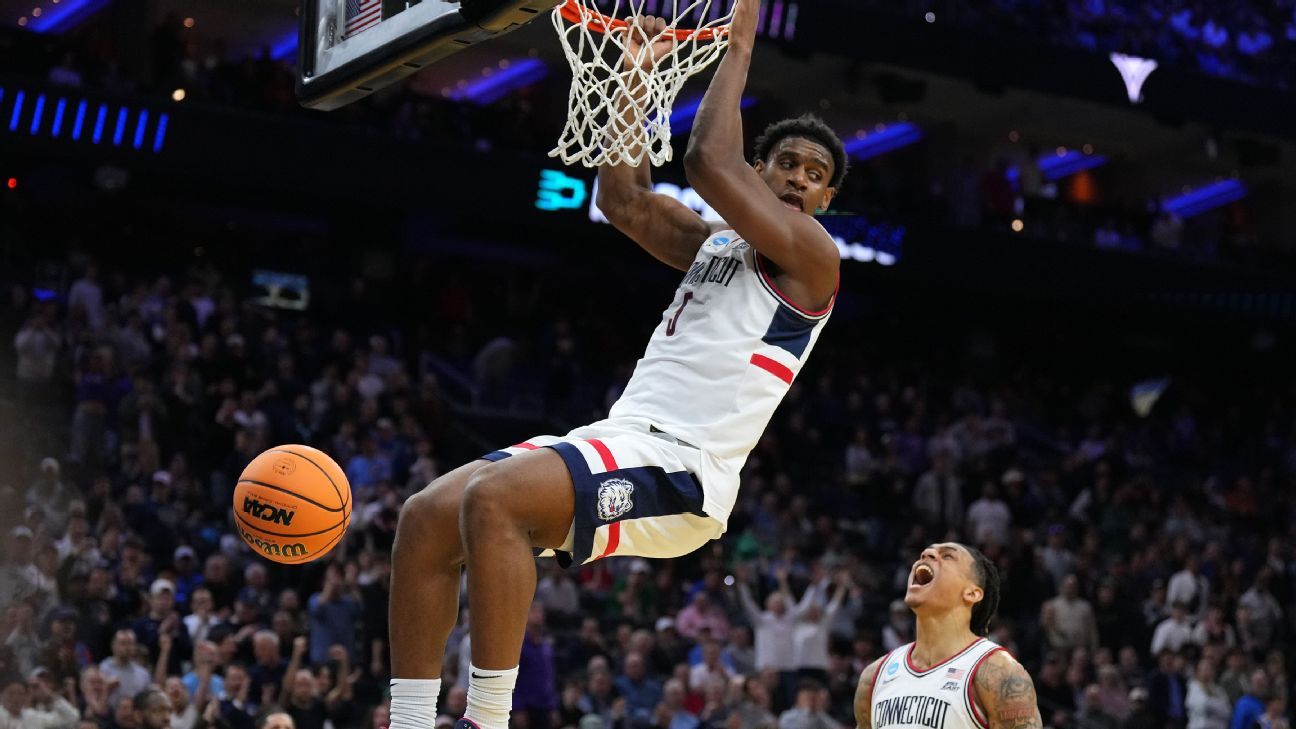
PHILADELPHIA — Tarris Reed Jr. delivered an astonishing statistical performance, unprecedented in the NCAA tournament for over half a century, thereby preventing UConn from suffering this March’s major upset.
Reed amassed 31 points on 12-of-15 accuracy from the field and 27 boards, propelling the number two seed Huskies to an 82-71 triumph over Furman. He became one of only two players in the last six decades, alongside Bill Walton, to achieve 30 points and 20 rebounds while shooting at least 80% in an NCAA tournament game, as per ESPN’s findings. Walton tallied 33 points and 21 boards with an 11-of-13 shooting record for UCLA in the 1972 collegiate championship semifinals against Louisville.
Still, Reed desired greater achievements.
“I believe I eased up slightly during the latter half,” he stated.
UConn (30-5) required every bit of contribution Reed provided, supplemented by Alex Karaban’s 22 points, to progress to a Sunday matchup against UCLA in the East Region’s second stage.
“He was the difference-maker, this player,” UConn coach Dan Hurley remarked, gesturing towards Reed. “That constitutes arguably the most commanding display by a big man in the annals of tournament play. Such is his potential. This individual is an absolute beast, and on this day, he performed like a true formidable force.”
For roughly 36 minutes, it certainly appeared as though Hurley and the Huskies were in jeopardy of returning home prematurely.
However, Reed denied them that fate, with the All-Big East center establishing himself as the first individual to record more than 30 points and 25 rebounds in an NCAA tournament match since Elvin Hayes of Houston achieved it twice in 1968, at a time when the participant pool comprised merely 23 squads.
Reed, who secured 11 boards on offense and 16 on defense, recognized from the outset that Furman would struggle to contain him.
“I feel like just watching film, right from the start,” Reed said. “Understanding the scouting report, having faith in my teammates, believing in the coaching personnel, realizing I would genuinely be capable of dominating inside and capitalizing on their interior players and exploiting the key.”
The Huskies were favored by 20½ points to handily defeat an institution many basketball enthusiasts would struggle to locate geographically. The truly significant metric, however, was the ultimate statistical outcome: The Huskies converted only 5 of 25 attempts from beyond the arc, with each rejected shot apparently acting as an invitation for the 15th-seeded Paladins to seize the opportunity and orchestrate a monumental upset.
After Alex Wilkins netted a three-pointer, narrowing UConn’s advantage to 69-64, and the Paladins (22-13) maintained a five-point deficit with 5:49 remaining, it appeared Furman was poised to stir things up on a tournament Friday largely characterized by expected outcomes.
“I thought if we could have secured points at that moment, we really could have rendered the contest much more compelling,” Furman coach Bob Richey said.
However, propelled by Reed, the Huskies mustered sufficient resolve through a late 12-4 surge to overcome the initial stage.
UConn competed without Silas Demary Jr., a first-team All-Big East honoree, who sustained an ankle injury during the Big East Tournament, and Jaylin Stewart was once more inactive due to a knee ailment that has kept him out of play since late February. Hurley expressed optimism that at least one, if not both, would participate on Sunday.
Their absence was felt against a Furman squad which had defeated top-ranked East Tennessee State to clinch the Southern Conference tournament title and earn a NCAA tournament berth.
The Huskies showed vulnerabilities throughout the season, notably a defeat to St. John’s in the Big East tournament championship contest, which jeopardized another extended March Madness campaign for a team accustomed to such performances. The ailments were not beneficial. Nor did the tenacious Furman team led by Richey.
Furman arrived ready to infuse Friday’s schedule of tournament contests with a much-needed element of unpredictability and put UConn on the defensive early.
The basketball fans inside the home of the 76ers erupted with fervor when Furman seized a 19-18 advantage halfway through the initial period.
Furman, a Greenville, South Carolina university named after a Baptist pastor, required more than mere hope to defeat UConn. It depended on three-pointers.
The Paladins converted them, sinking six during the opening half, with none more electrifying than Charles Johnston’s buzzer-beating shot in the first half which cut UConn’s lead to 40-36.
Johnston raised his arms triumphantly and raced to mid-court for an emphatic chest bump with a fellow player as the Paladins hastened off the playing surface into their changing quarters.
“I just sort of received the pass, noticed the shot clock briefly, and seeing single digits in the periphery, I figured, ‘Why not?'” Johnston said. “I believe that marks my inaugural transition three-pointer this campaign. It felt good to celebrate exuberantly one final time. Consequently, that was enjoyable.”
Furman achieved an overall shooting percentage of 48% in the half and received considerable assistance in turning this into a competitive match due to UConn’s abysmal 1-for-14 performance from beyond the arc.
Johnston executed a powerful slam dunk early in the latter period, maintaining Furman’s proximity at 54-47. Following his decisive move to the basket, Tom House, who tallied 21 points, sank a three-pointer, reducing the deficit to 56-50.
Furman was acquainted with orchestrating March upsets. The Paladins had only participated in two NCAA tournaments since 1980 but had defeated fourth-ranked Virginia in 2023 with a last-second shot.
They simply failed to secure another victory in March when facing one of basketball’s premier teams.
The Associated Press provided material for this article.