
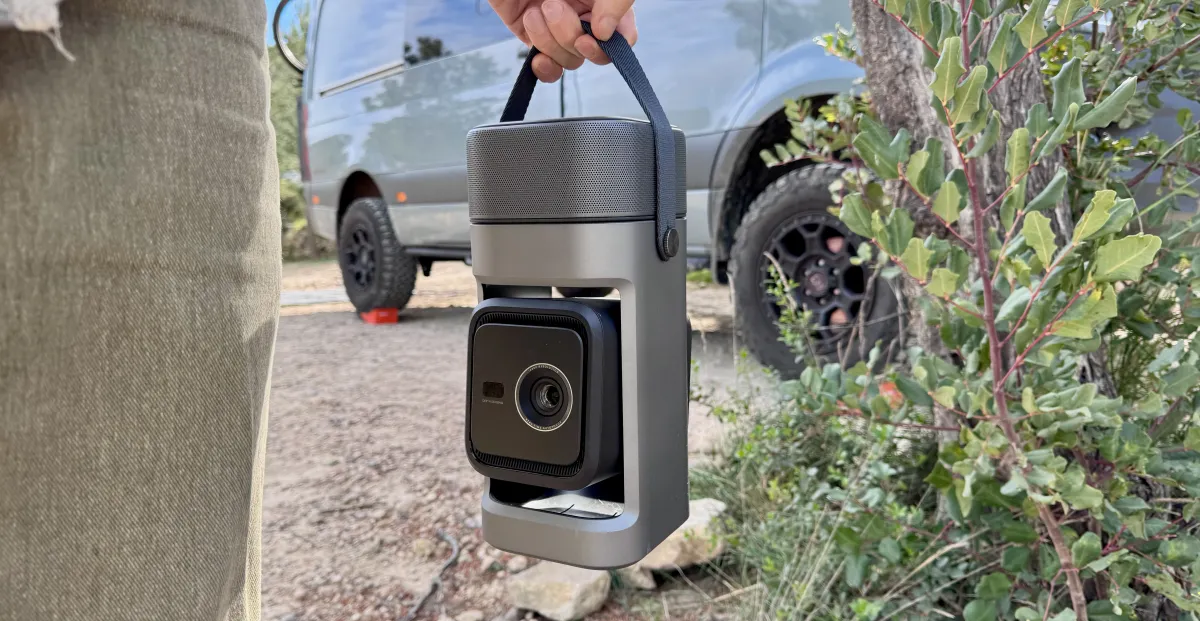
Anker’s Soundcore Nebula P1 is neither the most compact Google TV projector I’ve assessed, nor is it the most luminous. It also lacks an integrated power source. Rather, it stands as a competent video gadget that prioritizes audio quality.
A distinguishing characteristic of the Nebula P1 is its dual speakers, which can disengage to establish genuine left and right channel distinctiveness. This yields a far richer soundscape compared to conventional all-in-one units, such as the exceptionally mobile TCL PlayCube, Xgimi MoGo, or Anker’s well-known Capsule projectors.
While journeying through Europe’s rural expanses in my van, I’ve been evaluating the Nebula P1, priced at $799 (currently offered at $639). Although it isn’t my most preferred mobile projector, I’ve developed a significant appreciation for the P1 – akin to photographic devices, often the most suitable projector is the one at your disposal.

$639
The Advantages
- Separable speakers yield excellent audio for a mobile device
- Functions as a satisfactory Bluetooth speaker
- Adjustable stand facilitates simpler positioning
- Integrated Google TV with validated Netflix compatibility
The Disadvantages
- Lacks an integrated power source
- Ineffective display recognition and hindrance evasion
- The tilting apparatus significantly increases its volume
Anker has been highly productive with groundbreaking mobile projectors that prioritize outstanding audio, starting with the $3,000 Nebula X1 and subsequently the immensely bulky X1 Pro. The Nebula P1, however, scales back this superfluity, reducing its weight from 72 pounds to 5.3 pounds. This fashions a genuinely mobile (and considerably more affordable yet less powerful) projector, appropriate for mobile living or spontaneous film evenings wherever a surface (wall, sheet, or screen) is available, along with an electrical socket or a substantial USB-C power bank.
Within dimly lit environments, the P1 delivers a pleasing 1080p image, which remains the norm for mobile projectors in this category. Its LED light source, specified at 650 ANSI Lumens, proves insufficient to overcome rooms abundant with surrounding illumination. Nevertheless, it appears satisfactory inside my van during daylight hours when precisely projected onto a proximate area. Yet, it is the audio quality that truly allows the P1 to excel.

The separable 10W speakers collaboratively generate an expansive and agreeable auditory environment. Over my weeks of evaluation, I’ve developed a distinct liking for this compact speaker duo. An added benefit is their magnetic adherence to my van on either flank of my projection screen, enabling a tidy outdoor cinema arrangement. Positioning the speakers near the display significantly assists in fostering a more engrossing experience, as, typically, one is situated adjacent to the speakers embedded within mobile projectors, causing the audio to emanate from the side or near one’s legs rather than the visual content’s source.
On the whole, the audio quality is satisfactory, aligning with expectations for speakers of beverage container dimensions. I also appreciate the ability to deactivate the projector’s LED lamp and employ the P1 as a Bluetooth speaker. Its volume is sufficiently audible to readily envelop an RV or a living room.
Madeleine Peyroux’s interpretation ofLa Vie En Roseoffered superb fidelity, with distinct string articulations from the violin emanating from the left speaker, a plucked guitar from the right, and her sweet vocals, enveloped by a squeezebox, emerging from the center. Conversely, low-frequency rich tracks such as Kendrick Lamar’sNot like Uslacked depth. This is because, unlike Anker’s considerably bigger Nebula X1 and X1 Pro projectors, the Nebula P1 does not feature an integrated subwoofer within its base.


The Nebula P1 operates with exceptional quietness as a projection unit, registering merely 26dB from a distance of one meter — a sound almost imperceptible above the clamor of my slumbering canine. However, all evaluations were conducted on temperate days, preventing the cooling mechanisms from needing to accelerate. Its speakers possess an IP54 resilience against particulate matter and water spattering from every angle, while the projector’s somewhat restricted IP33 rating should shield it from minor precipitation.
Anker states that the P1’s speakers are designed to endure for 20 hours prior to requiring replenishment, which appears correct according to my evaluations thus far. They affix magnetically, then physically attach to the display unit’s upper part, where they will charge when the Nebula P1 is connected to a power outlet or a battery supplying 100W over USB-C. Furthermore, the speakers can be replenished via direct USB-C connection even during operation, a practical feature when a depleted power alert indicates low power mid-film.
From a complete shutdown, the Nebula P1 initiates Google TV in approximately 50 seconds, or around 5 seconds from standby mode, where it utilizes an almost unvarying 6W. During one hour of Netflix content streaming at peak luminosity, the projector depleted 51Wh of its power reserve. Consequently, a standard 99Wh portable charger will not endure sufficiently to watch a movie lasting two and a half hours, such asPulp Fiction, without necessitating a pause for power replenishment.
It is foolish, unwieldy, and I thoroughly dislike it.
Anker asserts that the Nebula P1 incorporates Intelligent Environment Adaptation (IEA) 4.0, implying features like self-adjusting focus, trapezoidal distortion adjustment, hindrance evasion, and display area alignment. My evaluations, however, revealed a dreadful performance at identifying impediments and my projection surface; this is likely exacerbated by my screen being devoid of dark margins. To “mechanize” detection, I had to turn to Anker’s awkward “VisionFit” technology. You open the Nebula Connect app and capture an image of the area where you wish to display the visual, and the P1 will then utilize that data to bypass obstructions and locate the screen. It is foolish, unwieldy, and I thoroughly dislike it.
Luckily, the automatic focusing mechanism and smart trapezoidal adjustment functioned effectively, complete with manual adjustments allowing you to forcibly adjust the picture to its position when required. The projector’s rotating base also provides greater positioning flexibility, eliminating the need to employ a pile of tomes. Additionally, configurations can be stored as predefined options if you frequently operate the projector from the identical spot.
1/13
Typically, I am disinclined toward mobile projection devices that are missing an integrated power source, as they necessitate connecting a cumbersome cord to a power outlet or transporting an additional power pack. Such is demonstrably true with the Nebula P1.
While I had a pleasant experience with it, I would opt for TCL’s $799.99 (currently discounted to $649.99) PlayCube when genuine mobility is the paramount concern. The PlayCube has an identical price, is somewhat more luminous, also pivots, and operates the identical Google TV OS, yet successfully accommodates a three-hour battery within a considerably more compact projection unit. Regarding audio quality, it simply cannot rival the Nebula P1.
- Projection Method:DLP 0.23” DMD
- Image Resolution:1920 × 1080
- Illumination Source:LED
- Luminosity:650 ANSI Lumens
- Color Coverage:124% Rec. 709
- Inherent Contrast Ratio:400:1
- Light Emitter Longevity:25,000 Hours
- Screen Proportions:16:9
- Projection Distance Ratio:1.2:1
- Vertical Displacement:100%
- 3D Media Support:No
- Focal Regulation:Auto / Manual
- Display Configuration:Front / Rear / Front Ceiling / Rear Ceiling
- Image Distortion Adjustment:Auto (Vertical ±40°), Auto (Horizontal ±30°)
- Connection Ports:HDMI 2.1 (eARC), AUX-OUT, USB-A, USB-C
- Operating System:Google TV (With Official Netflix)
- Operational States:Projector Mode / Bluetooth Speaker Mode
- Content Mirroring:Google Cast Integrated
- Processor:Quad Core ARM Cortex-A55
- Graphics Unit:ARM Mali-G52MC1
- Memory / Storage:2 GB / 32 GB
- Audio Outputs:10W ×2 (Dolby Audio Supported)
Visuals captured by Thomas Ricker / The Verge
{content}
Source:{feed_title}