
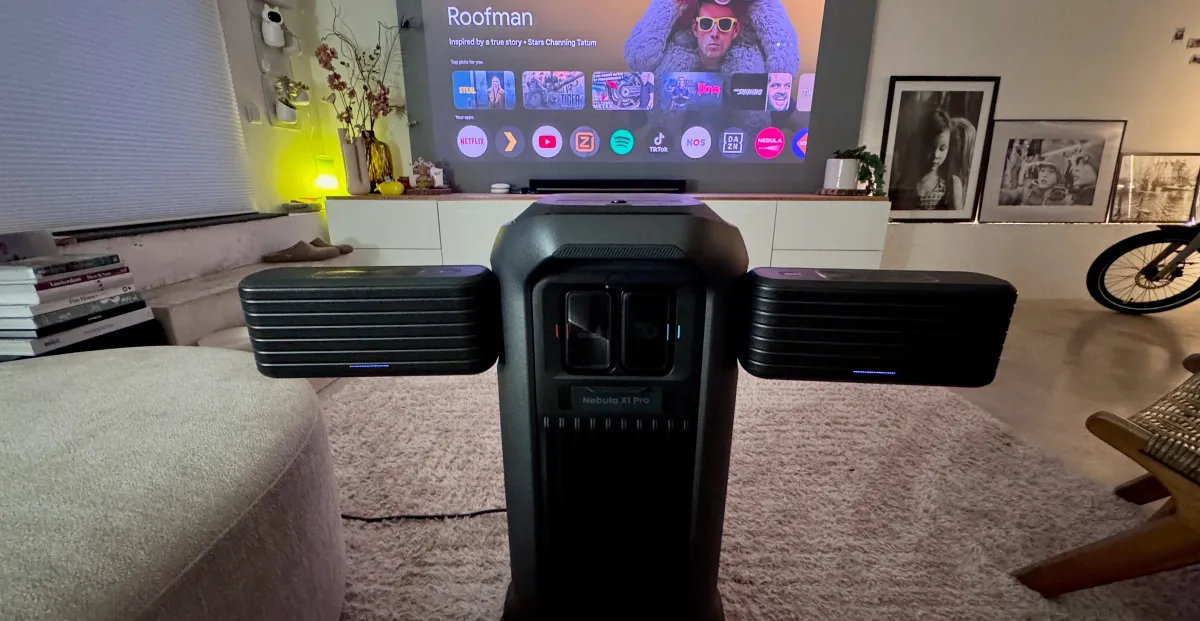
The Soundcore Nebula X1 Pro is excessively peculiar to be real. It combines the superb 4K projector and karaoke microphones from Anker’s Nebula X1, integrating them into a robust five-speaker Google TV mobile entertainment system. Its outlandish nature makes it seem like a fantastical device – and I am quite enthusiastic about it.
Central to this apparatus is the identical liquid-cooled, triple-laser projector, featuring comprehensive auto-image correction, which I examined the previous summer. For a 3500 ANSI lumen projector, it operates with astonishing quietness, asserting its position as the market’s most luminous and vibrant all-in-one portable projector. Presently, it also boasts the highest volume, thanks to the inclusion of 400W of audio in the updated Nebula X1 Pro.
Contained within the X1 Pro is a substantial, resonant subwoofer, delivering bass powerful enough to vibrate walls. Moreover, it features four battery-operated speakers that either automatically deploy or emerge, creating a total of seven horizontal channels plus an additional four overhead for an enveloping wireless 7.1.4 Dolby Atmos experience.
Apart from its dimensions and occasional connection disruptions, my sole grievance is that the Nebula X1 Pro can sometimes be excessively noisy. This is not a statement I ever anticipated uttering regarding a portable all-in-one projection unit.
Should you possess $4,999 to expend, Anker’s Nebula X1 Pro represents an exceptional choice.

$4999
The Good
- Full mobile cinema system
- Luminous, vibrant display
- Cable-free Dolby Atmos encompassing sound
- Abundant low-frequency sound
- Functions additionally as a Bluetooth audio device
The Bad
- Pricey
- “Transportable”
- Interrupted Wi-Fi links
As the video and karaoke functionalities of this projector mirror those of the Nebula X1, I will not reiterate them in this context. My attention will instead be directed toward the primary reason one might opt for the X1 Pro: its audio performance.
Upon observing the X1 Pro, one might ponder the location of all its loudspeakers. The subwoofer, naturally, resides internally, while the pair of front speakers deploy automatically, resembling wings, with a mechanical whoosh upon button activation. The duo of rear speakers detach from the unit’s posterior with a decisive press.

The X1 Pro functions across three distinct audio configurations: with all loudspeakers integrated for 2.1 sound (the rear units remaining dormant), with the forward speakers extended for 5.1.2 enveloping sound, and with all four dispersed throughout the space for comprehensive 7.1.4 distinction. Concerning the final mode, Anker offers animated instructions to facilitate the setup of its acoustic arrangement.
The quartet of satellite units are entirely cordless, exhibiting an operational lifespan exceeding eight hours in my trials. Recharging occurs through pogo pins when placed back on the projector, or alternatively via USB-C. For peak audio quality, the X1 Pro incorporates a four-microphone array designed to automatically fine-tune sound within the space, enabling users to position the ideal listening zone in their favored viewing location. Anker’s Flexwave spatial audio calibration technology performed admirably in my open-plan living area, though the prime listening zone accommodated only roughly two individuals.
Once separated, the four forward and aft speakers synchronize audio using a proprietary 5.8GHz Wi-Fi signal, rather than Bluetooth, ensuring superior, minimal-latency, lossless sound transmission. The X1 Pro’s speaker components operated without defect during my assessments. They established an automatic connection with the projector upon activation, devoid of the peculiar crackles or interruptions I observed with the X1’s singular speaker pair. Subsequently, the speakers entered a low-power state when the X1 Pro was deactivated, aiding in battery conservation.
Nonetheless, I encountered certain unexplainable Wi-Fi connection problems with Google TV. Approximately five instances within a fortnight of evaluation, it simply declined to reestablish connection with my domestic network, despite my phone and laptop functioning correctly. While a restart consistently resolved the issue, its occurrence was quite vexing when it interfered with a movie.


The low-frequency sound generated by the X1 Pro’s 160W subwoofer proves notably impressive for a transportable projector unit. Indeed, it occasionally proves to be quite dominant. Every front surround unit accommodates four 20W loudspeakers, each assigned to the upward, center, front, and surround channels. Conversely, the more compact rear units each feature two 20W speakers serving the upward and rear surround channels. Both the front and rear satellite units are equipped with collapsible stands and a tripod attachment point, aiding in their optimal setup.
When operating in 7.1.4 cinema mode, with all four loudspeakers disconnected and strategically situated in the room’s four extremities, and notably, Flexwaved, the audio quality favorably matched my personal 5.1 Sonos arrangement, which features a soundbar, subwoofer, and a pair of back satellite speakers.
I particularly appreciated perceiving helicopters above when experiencing the Dolby Atmos rendition ofTop Gun: Maverick. All content I presented to the X1 Pro delivered superb visuals and audio, appearing spatially precise, notably with films likeThe Dark Knight,All Quiet on the Western Front, andBlade Runner 2049. Dialogue clearly pierced through the audio environment via the front center channel, bullets streaked above, and oppressive automatons lurked within the shadowy areas surrounding me. Even at just 30 percent volume, my walls began to vibrate, indicating the X1 Pro’s suitability for alfresco cinematic evenings when spring arrives.


I enjoy audio playback with greater regularity than I view visual content, which is why I appreciate the X1 Pro’s ability to be promptly converted into a virtually quiet Bluetooth speaker, devoid of the persistent fan hum typical of most projection units. When all ancillary loudspeakers are connected for 2.1 audio mode, the X1 Pro can contend against large-scale JBL entertainment loudspeakers, merely without the redundant light display.

Experiencing Miles Davis on the X1 Pro delivered outstanding audio, with vibrant, clear brass instruments shimmering against the underlying bass. I found it necessary to lower the low frequencies in Spotify’s equalizer to fully appreciate compositions such as Ye’s “Black Skinhead” or even “Nutshell” by Alice in Chains. Bob Dylan’s vocal delivery in “Masters of War,” however, seemed less resonant when contrasted with my Sonos setup. The X1 Pro could effortlessly be amplified to a significant 50 percent volume, allowing continued enjoyment of the sound, but audio clarity diminished once the volume surpassed 70 percent.
Overall, the sound produced by the Nebula X1 Pro represents a considerable upgrade compared to the Nebula X1. Nevertheless, labeling the X1 Pro as genuinely “portable” is somewhat of an exaggeration.
Its extendable handle and integrated casters do facilitate the movement of the 435 × 343 × 761mm (17.13 × 13.50 × 29.96 inches) X1 Pro, within sensible limits, as you’ll likely still need assistance to lift the 32.8kg (72.31-pound) entertainment unit up flights of stairs or into an automobile.
Furthermore, I would hesitate to maneuver those fragile optical and electronic components across uneven ground. The product disclaimer, in fact, advises using it on firm surfaces like pavement and timber, and explicitly states to “avoid dragging the projector across grass, large gravel, cobblestone, or through water deeper than 50mm.” Considering a $400 motorized trolley to convey your $4,999 projector is not an unreasonable suggestion.
There’s also a caveat concerning the device’s IP43 rating for water and dust resistance. This protection is valid solely when the lens cover is shut and its speakers are withdrawn and stowed, circumstances that are improbable should the X1 Pro inadvertently remain outdoors following an evening viewing session. However, the projector is supplied with a protective sleeve for users who exercise greater care.
1/17
Frankly, as a technology enthusiast, I’m extremely keen on the Nebula X1 Pro. It’s unique in the current marketplace, and I commend Anker’s boldness in developing it. Personally speaking, if you require a movable 4K projector, then the Nebula X1 with its optional speaker kit is sufficiently audible even in open-air environments, and it will spare you approximately $1,000. Yet, if you absolutely require robust bass, then the Soundcore Nebula X1 Pro will certainly satisfy.
Images captured by Thomas Ricker / The Verge
{content}
Source:{feed_title}