
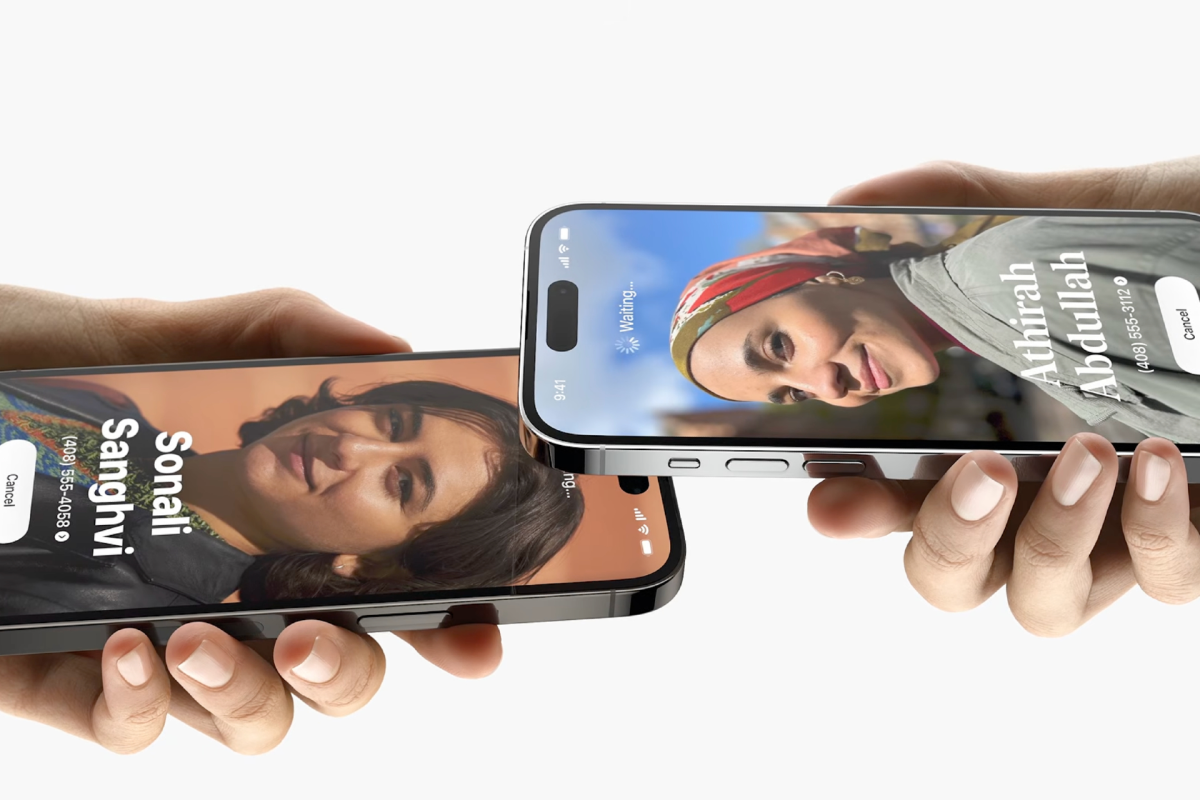
In a legal showdown echoing the classic “David vs. Goliath” narrative, a U.S.-based startup is suing tech titan Apple in India, alleging that its popular NameDrop feature infringes on patented technology. The dispute, which has already sparked a multi-front legal battle, could have significant implications for Apple’s burgeoning presence in the crucial Indian market.
Key Takeaways:
- Patent Infringement Allegations:GG Technologies claims Apple’s NameDrop feature, which allows iPhones to exchange contact info by proximity, infringes on its Indian patent for similar technology used in its StayTouch app.
- Multi-Front Legal Battle:GG Technologies has filed lawsuits in both India (seeking $161.86 million in damages and an injunction against NameDrop-enabled devices) and the U.S. (triggering an International Trade Commission investigation into potential import bans).
- High Stakes in India:The lawsuit targets Apple in a market increasingly vital for its growth and manufacturing diversification, raising the specter of a potential injunction that could disrupt sales and imports of iPhones and Apple Watches.
Cupertino-based Apple finds itself ensnared in a fresh intellectual property dispute, this time originating from a U.S.-based startup, GG Technologies. The contention revolves around Apple’s NameDrop feature, introduced with iOS 17, which enables seamless contact information exchange between iPhones by simply bringing them close together. GG Technologies alleges this functionality directly infringes upon its patented technology, which powers its own app, StayTouch. The startup is demanding a hefty ₹15 billion (approximately $161.86 million) in damages and, crucially, an injunction that could restrict Apple’s operations in India.
The legal offensive began in earnest with a lawsuit filed in the Bombay High Court in October, following the breakdown of pre-institution mediation efforts initiated in April. This Indian lawsuit is not an isolated incident; GG Technologies concurrently pursued similar patent infringement claims against Apple in the U.S. in April, leading to an investigation by the International Trade Commission (ITC). The convergence of these legal battles across two pivotal markets underscores the gravity of the allegations and the significant stakes involved for both parties.
The Technology at the Heart of the Dispute: NameDrop vs. StayTouch
At the core of this legal entanglement are two distinct, yet functionally similar, technologies. Apple’s NameDrop, a standout feature of iOS 17 and watchOS 10.1, offers a highly intuitive way to share contact details. Users simply hold their iPhone or Apple Watch near another compatible Apple device, and a vibrant animation initiates the exchange, removing the need for manual data input or complex pairing processes. This feature debuted for iPhones in late 2023, with Apple Watch support arriving shortly after.
Conversely, GG Technologies’ StayTouch app, launched in 2019, predates NameDrop and offers a parallel solution for exchanging contact information. The app, available on both iOS and Android, allows users to share details by bringing their phones into close proximity, functioning as a modern alternative to traditional business cards. GG Technologies asserts that its technology, which facilitates this proximity-based exchange without manual pairing, is protected by an Indian patent granted in July 2024. The startup first sought patent protection for this innovation in the U.S. in 2019, filing its Indian application in 2021. The timing of these filings and grants, juxtaposed with NameDrop’s June 2023 introduction, forms the bedrock of GG Technologies’ infringement claims.
A Multi-Front Legal Offensive: India and the U.S.
GG Technologies’ strategy against Apple is distinctly multi-pronged. In India, the lawsuit in the Bombay High Court is not merely about financial restitution; it seeks an injunction to “restrict the usage of the NameDrop feature which is native to iOS.” More aggressively, the startup has urged the court to prohibit Apple from selling or importing iPhones and Apple Watches preloaded with NameDrop into India. While the case awaits its first hearing, the potential ramifications of such an injunction are profound, capable of disrupting Apple’s supply chain and sales in a market it considers increasingly strategic.
Simultaneously, the U.S. front presents another formidable challenge for Apple. Following GG Technologies’ complaint, the International Trade Commission (ITC) initiated an investigation in August. The ITC, known for its rigorous enforcement of intellectual property rights, has the power to issue exclusion orders that could block the import of infringing Apple devices into the U.S., alongside restrictions on their domestic sale. This dual legal pressure highlights GG Technologies’ determination and the serious implications for Apple’s global product distribution and sales.
The David vs. Goliath Narrative: GG Technologies’ Stand
Behind GG Technologies stands Gaurav Goel, an alumnus of the prestigious Indian Institute of Technology (IIT) Delhi and a former Goldman Sachs investment banker. Goel founded GG Technologies in 2018 with the vision of modernizing contact exchange through StayTouch. This background lends significant credibility to the startup’s claim, positioning it as a tenacious innovator challenging a global tech behemoth. Taking on a company of Apple’s stature, with its vast legal resources and market dominance, is an arduous undertaking. While Apple has, in this instance, not responded to requests for comment, it is widely known for its robust legal defense in intellectual property disputes, often engaging in prolonged and costly battles.
India’s Pivotal Role: High Stakes in a Critical Market
The choice of India as a primary battleground for this patent dispute is particularly significant, underscoring the nation’s soaring importance in Apple’s global strategy. India is not just a fast-growing consumer market; it has rapidly transformed into a major manufacturing hub for Apple, serving as a crucial diversification point away from China. The Cupertino giant has aggressively expanded its retail footprint in the South Asian nation, recognizing the immense untapped potential. Despite its growing presence, iPhones still account for less than 10% of smartphone shipments in India, indicating substantial room for market penetration and growth.
An injunction in India, however, could jeopardize this strategic expansion. Restricting the sale or import of NameDrop-enabled iPhones and Apple Watches would not only hit Apple’s sales figures but also undermine its branding and market penetration efforts in a country where it is investing heavily. The case thus transcends a mere patent dispute, touching upon Apple’s broader geopolitical and economic ambitions, making the outcome keenly watched by industry observers and competitors alike.
Broader Implications and The Road Ahead
This lawsuit serves as a potent reminder of the complexities inherent in intellectual property in the fast-evolving tech landscape. For smaller innovators like GG Technologies, robust patent protection is often their most valuable asset, enabling them to challenge larger entities. For giants like Apple, such disputes are part and parcel of operating at the cutting edge, frequently requiring substantial legal battles to defend their innovations or address infringement claims.
The resolution of this multi-jurisdictional case could range from a confidential settlement to a protracted legal fight spanning years. A ruling in favor of GG Technologies, particularly an injunction, would set a significant precedent, potentially empowering other patent holders to pursue similar actions against tech behemoths. Conversely, a victory for Apple would reaffirm its formidable legal standing and potentially deter future challengers. The tech world will be watching closely as these proceedings unfold, understanding that the implications could ripple far beyond NameDrop and StayTouch.
The Bottom Line:
Apple’s NameDrop feature is now at the center of a high-stakes patent infringement battle with GG Technologies across two critical legal fronts: India and the U.S. The startup’s pursuit of a sales and import injunction in India particularly threatens Apple’s strategic growth and manufacturing diversification efforts in a market pivotal to its future. As GG Technologies, an emerging innovator, challenges a tech titan, the case underscores the enduring importance of intellectual property in the tech industry and could set significant precedents for how future disputes are resolved globally.
When you purchase through links in our articles, we may earn a small commission. This doesn’t affect our editorial independence.
{content}
Source:{feed_title}