
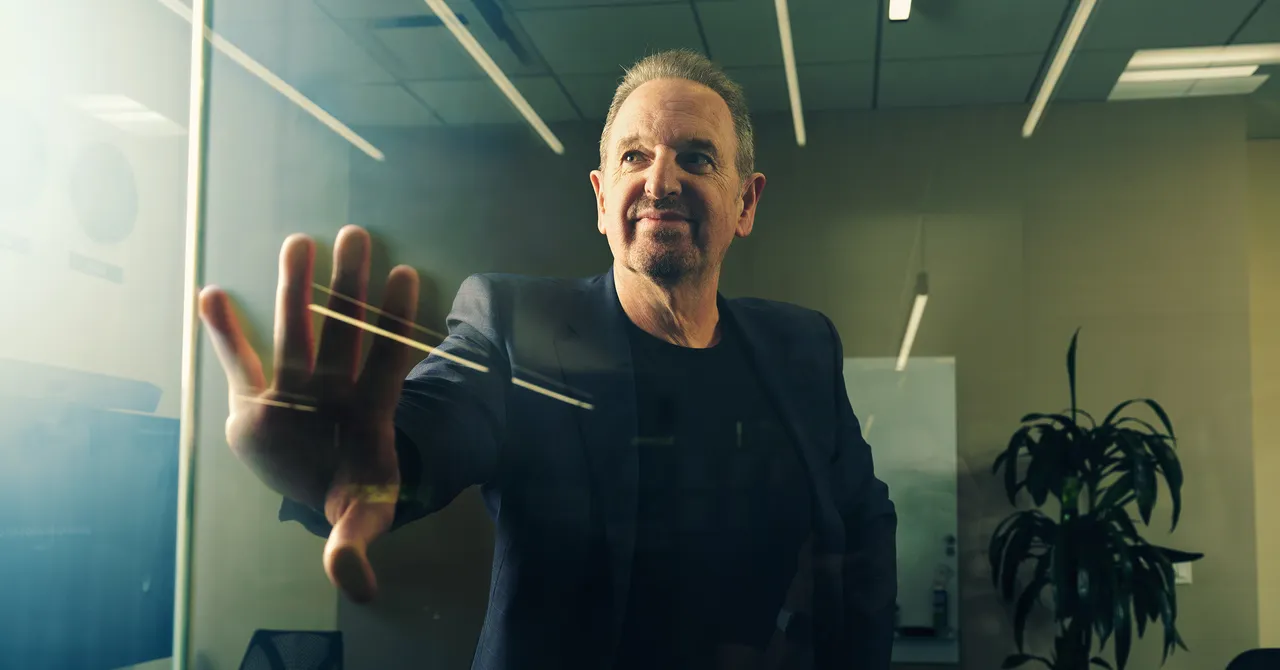
Rene Haas finds himselfsemi-reclined on a sofa within his workspace in San Jose, California. A basketball reposes in his grip, partially concealing his visage. Haas had winced when WIRED’s photographer initially requested he adopt this posture. The potential headlines instantly sprang to mind: “Individuals will claim ‘Arm’s CEO is napping on duty,’” he noted.
Nevertheless, Haas complies. He grants us 46 minutes of his schedule, subsequently ushering us out so he can join a conference with Masayoshi Son, the Softbank CEO and chairman of Arm’s board.
I’m convening with Haas merely days prior to the chip company’s significant disclosure that it plans to introduce its own silicon. For an entity that has amassed its wealth by licensing its blueprints to other semiconductor businesses and never manufacturing its own, this initiative represents a colossal gamble. Apple, Tesla, Nvidia, Microsoft, Amazon, Samsung, and Qualcomm either produce or distribute chips founded on Arm technology, through either licensing the chip schematics or remitting royalties to the organization. It’s been calculated that roughly three Arm chips exist for every individual globally.
Viewed from an alternative perspective, however, fabricating a chip signifies a reversion to Arm’s origins. The enterprise’s history extends to the late 1970s, a period when two computer architects established Acorn Computers, a firm that manufactured a microprocessor constructed upon an architecture termed RISC. By the early ’90s, the company found itself struggling, prompting the then-chief executive to shift towards licensing its layouts to other businesses. Advancing to the mid-2010s, Arm’s energy-efficient mobile chip schematics contributed to its status as the preeminent chip IP corporation globally.
Arm’s development path hasn’t always been seamless. Following Softbank’s acquisition of Arm in 2016 and its privatization of the publicly traded enterprise, the expansion of the smartphone sector decelerated. Arm was compelled to initiate a robust foray into novel commercial ventures. In 2020, Nvidia attempted to absorb it, but regulatory bodies obstructed the transaction. When that agreement disintegrated in 2022, Haas assumed the position of CEO. He subsequently reintroduced Arm to the public market, with Softbank retaining ownership of 90 percent of the corporation.
Haas had become part of Arm in 2013, transitioning from Nvidia, where he had headed the computing product business division, and ultimately assumed control of Arm’s most profitable asset, the IP products segment. Analogous to how Nvidia CEO Jensen Huang relies on his extensive, decades-spanning industry viewpoint—come close, young ones, as I recount the nascent period of parallel computing—Haas readily cites 1980s geopolitical turmoil when questioned about whether contemporary occurrences cause him apprehension regarding his enterprise. (No.) He has conversed with President Donald Trump on half a dozen occasions, he informs me, yet he is not especially apprehensive about the US government interposing in his UK company’s operations. He possesses a considerable stature, though not notably intimidating, and frequently sports Saint Laurent boots with modest heels, a blazer, and a Panerai timepiece.
Semiconductor sector experts assert that Haas, 63, is an adept networker who fraternizes with the most prominent figures in technology. The Wall Street Journal once designated him a “born diplomat.” However, with this semiconductor endeavor, which has been among the least guarded secrets in the Valley, Arm—and Haas—jeopardize upsetting some of the firm’s most devoted collaborators. Is it possible to maintain close friendships with individuals if, following years of cordial social gatherings, you declare your intention to acquire their dwelling? Haas appears certain of his ability to do so.
This discussion has been abridged and slightly revised for enhanced comprehension.
Lauren Goode: Since your ascension to CEO, it’s been suggested that a significant cultural transformation has occurred. Do you concur with that appraisal?
Rene Haas:What I have come to realize—something I understood inherently during my time working for Jensen, yet definitely assimilated upon assuming leadership here—is that the chief executive dictates the overall atmosphere for the organization.
My professional development, which ultimately molds one’s leadership persona, was significantly advanced by relocating to Silicon Valley three decades ago, engaging with several fledgling enterprises, and subsequently being employed by Nvidia. The overarching motif among all those entities is that I was serving under founders. Back then, I couldn’t articulate, “Ah, collaborating with founders, that’s the milieu I connect with.” Yet, in retrospect, that’s precisely where I believe my inherent character was forged and where I discovered the setting in which I prosper.
{content}
Source:{feed_title}