
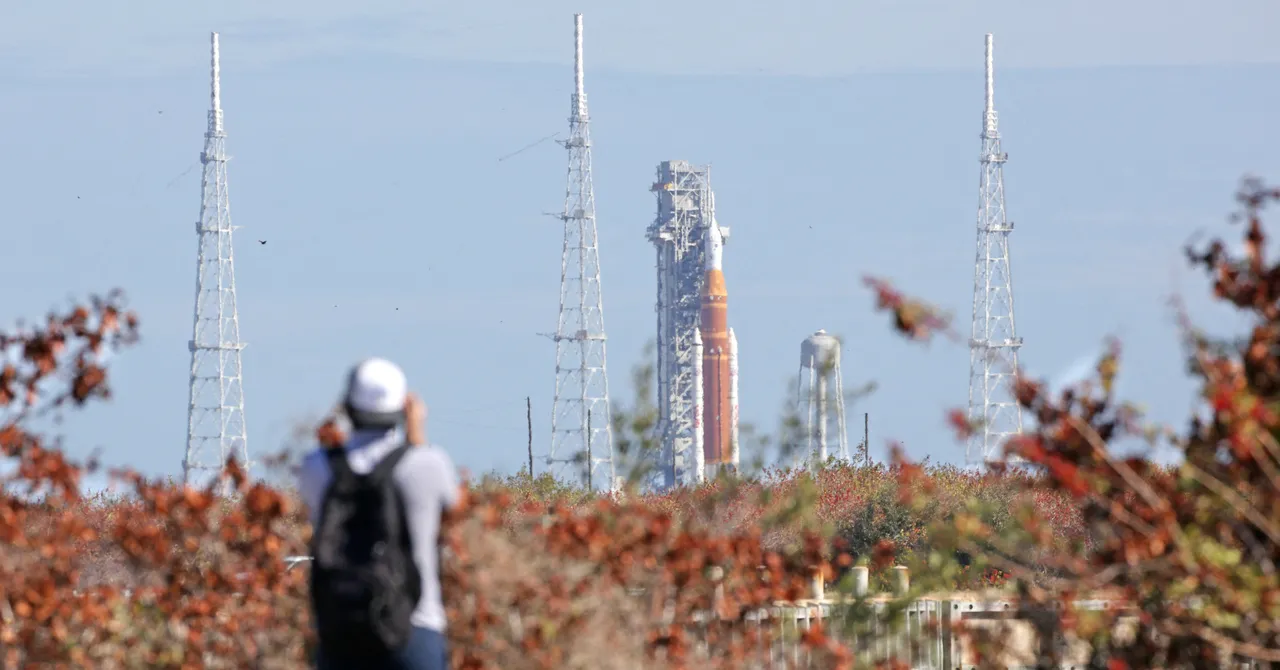
NASA has further delayed the takeoff of Artemis II, its manned mission to orbit the Moon, now establishing a new departure period for April. While March 6 was provisionally scheduled as the start date, the American space organization disclosed that an issue with the launcher has led to additional postponement.
As per NASA head Jared Isaacman, the malfunction was attributable to a disruption in the stream of helium within the interim cryogenic propulsion phase of the Space Launch System (SLS). This helium stream is crucial for cleansing the engines and boosting pressure in the propellant reservoirs. Despite operating flawlessly during the two full-scale practice runs carried out this month, the issue arose during a standard procedure.
Given the character of the issue, NASA engineers must rectify it from within the Vehicle Assembly Building (VAB), thus precluding any possibility of moving forward with the March departure period. The vehicle is currently returning to the assembly facility.
“I comprehend that individuals are dismayed by this occurrence,” the official declared on his X account. “Nonetheless, the team at NASA experiences the greatest dismay, having toiled relentlessly to ready for this momentous undertaking. Even in the 1960s, when NASA accomplished what many deemed unimaginable, a feat never replicated thereafter, numerous hindrances were encountered.”
Can Artemis II commence its expedition in April? NASA announced that swift arrangements have enabled the potential retention of the April departure period, should conditions permit. Everything hinges upon the incoming information, the restoration endeavors, and how the timeline crystallizes in the next few days.
Artemis II: The Obstacles
The project’s initial departure period was set between February 6 and 11. However, during the wet dress rehearsal (WDR), a complete simulation involving propellant, the team uncovered minor hydrogen escapes during propellant loading and some slight operational hitches. After assessing the circumstances, NASA determined that the peril was substantial and could jeopardize the safety of the crew members, thus opting to defer the takeoff.
A second practice run, carried out on February 19, proved to be a success. In an announcement, the space organization clarified that it filled 700,000 gallons of liquid fuel without any escapes. “During the trial, teams diligently observed liquid hydrogen propellant loading procedures, which had presented difficulties during earlier trials. Hydrogen gas concentrations stayed within permissible thresholds, instilling assurance in engineers regarding recently fitted gaskets in a connection point used for directing propellant to the rocket,” NASA stated.
At a later media briefing, project delegates affirmed to reporters that the provisionally set new departure day would be March 6. However, on February 20, the team could not establish helium circulation through the craft, a malfunction that had also transpired during trials of the Artemis I mission. Isaacman indicated that the root could be attributed to a defective filter, valve, or connecting panel.
“Numerous disparities exist between the 1960s and the present, and anticipations are justifiably elevated given the resources and expenditure allocated to this initiative,” Isaacman commented in his online update. “I will reiterate, the President established Artemis as a project destined to greatly exceed what America accomplished during Apollo. We will go back in the upcoming years, construct a lunar outpost, and conduct what ought to be ongoing expeditions to and from the Moon’s vicinity.”
When it ultimately lifts off, the Orion module will journey a greater distance than any other crewed vehicle during its ten-day journey, exceeding on its sixth day the 400,171-kilometer milestone established by Apollo 13. The re-entry will culminate in Orion’s splashdown in the Pacific Ocean near the shoreline of San Diego, California.
Even though there will be no Moon touchdown—that accomplishment is designated for the Artemis III mission—the subsequent takeoff holds paramount significance. Its triumph will illustrate that NASA possesses the technological prowess to revisit the Moon and initiate a fresh era of cosmic discovery.
This narrative was first published in WIRED en Español and has been rendered from Spanish.
{content}
Source:{feed_title}