
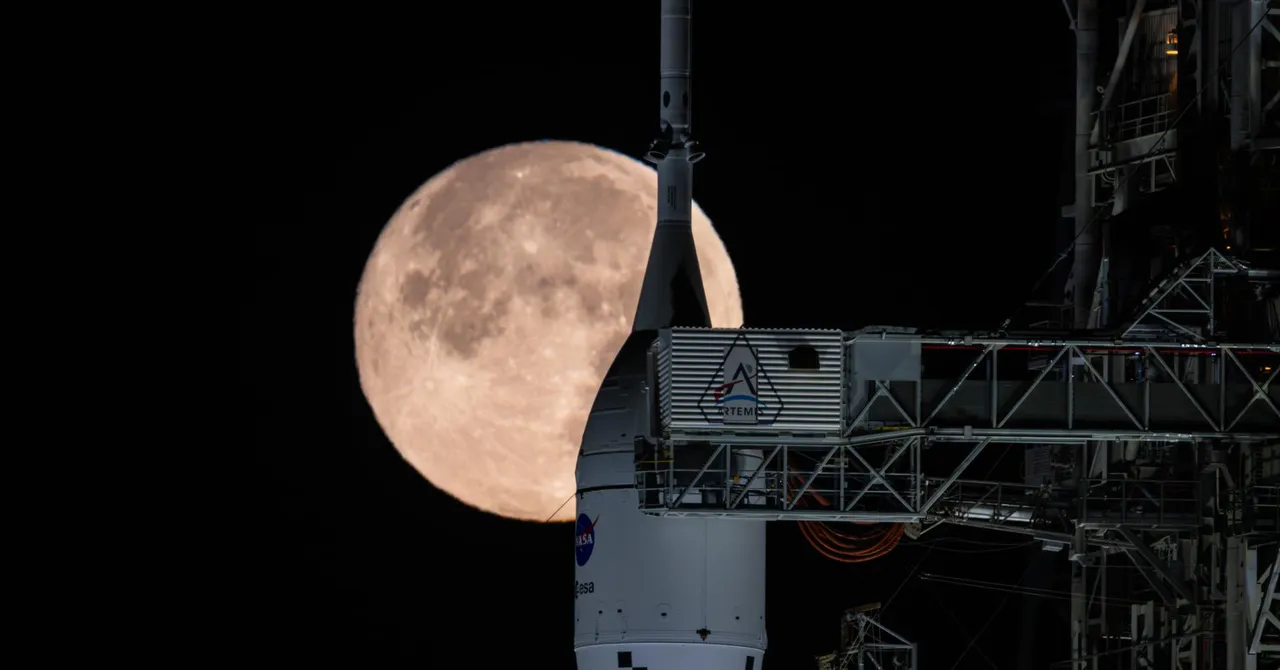
Following numerous postponements,booster overhauls, and a reorganization of the initiative to return to the moon, the Artemis II mission is prepared for launch. If there are no hitches, four astronauts will initiate NASA’s fresh moon endeavor on Wednesday, over five decades since the Apollo era.
The Artemis II crew will not land on the lunar surface; that is not slated until Artemis IV. But their capsule will traverse 6,000 to 9,000 kilometers above the terrain of the far side of our planet’s natural satellite, orbit it, and undertake the journey back home. The primary goal of the mission is to showcase that the space agency possesses the technical prowess to dispatch individuals to the moon securely and without incident.
Upon this accomplishment, NASA will commence groundwork for subsequent moon descents over the subsequent years, which will seek to establish the initial lunar outposts ever and with it, the continuous and enduring human footprint of mankind on the celestial body.
At What Time and Location Will You Be Able to Observe the Artemis II Launch?
The fresh launch opportunity commences Wednesday, April 1 at 6:24 pm EDT and will extend for a two-hour duration. This indicates that once all procedural checks are finalized, the launch of the Artemis II mission might take place at any point between 6:24 pm and 8:24 pm EDT. There is no precise moment, because the voyage is approved contingent upon engineering, meteorological, and orbital congestion factors. If an impediment hinders the launch this Wednesday, NASA has an additional five-day period for another attempt.
Monday, April 6, would be the final day within this launching period. Should this attempt prove unavailing, the launch window would be rescheduled for April 30.
As stated by NASA, the real-time transmission will be accessible on its YouTube channel.The feed will commence at 7:45 am with reporting on propellant loading procedures to fuel the rocket. Concurrently, at 12:50 pm the formal reporting will start and persist until launch. Two hours after the launch, NASA will conduct a media briefing.
Expedition Particulars
The astronauts will launch aboard a NASA SLS rocket and journey within the Orion capsule, characterized as a space vessel roughly the dimensions of a substantial utility vehicle. They will circumnavigate our planet for at least two days to evaluate the internal equipment. Then they will orient the vessel to commence its voyage toward the moon. By the fifth or sixth day of the mission, the capsule is anticipated to penetrate the lunar gravitational domain, where the satellite’s gravity is more potent than that of Earth, and rendezvous with its trajectory.
When the spacecraft transits the far side of the moon, the most perilous stage will commence. The crew will be beyond communication range with Earth for about 50 minutes owing to signal disruption caused by the lunar body. During this critical juncture, the crew must record visuals and information from the moon, utilizing the significantly superior technology they carry compared to what existed during the Apollo period.
After finalizing its turnaround, the capsule will make its way back to Earth, harnessing the gravitational interaction between Earth and moon to conserve propellant. Based on NASA’s projections, by the tenth day of the mission the crew will be nearing their arrival at the celestial body.
{content}
Source:{feed_title}