
Holographic projections are acommon fixture in speculative fiction, appearing throughout the vast realms ofStar Wars,Star Trek,Halo, andThe Expanse. Should a narrative unfold in a futuristic setting or outer space, it often features a hologram. Regrettably, this scenario is less prevalent in actuality, even with numerous technology firms keen on materializing holographic displays.
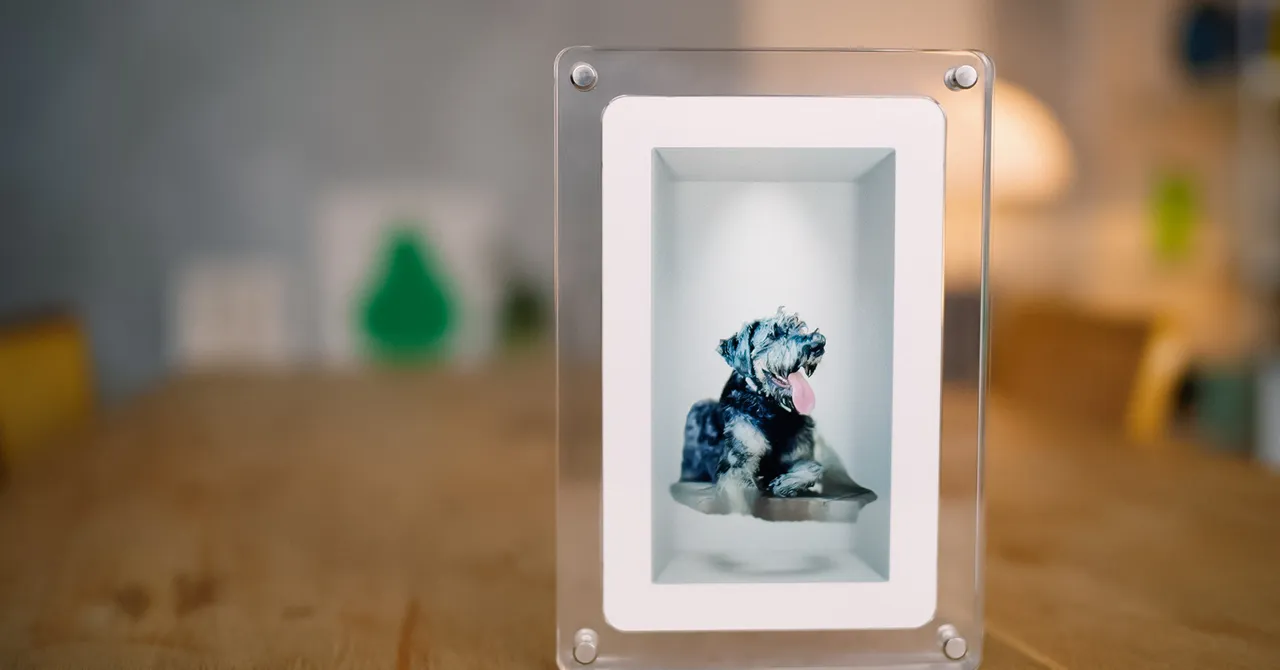
The newest endeavor to introduce a holographic gadget into our existence originates from Looking Glass, a firm headquartered in Brooklyn, which has been experimenting with three-dimensional holographic displays for almost ten years. Presently, it unveiled the Musubi, a digital photo frame geared towards end-users.
Provided by Looking Glass
Submit any image or moving footage, and the Musubi employs artificial intelligence to pinpoint the crucial element and suspend it in three-dimensional form within the enclosure. This might be a recording of a child’s initial strides or a momentary capture of a celebratory gathering. (Alternatively, mirroring an illustration from Looking Glass, a feline revealing its posterior.) The visual will be rendered in a three-dimensional format, perceivable in its complete holographic splendor over almost 170 degrees.
“Our aspiration is to make holographic technology accessible to everyone,” states Shawn Frayne, CEO of Looking Glass. “In essence, it approaches the science fiction ideal as closely as can be achieved.”
The Musubi stands in stark contrast to offerings such as the Ava AI, a near-holographic entity that the gaming firm Razer introduced at CES this year, providing additional insights about it this week at the Game Developers Conference in San Francisco. Razer’s product is an artificial intelligence chatbot persona that levitates within a three-dimensional cylinder, suitable for placement on one’s desk. The corporation markets it as a “Lifelong Companion” capable of interjecting during gaming sessions or assisting with the coordination of daily chores. (Indeed, it is portrayed to resemble an adorable anime maiden, though alternative personalities are available.)
The Musubi functions as a 7-inch frame for images and moving pictures. No Wi-Fi connectivity is necessary, nor is an application, onboard cameras, or a subscription plan for its operation. The genuine processing needed to transform a visual or video into a hologram occurs within a software application on a personal computer or MacBook, provided without charge by Looking Glass. Subsequent to editing the visuals, they can be transferred to the apparatus using a USB-C cord; the Musubi possesses the capacity to retain up to 1,000 pictures. (While videos consume greater storage, they are restricted to segments no longer than 30 seconds.) The Musubi is capable of being connected to a power outlet and features an integrated rechargeable power source that endures for as long as three hours.
{content}
Source:{feed_title}