
Across the country, Americans are debating how their lives might change if new AI data centers are built in their backyards. Data center companies and their customers are promising new jobs and economic growth, but that pitch hasn’t won over a majority of Americans who oppose data center construction in their area, often over environmental and energy concerns.
Key Takeaways
- Growing Local Opposition:Communities nationwide, especially those with a history of industrial pollution, are strongly opposing the construction of new AI data centers due to concerns over environmental impact, energy consumption, and limited local benefits.
- Significant Environmental Cost:The rapid expansion of AI infrastructure is projected to dramatically increase natural gas consumption and greenhouse gas emissions, exacerbating climate change and contributing to air pollution linked to one in five deaths globally.
- Demand for Environmental Justice:Activists, drawing on past experiences with harmful industries, are advocating for moratoriums and greater scrutiny, challenging the narrative of economic progress at the expense of public health and local resources.
The rise of artificial intelligence is revolutionizing industries, but its physical footprint is sparking a contentious debate across America. As tech giants clamor for more powerful data centers to fuel the AI boom, communities are increasingly pushing back against construction, citing profound concerns about environmental degradation, energy strain, and local quality of life. The promise of jobs and economic growth often falls flat against a deeper, more visceral fear, particularly in neighborhoods that have borne the brunt of industrialization for generations.
Philadelphia’s Grays Ferry: A Legacy of Burden
For activist Shawmar Pitts, these concerns aren’t theoretical. He knows better than anyone what it’s like to live in the shadow of American industrialization. A lifelong resident of the Grays Ferry neighborhood in Southwest Philadelphia, Pitts grew up next to what was then the East Coast’s largest oil refinery. This colossal industrial complex, which shut down after a catastrophic explosion in 2019, cast a literal and figurative pall over his community for decades. While many of his friends and family suffered from chronic health conditions, the dots connecting their illnesses to their environment weren’t fully connected for Pitts until 2018.
That year, he encountered the environmental justice group Philly Thrive, which was tabling in his neighborhood about a proposed oil refinery expansion. “I read the information they had on the table about how living near the refinery affects you, and I’m looking at all the sicknesses on this paper, and I’m like, ‘My mother has this, my sister has that, my next-door neighbor suffers from this’ — every house, someone has something on that list,” Pitts told TechCrunch. “From that point, I was all the way in.”
Pitts, now the managing co-director of that same organization, is among those leading the charge for a data center moratorium in Philadelphia. While there have been no formal proposals for construction yet, city officials have identified two potential sites: one in Northeast Philadelphia and the other, disturbingly for Pitts and his neighbors, right back in his Grays Ferry neighborhood. The idea of replacing one industrial burden with another, even a “cleaner” one, is a bitter pill for residents still grappling with the refinery’s toxic legacy.
Voices from the Frontlines: The Human Cost of Industry
This potent opposition to data centers is far from unique to Philadelphia. Residents across the United States have pushed back vehemently against new data center construction, particularly those living in cities and towns already struggling with finite resources like water and power. But the pushback has been particularly swift and passionate from people living in communities where big industry’s mark is still painfully felt, where generations have paid a steep price for “progress.”
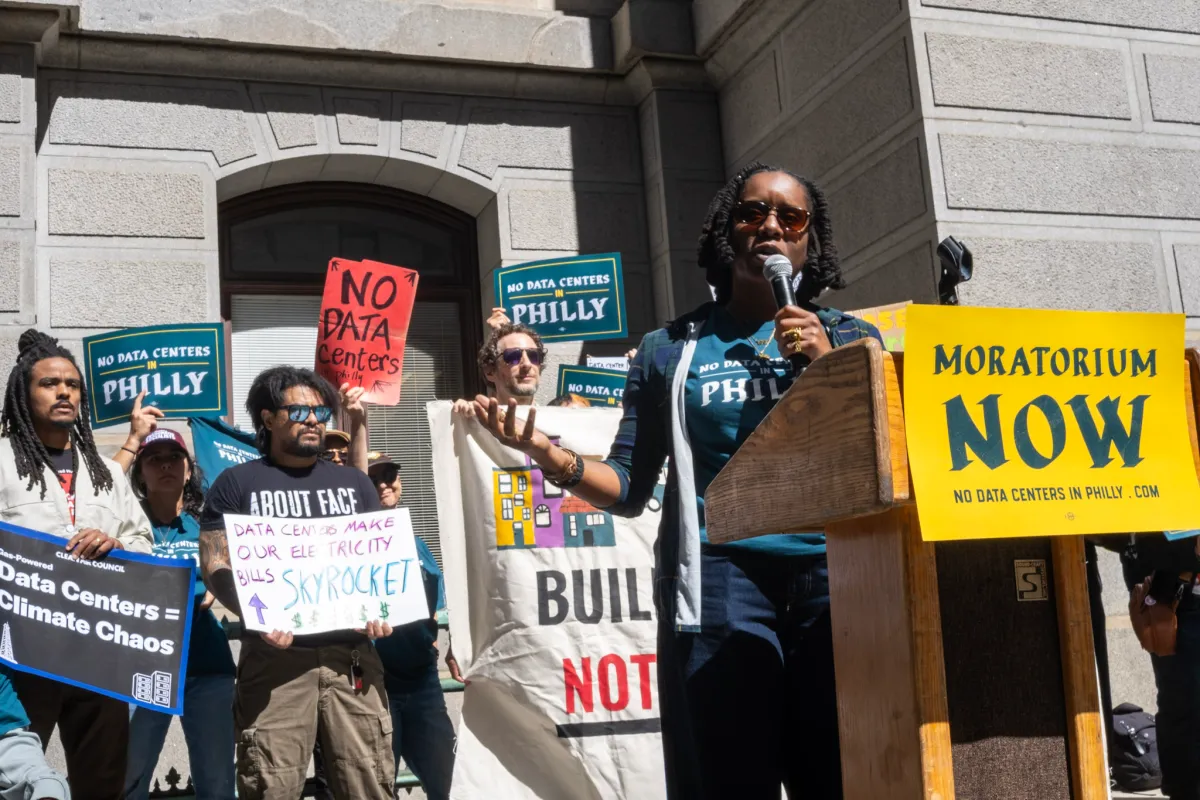
“We don’t want data centers,” Philly Thrive board president Sonya Sanders declared at a rally on Monday at Philadelphia’s City Hall. “We don’t want the pollution, we don’t want the noise, and we know they’re not going to bring us more jobs.” Sanders’ testimony carried the weight of personal tragedy. Her husband, also a resident of Grays Ferry, died of a rare bone cancer in 2020. He didn’t smoke or drink, and she is convinced that emissions from the now-defunct refinery caused his illness.
“In my eyes, they killed him,” she said at the rally, her voice resonating with grief and resolve. “The pollution killed him. I believe he would be here today if he wasn’t silently murdered, because it was the pursuit of profit that killed him.” Her words underscore a deep-seated mistrust that corporations prioritizing profit will inevitably compromise the health and well-being of local populations, a pattern that communities like Grays Ferry know all too well.

The Environmental Footprint of AI: A Global Challenge
While a single Philadelphia data center may not have as severe an immediate environmental impact as the now-defunct Philadelphia Energy Solutions refinery, which processed an astonishing 335,000 barrels of crude oil daily, the cumulative effect of the international race to dominate the AI industry is raising alarming red flags. The sheer scale of energy demand is staggering: BloombergNEF predicts that by 2035, U.S. data centers will consume more natural gas than Germany and Japan combined. This projection has almost doubled in just nine months, highlighting the accelerating pace of AI’s energy appetite.
Natural gas, often touted as a “cleaner” alternative to other fossil fuels like oil, is far from harmless. Burning one cubic foot of natural gas releases the equivalent of 60 grams of carbon dioxide into the atmosphere. The additional data center demand is expected to generate an extra 1 million metric tons of greenhouse gas pollution each day – a colossal figure that represents about 12% of all present-day U.S. greenhouse gas emissions. This isn’t just about abstract climate models; it has direct human consequences. Harvard University researchers found in 2021 that fossil fuel air pollution is responsible for a devastating one in five deaths worldwide, a staggering figure that is bound to increase in the age of AI.
“A typical data center planned in Pennsylvania has hundreds of diesel engines that spew air pollution, and even if they’re supposedly reserved for emergencies, the government has already said that the data center should use those rather than drawing from an overstressed electrical grid during some heat waves,” warned Clean Air Council attorney Annie Fox at the rally. She emphasized the cyclical nature of the problem: “We can expect that to get more frequent… Fossil fuel-hungry data centers will worsen climate change, making those heatwaves more frequent and severe.” The increased reliance on backup diesel generators during peak demand, often driven by heatwaves, further exacerbates air quality issues precisely when vulnerable populations are most at risk.
Bottom Line
The rapid expansion of AI infrastructure is exposing a critical fault line in the pursuit of technological progress, one that runs directly through communities already burdened by industrial pollution. As data centers promise innovation and economic growth, they simultaneously demand immense energy, often sourced from fossil fuels that worsen climate change and degrade local air quality. Communities like Grays Ferry, fortified by a painful history, are no longer willing to accept these trade-offs. Their fierce opposition signals a growing demand for environmental justice and forces a reckoning with the true, often unseen, costs of the AI revolution, urging a more sustainable and equitable path forward for technological development.
Local Resistance Mounts Against Data Center Expansion: A National Trend
As the digital world expands, so does its physical footprint. But communities across the United States are increasingly questioning the hidden costs of our always-on, data-driven lives. From bustling city centers to quiet suburbs, a grassroots movement is emerging, challenging the unchecked proliferation of massive data centers and demanding a more sustainable, community-centric approach to digital infrastructure.
Key Takeaways
- Rising Local Opposition:Communities nationwide are actively protesting the construction of new data centers, citing concerns over environmental impact, resource strain (power, water), noise pollution, and quality of life.
- State and City Moratoriums:Governors and local councils are responding to public pressure by enacting temporary bans or stricter regulations on data center development to allow for comprehensive impact assessments.
- Demanding Sustainable Growth:The burgeoning movement underscores a critical shift towards demanding that digital infrastructure growth be balanced with environmental responsibility, local resource preservation, and community well-being.

Image Credits:Amanda Silberling / TechCrunch
The Growing Local Resistance: Philadelphia Takes a Stand
On a recent Monday, the steps of Philadelphia’s City Hall echoed with chants as more than 100 concerned residents launched the “No Data Centers in Philly” campaign. Their message was clear: the city’s ambition to become a burgeoning tech hub should not come at the expense of its environment, precious resources, or the well-being of its citizens. The rally served as a powerful kick-off, aiming to ensure city council members heard the collective voice of a community wary of what unchecked data center development could bring to their neighborhoods.
Donna Greenberg, a Philadelphia resident who attended the spirited demonstration, articulated the core anxieties shared by many. “I’m worried about pollution,” she told TechCrunch, highlighting the potential for increased carbon emissions and air quality degradation often associated with the immense power demands of these facilities. Data centers, while essential for the digital age, require vast amounts of electricity, frequently sourced from grids still reliant on fossil fuels, contributing to local and global environmental challenges. Her concerns extended beyond the immediate environmental impact: “I’m worried about surveillance and the fact that they’re going to have access to information they have no business knowing.” While data centers are primarily physical infrastructure, their existence undeniably underscores a broader societal unease about data privacy and the vast quantities of personal information they house and process.
Perhaps most acutely, Greenberg pointed to the strain on essential resources: “I’m concerned that they’re going to be using water and electricity that takes away from the people and the neighborhoods who need it.” Data centers are notoriously resource-intensive, consuming staggering amounts of power to run servers and even more water for cooling systems, especially those utilizing evaporative methods. This resource drain can lead to higher utility bills for existing residents, exacerbate water scarcity in certain regions, and place undue stress on already aging infrastructure.
The sentiment on the ground was one of empowered collective action. As one participant, Pitts, remarked, “I just think that our community standing up and fighting back is tremendous. It takes a lot of effort and a lot of people.” This grassroots mobilization in Philadelphia is not an isolated incident but rather a microcosm of a larger national trend, demonstrating a growing public awareness and willingness to challenge industrial development they perceive as detrimental to their quality of life.
A National Trend: Cities and States Pump the Brakes
Indeed, concerned citizens across the country do seem to be getting through to their officials, prompting a wave of legislative action and policy reconsiderations. In a significant move, New York Governor Kathy Hochul signed an executive order that temporarily prevents the state from approving new permits for large projects. This proactive measure reflects a growing recognition at the state level that the rapid expansion of digital infrastructure requires careful consideration and planning, not just unfettered growth. It’s a vital pause, designed to allow for comprehensive assessments and the development of more sustainable guidelines.
Governor Hochul’s statement at a press conference resonated deeply with community advocates: “Progress shouldn’t arrive with a higher utility bill, deleted water supply, or noise pollution.” Her words directly address the very concerns voiced by residents like Donna Greenberg. The “higher utility bill” speaks to the immense energy demands of data centers, which can strain local grids, increase energy prices for all consumers, and necessitate costly infrastructure upgrades. “Deleted water supply” highlights the vast quantities of water required for cooling, especially in evaporative cooling systems, which can deplete local water resources, particularly critical in drought-prone areas, and impact delicate ecosystems. And “noise pollution” acknowledges the constant hum and drone from cooling towers, generators, and other equipment that can significantly degrade the quality of life for those living nearby, disrupting sleep and outdoor activities.
Hochul emphasized a crucial principle for future development: “These data centers can only be built, should only be built in places that want them.” This statement champions local autonomy and the right of communities to have a substantial say in the industrial development occurring within their borders. It represents a significant shift away from a top-down approach that often sidelines local environmental and social concerns in favor of economic incentives.
This sentiment is echoed in a growing number of U.S. cities, where data center moratoriums have also been approved. Denver, Indianapolis, Asheville, Charlotte, and Reno are among the municipalities that have implemented temporary pauses on new data center construction. The primary purpose of these moratoriums is often to allow city officials to collect more information about the potential long-term impacts of building data centers. This includes conducting comprehensive environmental impact assessments, studying the strain on local power grids and water infrastructure, evaluating potential for noise and air pollution, and developing more robust zoning regulations that ensure data centers are sited responsibly and sustainably. It’s a critical period for analysis, enabling policymakers to understand the full scope of economic, environmental, and social trade-offs before committing to irreversible development that could have lasting negative consequences.

The Unseen Costs: Decoding Data Center Footprints
The increasing demand for cloud computing, artificial intelligence, streaming services, and the Internet of Things (IoT) necessitates an ever-growing network of data centers. These facilities are the silent engines of our digital economy, enabling everything from our daily emails to complex scientific research. However, their rapid proliferation often comes with significant, often overlooked, environmental and social costs that are now sparking widespread debate.
One of the most pressing concerns is their gargantuan energy consumption. A single large data center can consume as much electricity as a small city, running thousands of servers, networking equipment, and cooling systems 24/7. This immense power demand often strains local energy grids, which may still be heavily dependent on fossil fuels, thereby contributing to carbon emissions and climate change. Even when data centers commit to renewable energy, the sheer volume of electricity required can strain existing grid capacity and divert clean energy that could otherwise power homes and businesses, raising questions about true net impact.
Equally critical is the issue of water usage. To prevent overheating, servers in data centers require constant and efficient cooling. While some employ closed-loop cooling systems, many utilize evaporative cooling technologies, which can consume millions of gallons of water annually. This process essentially releases water vapor into the atmosphere, meaning the water is permanently removed from the local watershed. In regions already facing water scarcity or prolonged drought conditions, such consumption places an unsustainable burden on local water tables, impacting agriculture, domestic supply, and natural ecosystems. The visual of giant cooling towers emitting plumes of steam might seem benign, but it often represents significant and irreversible water loss.
Beyond resources, data centers also impact land use and local environments. These are not small structures; they are often sprawling complexes that require substantial tracts of land, sometimes displacing agricultural areas, natural habitats, or potential residential development. The sheer physical footprint can alter local hydrology and increase impervious surfaces, contributing to stormwater runoff issues. Furthermore, the constant low hum of cooling equipment, generators, and other machinery can be a source of persistent noise pollution for nearby communities, significantly diminishing their quality of life, disrupting sleep, and reducing enjoyment of outdoor spaces. While often touted for bringing economic benefits, the long-term operational employment figures for data centers are often modest compared to the scale of investment and the generous tax incentives frequently offered to attract them, leading some communities to question the true value proposition.
Towards a Sustainable Digital Future
The current pushback against data center expansion isn’t a rejection of technological progress but rather a demand for *responsible* progress. It highlights the urgent need for the tech industry and policymakers to prioritize sustainability and community well-being in the design and deployment of digital infrastructure. Solutions include accelerating the integration of 100% renewable energy sources directly into data center operations, investing in more advanced and water-efficient cooling technologies (like liquid cooling), and exploring distributed computing models that might reduce the need for hyper-scale facilities in sensitive areas.
Crucially, there’s a growing call for greater transparency and robust community engagement throughout the planning process. Empowering local communities with comprehensive information and a genuine voice in siting decisions, coupled with stringent, independent environmental impact assessments, can help foster trust and lead to outcomes that benefit all stakeholders. The era of building first and asking questions later is clearly drawing to a close, replaced by a demand for foresight, accountability, and genuine partnership in shaping our digital future.
The Bottom Line
The rise of local and state-level moratoriums on data center development signals a pivotal moment for the tech industry. As our reliance on digital services deepens, the physical infrastructure that powers it can no longer be seen as an invisible backdrop or a universally welcomed economic boon. Communities are increasingly aware and vocal about the environmental footprint and resource demands of data centers, from immense power consumption and critical water usage to persistent noise and extensive land appropriation. The collective pushback, from passionate rallies in Philadelphia to decisive executive orders in New York, underscores a clear mandate: future digital growth must be equitable, environmentally sound, and developed in genuine partnership with the communities it impacts. The challenge now is for industry leaders and policymakers to innovate not just in technology, but in sustainable and responsible development practices, ensuring that the progress of the digital age truly benefits everyone without compromising local environments or quality of life.
Source:{feed_title}