
Key Takeaways
- Revolutionizing AI Inference:XCENA is tackling a fundamental bottleneck in AI inference by bringing compute directly to memory, sidestepping the inefficient data relay race between CPUs, GPUs, and DRAM for every AI query.
- Significant Cost Savings & Investor Confidence:With its MX1 chip, XCENA promises to drastically reduce AI infrastructure costs for hyperscalers, a potential that has attracted $135 million in Series B funding, valuing the company at $570 million.
- Innovative Architecture & Future Outlook:Leveraging RISC-V cores and a vertically integrated design, XCENA’s prototype MX1 is slated for mass production by late 2026, aiming to generate revenue by 2027 and fundamentally reshape memory-centric AI architectures.
Every interaction with a sophisticated AI model like ChatGPT ignites a complex, high-stakes data relay race. Information zips from memory, through a CPU for initial processing, then to a GPU for intensive computations, and finally back. This entire, circuitous journey repeats itself for every single word the AI generates, creating a fundamental structural bottleneck within the very heart of modern AI infrastructure.
This ceaseless data shuttling necessitates constant engagement with some of the industry’s most expensive and power-hungry chips, making AI inference inherently inefficient. It’s a challenge that XCENA, a burgeoning startup with dual bases in South Korea and the U.S., is not just observing, but actively seeking to dismantle. For the past four years, XCENA has been meticulously designing a revolutionary chip engineered to position computational capabilities significantly closer to DRAM – the dynamic random-access memory chips that serve as fast, short-term data reservoirs for active processors. This innovative proximity allows a vast array of routine data operations to be handled right at the memory module, eliminating the costly, power-draining round trips that currently define data processing between CPUs, GPUs, and memory.
A $135 Million Bet on Architectural Revolution
Should XCENA’s solution prove scalable, the ripple effects on AI infrastructure costs could be nothing short of transformative. This potential impact largely underpins the widespread investor enthusiasm that has coalesced around the company. Indeed, XCENA recently closed a robust $135 million Series B funding round, pushing its valuation to an impressive $570 million and bringing its total capital raised to $185 million. This substantial investment is a clear signal of confidence in the startup’s vision and its capacity to address a critical pain point in the burgeoning AI landscape.
XCENA’s leadership team is a formidable trio of industry veterans. CEO Jin Kim co-founded the startup in 2022 alongside CTO Dohun Kim and CPO Harry Juhyun Kim. All three bring invaluable experience from memory giants Samsung and SK Hynix, companies that ironically supply the very memory chips powering Nvidia’s dominant GPUs. “CPUs and GPUs have both gotten smarter over the decades. Memory never did. XCENA wants to change that,” Kim stated in an exclusive interview. He emphasized a broader industry shift: “The recent rise in memory prices and related stocks points to a broader shift in AI infrastructure toward memory-centric architectures.” This month, a significant milestone underscored this trend, as Samsung, SK Hynix, and Micron – the three titans of the global memory chip market – each surpassed a trillion-dollar valuation for the first time, signaling memory’s ascendance in the tech ecosystem.
At its core, XCENA’s business strategy is predicated on a powerful thesis: “inference isn’t just a compute problem; it’s increasingly a memory scaling problem,” according to Kim. This perspective challenges conventional wisdom, suggesting that the true bottleneck lies not just in raw processing power, but in how efficiently data is accessed and managed at the memory layer.
The MX1: Bringing Compute to Data
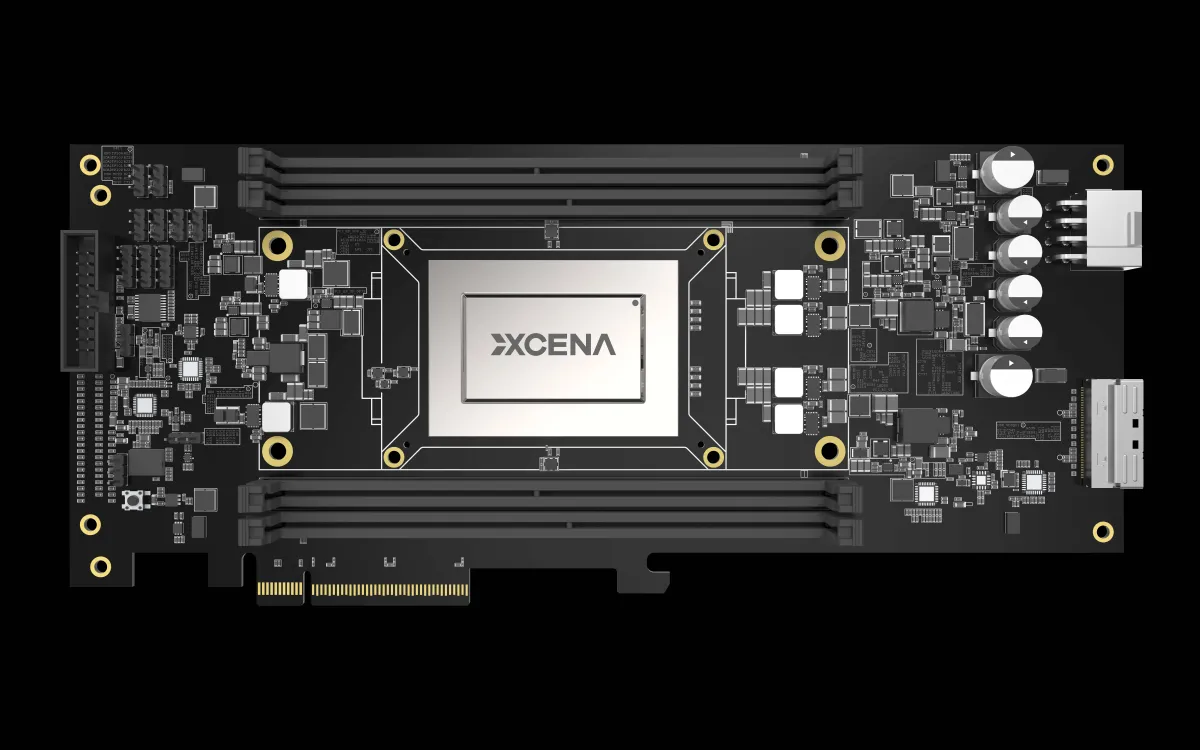
XCENA’s flagship chip, the MX1, represents the tangible manifestation of this thesis. It ingeniously connects to the CPU through CXL (Compute Express Link), a high-speed, low-latency, dedicated interconnect that acts as an express lane between the processor and memory. Crucially, the MX1 processes data *before* it ever needs to leave the memory module. This innovative approach effectively brings compute to the data, rather than the inefficient traditional method of continuously moving data to the compute unit. The company boasts that what previously required a rack of 10 servers could potentially be consolidated onto just one, a claim with monumental implications for data center power consumption and operational costs.
“While GPUs excel at matrix multiplication — the heavy math behind AI model training — much of the surrounding data orchestration, including preprocessing, KV cache management [the system that stores prior conversation context so a model doesn’t have to reprocess it], and data caching, still runs on CPUs,” Kim explained. “Our chip handles those tasks directly within the memory module itself.” By offloading these critical, yet often overlooked, memory-intensive operations from the CPU, the MX1 frees up valuable processing cycles and dramatically reduces latency, leading to faster and more efficient AI inference.
Market Momentum and Future Deployment
The timing for XCENA appears fortuitous. Demand for advanced memory solutions has experienced a significant surge since the latter half of last year, a trend that the company believes is perfectly aligned with its innovative offerings. Early-stage conversations are already underway with several global memory vendors, though Kim prudently declined to disclose their names. XCENA’s ideal customer profile consists of hyperscalers – the tech giants spending tens of billions annually on AI infrastructure. For these players, even a marginal gain in memory efficiency, perhaps a mere percentage point, could translate into savings of hundreds of millions of dollars, making XCENA’s proposition incredibly attractive.
It’s important to note that the MX1 is currently a prototype. However, the path to commercialization is clearly mapped. Mass production chips are scheduled to begin rolling off Samsung’s advanced foundry lines by the end of 2026, with the company projecting its first significant revenues to commence in 2027. This timeline positions XCENA to capitalize on the rapidly expanding AI market, particularly as inference workloads continue to proliferate.
Competitive Edge in a Crowded Field
While many neural processing unit (NPU) makers are locked in a fierce battle to challenge Nvidia’s dominance in AI training workloads, XCENA carves out a distinct niche. It targets the memory-intensive layer that underpins and supports *all* of these operations, whether for training or inference. This strategic focus positions them uniquely in the AI hardware ecosystem.
XCENA’s closest publicly traded rivals include Astera Labs and Marvell, both actively developing next-generation memory connectivity solutions. Marvell, a large and established player, operates in a similar domain, as Kim acknowledges. However, he asserts that XCENA’s key differentiator lies in its superior intellectual property and architectural approach. “We have thousands of cores,” Kim stated, contrasting this with Marvell’s approach which, based on public specifications, relies on a comparatively smaller “handful of general-purpose cores.”
These thousands of cores within the MX1 are built on RISC-V – an open-source instruction set architecture that offers flexibility and efficiency – and are meticulously optimized specifically for data processing. Each core is deliberately designed to be small and highly efficient. Beyond the sheer number of optimized cores, XCENA further distinguishes itself through a high degree of vertical integration. The company designs its own internal memory hierarchy, interconnect bus, and DRAM controller. This level of in-house development is a significant competitive advantage, as most chip companies, even larger rivals, typically outsource these complex design elements, allowing XCENA greater control over performance, power, and cost.
The recent Series B round was co-led by Seoul-based VC firms Altinum and IMM Investment, with additional participation from Corstone Asia and existing investors SBI Investment and Mirae Asset Capital. The company, which boasts a team of over 90 staff across its offices in Pangyo (a prominent tech hub outside Seoul) and Sunnyvale, California, is also in active discussions with international investors, exploring opportunities for further funding to fuel its ambitious growth trajectory.
The Bottom Line
XCENA is not merely incrementally improving existing AI infrastructure; it is fundamentally rethinking the relationship between compute and memory. By strategically embedding processing capabilities directly within the memory module via its MX1 chip, the startup promises to unlock unprecedented efficiencies and cost reductions for the hyperscalers powering the global AI revolution. While the MX1 is still in its prototype phase with mass production slated for 2026, XCENA’s innovative approach, backed by substantial investor confidence and a leadership team steeped in memory expertise, positions it as a formidable force poised to redefine the “memory scaling problem” at the heart of AI inference. If successful, XCENA could become an indispensable architect of the next generation of AI, making large language models and other advanced AI applications not just smarter, but significantly more sustainable and cost-effective.
When you purchase through links in our articles, we may earn a small commission. This doesn’t affect our editorial independence.
{content}
Source:{feed_title}