
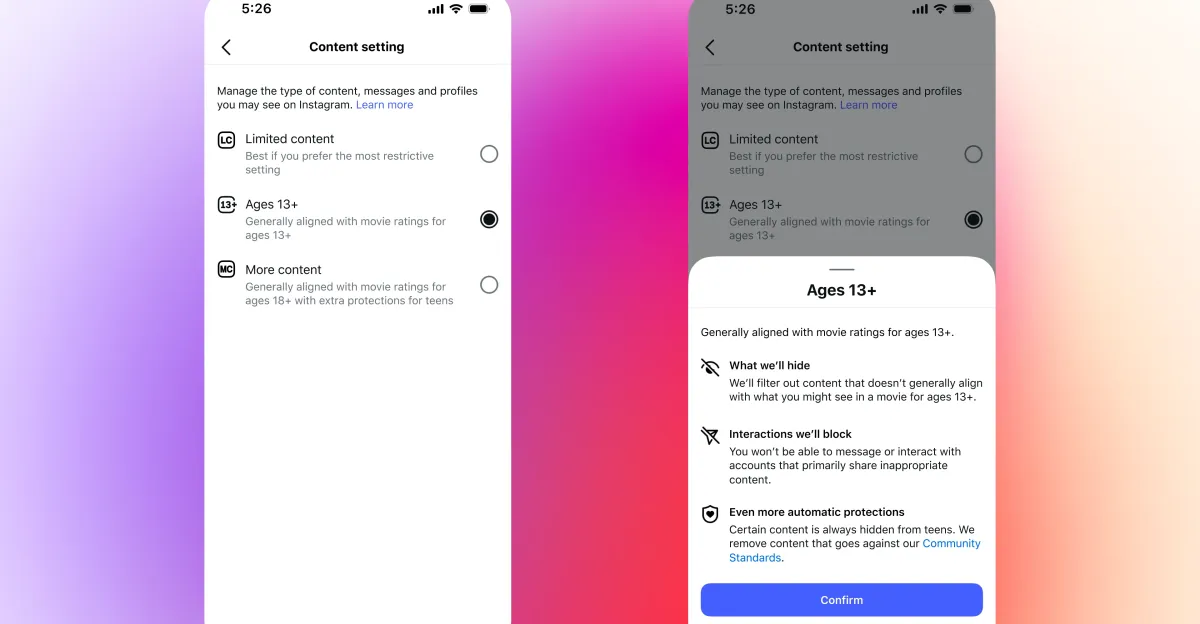
There are lots of differences between social media and movies. We didn’t work with the MPA when updating our content settings, and they’re not rating any content on Instagram, and they’re not endorsing or approving our content settings in any way. Rather, we drew inspiration from the MPA’s public guidelines, which are already familiar to parents. Our content moderation systems are not the same as a movie ratings board, so the experience may not be exactly the same.
Key Takeaways
- Inspired, Not Partnered:Instagram’s new content settings draw conceptual inspiration from the MPA’s familiar public guidelines to help parents, but there is no formal partnership, endorsement, or direct rating system collaboration with the Motion Picture Association.
- Distinct Moderation Challenges:Social media content moderation differs fundamentally from movie ratings due to the sheer volume, dynamic nature, user-generated origin, and global scale of digital content, necessitating a unique, AI-assisted approach.
- Empowering Parental Control:The initiative aims to provide parents and users with more intuitive controls over their content experience, leveraging a framework that resonates with existing understanding of age-appropriateness, rather than imposing external ratings.
In an increasingly complex digital landscape, social media platforms are under constant pressure to evolve their content moderation strategies, particularly concerning age-appropriate viewing. Instagram, a dominant force in visual social media, has recently articulated its approach to content settings, drawing a clear line between its internal mechanisms and the well-established systems of traditional media like film. This move underscores a crucial distinction: while inspiration can be derived from existing frameworks, the challenges and solutions for user-generated content demand an entirely bespoke system.
The core of Instagram’s statement revolves around its relationship, or lack thereof, with the Motion Picture Association (MPA). The platform explicitly states, “We didn’t work with the MPA when updating our content settings, and they’re not rating any content on Instagram, and they’re not endorsing or approving our content settings in any way.” This clarification is vital. It preempts any misunderstanding that Instagram might be outsourcing its content review or adopting a Hollywood-style censorship board. Instead, Instagram is leveraging a familiar public touchstone – the MPA’s guidelines – as a conceptual guidepost for parents, not as a direct operational partner.
The Art of Inspiration: Leveraging Familiarity for Digital Safety
Why would Instagram, a tech behemoth with its own sophisticated algorithms and policy teams, look to a film industry body for inspiration? The answer lies in accessibility and familiarity for end-users, especially parents. The MPA’s rating system (G, PG, PG-13, R, NC-17) has been ingrained in public consciousness for decades, providing a simple, understandable shorthand for content suitability. By drawing “inspiration from the MPA’s public guidelines,” Instagram aims to tap into this existing mental model. This allows parents to intuitively grasp what different content settings might mean on Instagram, without having to learn an entirely new, platform-specific lexicon from scratch. It’s a strategic move to reduce cognitive load and enhance user empowerment, making the platform’s safety features more approachable and actionable.
The Chasm Between Reels and Ratings Boards: Why Social Media is Different
Despite this inspiration, Instagram emphatically reiterates that “Our content moderation systems are not the same as a movie ratings board, so the experience may not be exactly the same.” This is not merely a disclaimer; it’s a fundamental truth about the vast differences between curating pre-produced cinematic works and moderating a torrent of real-time, user-generated content. A movie ratings board reviews a finite number of professionally produced films before public release, applying subjective yet consistent human judgment to various thematic elements, language, violence, and nudity. The process is deliberate, human-intensive, and designed for a curated product.
Social media, however, operates on an entirely different scale and speed. Billions of pieces of content—photos, videos, stories, reels, comments, live streams—are uploaded and consumed every day across diverse cultures and languages. This volume renders a traditional, human-led ratings board approach utterly impractical. Instagram’s moderation relies on a hybrid model: advanced artificial intelligence and machine learning for initial detection, coupled with a vast network of human moderators for nuanced review, context-specific decisions, and handling user reports. These systems must contend with evolving slang, visual trends, deepfakes, and the rapid spread of misinformation, challenges almost entirely absent from the film industry’s rating paradigm.
Empowering Users: Granular Control in a Complex Ecosystem
The shift towards MPA-inspired settings, even if not directly implemented, signals Instagram’s ongoing commitment to giving users more control over their experience. For parents, this means potentially more intuitive options to filter or restrict certain types of content for younger users on their accounts. For general users, it could translate to a more personalized feed where they can actively choose their comfort level regarding sensitive topics. This iterative refinement of content settings is part of a broader industry trend towards greater transparency and user agency, driven by both public demand and increasing regulatory scrutiny globally.
However, the challenge remains immense. Defining “appropriate” content is subjective, culturally dependent, and constantly evolving. What is acceptable in one region may be offensive in another. Balancing freedom of expression with safety and preventing the spread of harmful content is the tightrope social media platforms walk daily. Instagram’s choice to draw inspiration from a widely understood framework is a pragmatic step towards demystifying their content policies and making them more accessible, even if the underlying technological and human infrastructure is far more complex than any movie rating process.
The Bottom Line
Instagram’s strategic embrace of “MPA-inspired” content settings, while clearly delineating its independent operational model, represents a calculated effort to demystify content moderation for its vast user base, particularly parents. By echoing a familiar language of content suitability, the platform aims to empower individuals with more intuitive controls, even as its sophisticated, AI-driven moderation systems tackle the unprecedented scale and complexity of user-generated content in a way no traditional ratings board ever could. This move underscores the ongoing evolution of digital platforms in their quest for safer online environments, blending lessons from traditional media with cutting-edge tech solutions to navigate the intricate balance between open expression and user protection.
Source:{feed_title}