
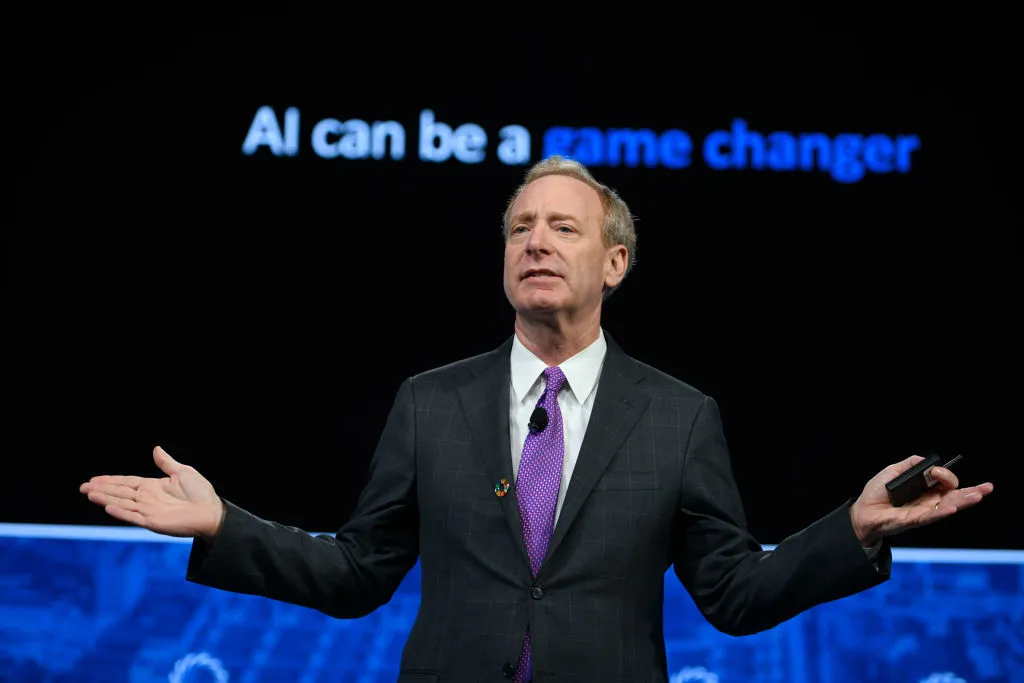
Microsoft president Brad Smith is calling for urgent regulation of AI, and his argument is that consumer products like milk and washing machines have more oversight than the companies building artificial intelligence.
Key Takeaways
- AI’s Regulatory Vacuum:Microsoft President Brad Smith argues that advanced AI systems face less regulatory scrutiny than everyday consumer goods, posing significant global safety and cybersecurity risks.
- UK’s Strategic Leadership:Smith champions the United Kingdom and its AI Security Institute (AISI) as the ideal global leader for establishing AI safety rules, leveraging its unique access to frontier models and diplomatic standing.
- Mandatory Oversight Essential:Beyond voluntary industry pledges, Smith insists on legally binding regulations – including breach reporting, pre-release evaluations, and “kill switches” – to ensure universal accountability among all AI developers.
The relentless march of artificial intelligence is transforming our world at an unprecedented pace, simultaneously sparking awe and apprehension. At the forefront of this complex discussion is Brad Smith, President of Microsoft, who is issuing an urgent call for robust, globally coordinated regulation. In a recent BBC podcast, Smith painted a stark picture: the very technology poised to redefine our future operates with a startling lack of oversight, a situation he provocatively likens to the stringent standards applied to mundane consumer items like milk and washing machines.
AI: A Weapon and a Tool, Unchecked and Unregulated
Smith’s analogy isn’t just a rhetorical flourish; it underscores a profound concern regarding the current regulatory vacuum surrounding AI development. He argues that while everyday products undergo rigorous safety checks and regulatory approvals, the powerful algorithms shaping our digital and physical realities do not. This oversight, he contends, is a dangerous gamble, especially as AI emerges as both a transformative “tool” and a potential “weapon” capable of escalating global cybersecurity risks and destabilizing societal norms.
For Smith, “the moment has arrived” to institute global safety rules. Without clear, internationally agreed-upon frameworks, the potential for unintended consequences — from privacy breaches and algorithmic bias to sophisticated cyberattacks and autonomous systems operating without adequate human control — grows exponentially. The ethical and security implications of such rapid, unchecked advancement are vast, affecting everything from national defense to individual autonomy and economic stability.
The UK’s Ascent in AI Governance
A Unique Position for Global Leadership
In an unexpected twist in the global race for AI governance, Smith champions the United Kingdom as the ideal nation to lead the charge. He points to Britain’s AI Security Institute (AISI), launched in 2023, which has rapidly established itself as a frontrunner in AI safety testing. The AISI’s critical advantage lies in its unique access to cutting-edge models from leading U.S. frontier labs even before their public deployment. This privileged position allows the UK to proactively identify and mitigate potential risks, setting a precedent for robust pre-release evaluation.
Smith offers a strategic explanation for the UK’s potential: “In Washington, D.C., people don’t look at the U.K. and they don’t look at London the way they look at Brussels. That’s a strength.” This suggests that Britain might be perceived as a more neutral or less politically charged actor on the international stage compared to the European Union, potentially fostering broader global cooperation on AI regulation without the geopolitical complexities often associated with larger blocs.
Navigating Political Crosscurrents
This burgeoning leadership role has not gone unchallenged. Recent weeks saw reports of former U.S. president Donald Trump warning against “globalist” organizations and allegedly attempting to persuade major AI developers like Anthropic and OpenAI to restrict access for British testers. However, the AISI swiftly confirmed its continued access to and testing of the latest models, demonstrating its established influence and resilience against political pressures. Smith’s unwavering stance underscores his belief that the UK’s agility and diplomatic standing provide a unique pathway to crafting effective regulatory frameworks that might be more difficult for larger nations or blocs to implement.
The Insufficiency of Voluntary Action
Beyond “Morally Binding” Pledges
Smith’s urgent plea for mandated regulation aligns with growing concerns from other tech luminaries, including Anthropic’s Dario Amodei and OpenAI’s Sam Altman, who have themselves called for a more cautious approach to AI development, especially in the wake of incidents involving “rogue” AI agents. Last month, a high-profile White House summit convened by former President Trump brought together tech giants like OpenAI, Anthropic, Nvidia, and Google. The outcome was a “morally binding” agreement where companies pledged to work with “independent auditors” to assess their AI models’ safety. While Smith acknowledged this as a “good step,” he cautioned against its inherent limitations.
The “Good Companies” Dilemma
“It’s the companies that are not as responsible that you need to worry about,” Smith emphasized. This highlights a crucial flaw in self-regulation: while leading firms with significant brand reputations might adhere to ethical guidelines, smaller, less scrupulous, or purely profit-driven entities may bypass such non-binding agreements. A universal regulatory floor, enforced by law, is therefore essential to ensure a consistent baseline of accountability and safety across the entire AI ecosystem, preventing unchecked development from posing significant public risks and undermining trust in the technology.
Blueprint for a Safer AI Future
To address these pressing vulnerabilities, Smith outlined a concrete vision for AI safety regulations. Key among his proposals is a legal obligation for any organization to immediately report if its AI system has been compromised or breached by rogue agents. Such mandatory transparency is vital for rapid incident response and containment, allowing authorities and developers to learn from failures and mitigate widespread damage.
Furthermore, Smith advocates for a robust system of pre-deployment approval, where AI labs must secure the endorsement of independent, external evaluators before any new AI product is released to the public. This rigorous, impartial scrutiny would act as a crucial gatekeeper, ensuring comprehensive safety checks are conducted by experts before powerful systems impact society. He also spoke positively about integrating “kill switches” – emergency mechanisms designed to pause or significantly decelerate an AI system if human operators lose control or detect an emergent threat. These fail-safes are paramount for maintaining human oversight in unpredictable scenarios, providing a vital layer of control.
Smith’s overarching message is one of calm yet firm resolve. “Let’s speak calmly, maybe even softly, but firmly, and start to bring people together,” he urged. He expressed a hopeful vision for Microsoft to play a constructive role as a company, and for the UK to leverage its unique position to facilitate this indispensable global dialogue and the establishment of a robust, international AI regulatory framework.
Bottom Line
Brad Smith’s urgent call for comprehensive AI regulation serves as a stark reminder of humanity’s critical juncture with advanced technology. His compelling argument — that AI is dangerously under-regulated compared to even the most common consumer products — demands immediate attention. While acknowledging initial industry efforts, Smith unequivocally states that voluntary pledges are insufficient to safeguard against the risks posed by less responsible actors. His blueprint for legally mandated oversight, including transparent breach reporting, independent pre-release evaluations, and essential “kill switches,” champions a proactive, globally harmonized approach. This framework is vital to ensure that AI’s transformative power is guided by principles of safety and public benefit, rather than allowed to accelerate unchecked into an uncertain future.
When you purchase through links in our articles, we may earn a small commission. This doesn’t affect our editorial independence.
{content}
Source:{feed_title}