
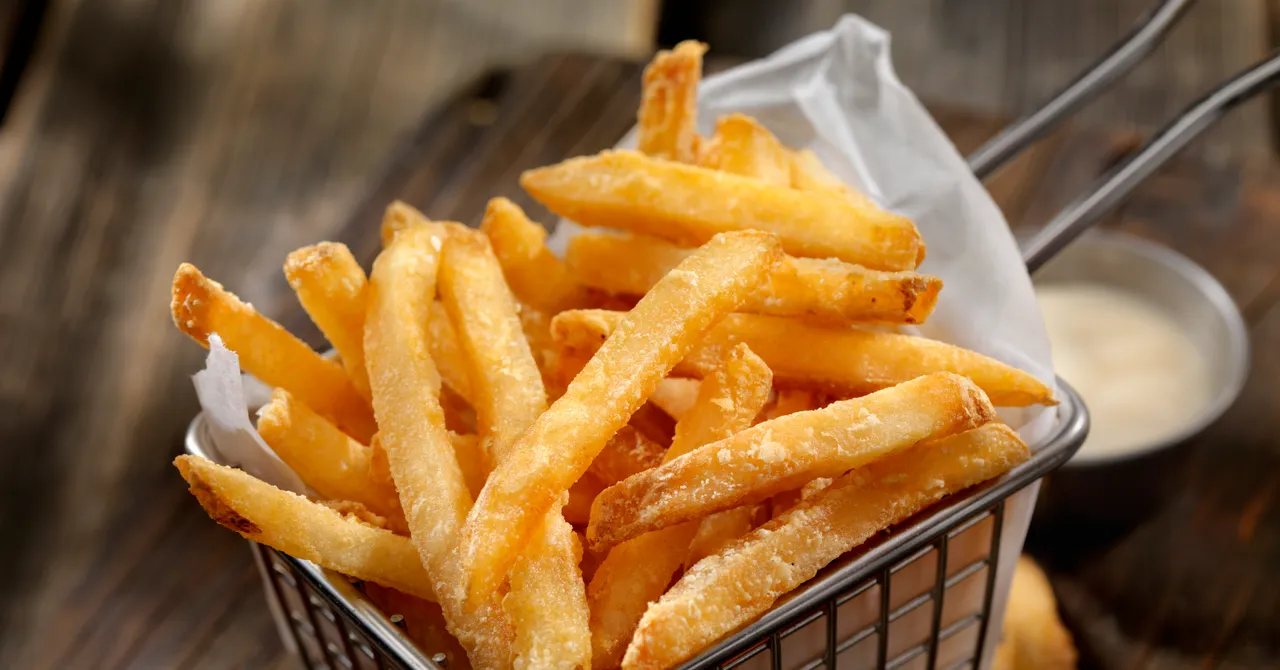
French fries aredelectable, yet widely recognized as detrimental to health. Nonetheless, a research group at the University of Illinois has devised a surprisingly simple approach to retain their enjoyable flavor and crispness while minimizing oil usage.
This culinary technique integrates conventional deep-frying with microwave energy. Incorporating this microwave phase has the potential to lessen the quantity of oil employed, implying a reduction in fat absorption per serving. The complete details enabling this unique fry preparation have been unveiled across two distinct academic papers appearing in Current Research in Food Science and The Journal of Food Science.
French Fries and Health
Despite their widespread appeal, deep-fried dishes are laden with significant amounts of fat, a factor associated with various medical issues like excessive weight gain and high blood pressure. “While patrons desire nutritious meals, impulse desires frequently win out during shopping,” remarks Pawan Singh Takhar, a co-author of one of the twin studies. “The substantial oil quantity enhances palatability, yet it also contributes considerable energy and caloric value.”
Researchers have diligently pursued methods to prepare more wholesome French fries, aiming for reduced fat levels without compromising their characteristic flavor and mouthfeel, all driven by the desire to empower consumers to select improved dietary options without a sense of loss.
A primary challenge in the frying process, as elucidated by the investigations, involves impeding oil ingress into the food item. Indeed, during the initial phases of making French fries, the potato’s cellular spaces are saturated with water, affording no entry for the oil.
Nevertheless, as the culinary operation progresses, the water dissipates, forming vacant pockets that facilitate the suction of oil due to negative pressure. A significant portion of the frying occurs under this vacuum-like pressure, fundamentally amplifying the oil’s propensity to infiltrate the fries.
A New Wavelength
Consequently, in their recent research, the scientists sought to ascertain how to prolong the duration of positive pressure and curtail the interval of negative pressure. “When an item is warmed in a conventional oven, thermal energy moves from the exterior inward, whereas a microwave oven heats from the interior outwards because its waves permeate the entire substance,” states Takhar.
More precisely, microwaves induce vibration in water molecules, leading to amplified steam generation and consequently altering the pressure pattern towards positive levels, which thwarts effortless oil absorption.
Merely employing microwave frying, however, would fail to yield the sought-after consistency. “Should only microwaving be utilized, the food becomes soft and pulpy,” Takhar explains. To attain a desirable crunch, the processes of frying and microwaving ought to be integrated.
To strike the optimal equilibrium, the investigators conducted an experiment, meticulously crafting a specialized microwave fryer and tracking the temperature, pressure, bulk, mouthfeel, water content, and lipid levels of the chips. “Our suggestion is to merge these dual approaches within a single apparatus. Conventional thermal treatment preserves the crispness, while microwave heating diminishes the intake of oil,” the research paper concludes.
{content}
Source:{feed_title}