
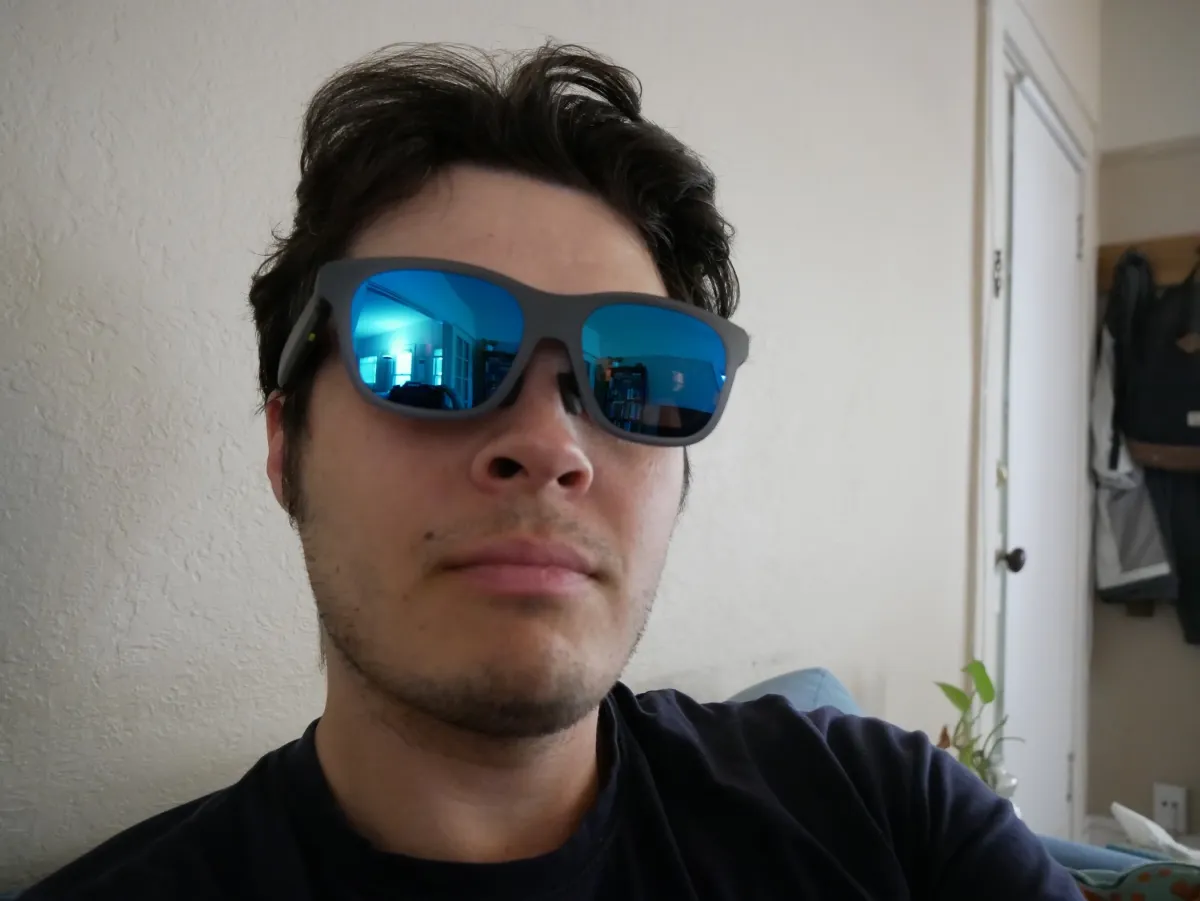
As a self-proclaimed cinephile, I’m always on the lookout for novel ways to immerse myself in cinematic experiences. So when XREAL, a prominent player in the smart glasses arena, sent over their a01 model – a newer release from May – I was eager to plug in and see if it could revolutionize my movie-watching habits. Marketed as a versatile “wearable display” for both gaming and media consumption, the a01 presents an intriguing, albeit basic, proposition in the evolving smart glasses landscape.
Key Takeaways
- Visuals Impressive, Practicality Lacking:The XREAL a01 delivers sharp, vibrant 1080p OLED visuals, creating an immersive, large-screen feel. However, its core functionality as a screen-mirroring device often leads to a redundant and questionable user experience, especially when tethered to a laptop or phone.
- Comfortable but Prone to Heat:While relatively lightweight and comfortable for extended wear compared to some bulkier AR glasses, the a01 suffers from a common XR device drawback: noticeable heat generation around the nose bridge and eyes during use.
- A Glimpse into the Future, Not the Present Ideal:At an accessible $300, the a01 is an interesting entry point into wearable displays, particularly for handheld gaming. Yet, for dedicated movie watching, its limitations – including lack of independent processing, reliance on external power, and screen mirroring – prevent it from truly competing with traditional large-screen TVs or a dedicated cinema experience.
Exploring the XREAL a01: A Basic Smart Display for the Media Fanatic
My passion for film runs deep, always driving me to seek out new formats and technologies that promise a fresh perspective on storytelling. It was this enthusiasm that led me to the XREAL a01, a pair of smart glasses I hoped might unlock a new dimension in personal media consumption. XREAL, a company making waves in the smart glasses space, positions the a01 as an accessible entry point into wearable displays, optimized for gaming but also advertised for movies and TV.
Unpacking the a01: A “Wearable Display” at its Core
Let’s be clear about what the a01 is, and isn’t. This isn’t a sophisticated, software-heavy augmented reality (AR) device akin to a Meta Orion or Snap’s Specs. Instead, the a01 functions primarily as an external monitor for your eyes. It lacks an internal battery or processing power, relying entirely on a simple USB-C connection to a device of your choice – be it a laptop, a handheld gaming console, or a smartphone – for both power and content. This straightforward design contributes to its relatively affordable price point of around $300.
While the a01 is technically optimized for handheld gaming devices like the Steam Deck, XREAL also champions its utility for watching films and television. Naturally, as a movie buff, this was the primary avenue I chose to explore. My initial test involved plugging the a01 into my laptop and firing up the Criterion Channel. Soon, I was deep into David Lynch’s “Wild at Heart,” enjoying Nicolas Cage’s iconic snakeskin jacket and Elvis-inspired antics, all through the lens of XREAL’s wearable tech.
The Visuals: A Personal Projector on Your Face
From a purely visual standpoint, the a01 truly impressed. Outfitted with dual mini OLED panels, the glasses deliver a remarkably crisp and vibrant image. Boasting 1080p resolution and up to 1,600 nits of brightness, the colors pop, and details are sharp. Directing the glasses at a wall evoked the feeling of a vivid home projector, or perhaps even a private drive-in movie experience. In a darkened room, the immersive quality took a step closer to a true in-theater feel. The claim that the device’s projections are equivalent to a massive 147-inch screen feels less like hyperbole and more like an accurate representation of the perceived scale.
However, this initial immersion quickly gave way to a fundamental question: Why am I wearing these glasses, tethered to my laptop, watching content that is simultaneously playing just 14 inches away on my computer screen? While XREAL touts the immersive benefits, the redundancy of this setup immediately sparked a debate in my mind about the device’s practical purpose for sedentary viewing.
Connectivity and the Redundancy Dilemma
Laptop as a “Second Monitor”?
XREAL has suggested the a01 can function as a “second monitor,” or a “wearable display,” which sounds appealing in theory. However, in practice, this functionality is fraught with limitations. The immersive nature of the glasses means that focusing on anything other than what they’re projecting becomes incredibly difficult. Trying to multitask or use a laptop’s primary screen while wearing the a01 for a secondary display proved to be an exercise in frustration. It’s simply not designed for that kind of split attention.
On-the-Go with a Smartphone
The prospect of connecting the a01 to a smartphone offers a more compelling use case for portability. Imagine watching a movie on a plane, train, or even during a leisurely walk (though the latter is generally ill-advised for safety reasons). Unfortunately, my older iPhone required an adapter to be compatible with the a01’s USB-C cable, a minor inconvenience that highlights the need for broader out-of-the-box compatibility.
Even with phone connectivity, the core redundancy problem persists. The a01 remains a screen-mirroring device, meaning your phone’s screen must stay active while you’re watching through the glasses. You’re essentially consuming content on two screens simultaneously, one of which is less than a foot from your face and the other in your pocket or hand. While you could attempt to pocket your phone, the risk of playback interruption from jostling seems high, undermining the “portable” advantage.
The Beam Pro Solution (at an extra cost)
To address some of these limitations, XREAL offers a separate accessory: the Beam Pro. This mini-tablet acts as an isolated streaming hub, allowing users to download content directly and connect it to the glasses, thus freeing them from relying on a tethered laptop or phone. However, this convenience comes at an additional cost of $200, pushing the total investment closer to the price of a more capable standalone device.
Comfort, Heat, and Design
One notable drawback, common across many XR devices, is the heat generation. It doesn’t take long for the a01 to warm up, creating a peculiar tingling sensation on the bridge of your nose and around your eyes. This isn’t unique to XREAL, as cramming powerful electronics into a small, wearable form factor inevitably leads to thermal issues. While not unbearable, it is undoubtedly a disconcerting element, detracting from what should be an entirely comfortable viewing experience.
Despite the heat, the a01 is surprisingly lightweight and comfortable. I’ve tried other smart glasses, like Snap’s Specs at CES, which felt significantly heavier and more cumbersome. The a01’s design manages to avoid excessive bulk, making it a relatively pleasant device to wear for extended periods, heat notwithstanding. This comfort factor is a significant achievement in the nascent wearable tech market.

Looking Ahead: Project Aura and the Future of XREAL
XREAL is clearly on a path of continuous iteration, with each new product attempting to refine the user experience. Many of the existential questions raised by the a01’s design appear to be addressed in XREAL’s upcoming device, Project Aura. I had a brief glimpse of Aura at Google I/O, and it promises a significantly more immersive and convenient experience. Powered by Android XR, an extended reality operating system developed by Google and Samsung, Aura offers native hand tracking (a feature missing from the a01) and access to the Google Play Store, greatly expanding its interactive and AR capabilities.
Crucially, Aura comes with a tethered puck that serves as both a charging source and a compute node. This discreet, pocketable puck grants users substantially more mobility than the a01, as it eliminates the need to remain physically plugged into a separate host device. This evolution points to a more independent and genuinely portable wearable display experience, solving some of the a01’s most glaring limitations.
The Cinephile’s Verdict: Big Screen Still Reigns Supreme
Returning to the a01, and from a dedicated cinephile’s perspective, watching movies on a pair of smart glasses, even with excellent visuals, isn’t quite ideal. The quintessential movie-watching experience, for most, involves a large screen – the bigger, the better. In an era dominated by increasingly affordable, gargantuan 4K OLED displays, consumers are spoiled for choice. My own 55-inch TCL S-series TV, while not a top-tier device, offers a home viewing experience that is undeniably more comfortable and satisfying than what the a01 can provide. For me, viewing a film at home on a large flatscreen is second only to the immersive grandeur of an actual cinema. Watching a movie on tiny screens inches from my eyes, while undeniably interesting for its unique sense of immersion, doesn’t quite hit the mark as an optimal, preferred method.
The Bottom Line
The XREAL a01 stands as an intriguing, budget-friendly gateway into the burgeoning world of wearable displays. It excels in delivering sharp, vibrant visuals, making it a compelling option for personal, immersive gaming sessions on handheld consoles. However, for general movie and TV watching, its reliance on screen mirroring, external power, and the inherent redundancy of its operation pose significant practical hurdles. While comfortable and relatively lightweight, the issue of heat generation further tempers its appeal for extended media consumption. The a01 is less of a revolutionary media device and more of an evolutionary step, showcasing the potential for personal, portable large screens while simultaneously highlighting the challenges that the XR hardware industry must overcome. Its true value lies in offering an accessible taste of what’s to come, with XREAL’s Project Aura already hinting at a future where smart glasses might finally offer the truly independent and intuitive media experience that enthusiasts crave.
When you purchase through links in our articles, we may earn a small commission. This doesn’t affect our editorial independence.
{content}
Source:{feed_title}