
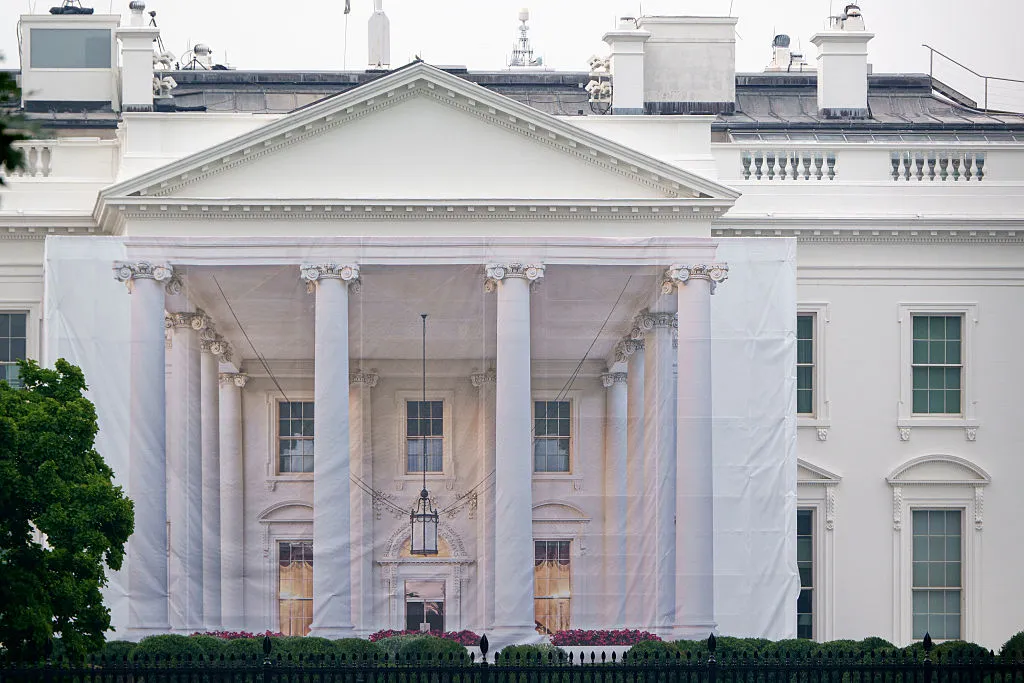
A video game posted to the Trump administration’s website — one that closely resembled Tetris — has been taken down after the Tetris Company complained.
Key Takeaways:
- Copyright Clash:The Trump administration’s “Build the Wall” game, mirroring Tetris, was removed from the White House website following a copyright infringement complaint from The Tetris Company.
- Political Gaming:The incident highlights a controversial trend of governments using arcade-style games, like “Build the Wall” and “Rio Run,” for political messaging, often with racially charged undertones.
- Digital Accountability:The swift takedown underscores the legal and ethical scrutiny facing government digital platforms, particularly regarding intellectual property rights and the potential for propaganda.
White House Game “Build the Wall” Crumbles Under Copyright Pressure
In an unusual intersection of politics, gaming, and intellectual property law, the Trump administration recently found itself in the crosshairs of a global entertainment giant. A digital game titled “Build the Wall,” hosted on the official White House website and strikingly reminiscent of the iconic puzzle game Tetris, was quietly removed following a stern complaint from The Tetris Company. This incident not only shines a light on novel methods of political communication but also raises critical questions about copyright enforcement on government platforms and the ethical boundaries of digital propaganda.
The Digital Frontier of Political Messaging
The presence of arcade-style video games on a governmental website was, in itself, a peculiar and largely unprecedented move. Amidst official policy documents and press releases, the White House introduced a suite of games, seemingly designed to engage visitors in a more interactive, albeit politically charged, manner.
“Build the Wall”: A Controversial ‘Game’
At the heart of the controversy was “Build the Wall,” a game that immediately drew comparisons to the classic Tetris. Players were reportedly tasked with arranging falling blocks of various shapes and sizes to construct a barrier. However, unlike Tetris’s abstract goal of clearing lines, “Build the Wall” explicitly stated its objective: to erect a wall to repel a “zombie border siege.” This overtly political and widely criticized premise, seen by many as a thinly veiled endorsement of racist rhetoric and anti-immigrant sentiment, quickly ignited a firestorm of public outrage and condemnation. The game’s narrative, directly linking a fantastical threat to real-world policy, underscored the administration’s willingness to leverage digital entertainment for ideological messaging.
The Mechanics of Provocation
While the game’s precise mechanics are now lost to a 404 error, descriptions indicated a direct mirroring of Tetris’s core gameplay loop – rotating and dropping tetrominoes to complete rows. This borrowing of a beloved, universally recognized game structure, and then recontextualizing it with highly charged political imagery, was a deliberate and provocative act. It aimed to normalize a specific political agenda through the accessible, seemingly innocuous medium of a puzzle game, thereby bypassing traditional media filters and directly engaging a potentially younger, digitally native audience with its messaging. The choice of Tetris’s mechanics wasn’t arbitrary; its simplicity and widespread familiarity made the politically loaded reskin all the more accessible and, to its critics, insidious.
Intellectual Property Under Siege
The controversy surrounding “Build the Wall” quickly transcended its political messaging to encompass serious intellectual property concerns. The Tetris Company, custodians of one of gaming’s most enduring and protected franchises, took swift action.
Tetris Company’s Swift Response
Upon learning of the game’s existence and its striking resemblance to their flagship product, The Tetris Company wasted no time in clarifying its non-involvement and asserting its rights. In an Instagram post, which quickly circulated across tech and gaming news outlets, the company unequivocally stated: “The Tetris Company was not involved in the creation of ‘Build the Wall.'” It then added a clear warning: “We take copyright infringement very seriously.” This direct address from a private entity to a sitting government administration regarding IP violation was highly unusual and indicative of the perceived gravity of the infringement. The statement served as both a disclaimer to protect their brand’s neutrality and a legal threat, signaling their intent to defend their intellectual property.
Copyright in the Digital Age
The Tetris Company’s complaint highlighted the robust protections afforded to intellectual property, even when the alleged infringer is a government entity. Copyright law protects the original expression of an idea, and while “Build the Wall” might have used a different aesthetic, its fundamental gameplay mechanics — the core “look and feel” — were arguably too close to Tetris to escape scrutiny. This incident serves as a stark reminder that digital content, even when hosted on official government websites, is not exempt from the legal framework governing intellectual property. Businesses, regardless of their political alignment, have a right and an obligation to protect their brands and creations from unauthorized use, especially when that use could be perceived as an endorsement or association with controversial political messaging.
The Swift Eradication
The pressure from The Tetris Company, combined with widespread public outcry, quickly led to the game’s disappearance from the official White House portal.
A 404 Echo
Not long after The Tetris Company’s public statement and mounting media attention, the web page dedicated to “Build the Wall” began returning a “404 Not Found” error. This digital ghost signified the game’s quiet removal, first noticed and reported by gaming news outlets like Kotaku. The abrupt disappearance, without any official announcement or explanation from the White House, suggested a tacit acknowledgment of the issues at hand, whether related to copyright infringement, public relations backlash, or both. The digital erasure left only lingering questions and the impression of an attempt to quietly sweep the controversy under the rug.
Silence from the Source
TechCrunch, among other media outlets, reportedly reached out to the Trump administration for comment regarding the game’s removal and the underlying copyright concerns. As is often the case with politically sensitive issues, these requests were met with silence. The lack of an official statement left the public to speculate on the precise reasons for the takedown – whether it was a direct response to the Tetris Company’s complaint, a reaction to the widespread accusations of racism, or a combination of factors. This governmental reticence further fueled the narrative of an administration willing to push boundaries but reluctant to account for the consequences.
A Broader Playbook?
“Build the Wall” was not an isolated incident in the administration’s digital strategy. Its presence alongside other contentious games hinted at a broader, albeit controversial, approach to public engagement.
“Rio Run” and Beyond
Still visible on the government’s website at the time was another game, “Rio Run,” which also garnered significant criticism. In this game, players controlled a white male character whose objective was to “deport as many immigrant characters as possible.” The overtly xenophobic theme of “Rio Run,” coupled with “Build the Wall’s” anti-immigrant narrative, painted a clear picture of the administration’s intent to use gaming platforms to reinforce its political agenda and rhetoric. These games transcended simple informational campaigns; they were interactive tools designed to normalize and gamify controversial policies, potentially shaping public opinion in a novel and direct manner.
Gaming as a Political Tool
The deployment of these games on a government website marked a significant, and arguably unsettling, evolution in political communication. Traditionally, governments use official channels for factual dissemination, policy advocacy, or public service announcements. The introduction of ideologically charged arcade games represented a pivot towards using popular cultural forms to directly engage and influence citizens, particularly those within the administration’s political base. This strategy raises questions about the future of digital political engagement, where the lines between entertainment, information, and propaganda become increasingly blurred, and where familiar game mechanics are co-opted for partisan messaging.
Unpacking the Implications
The “Build the Wall” controversy, though seemingly minor in the grand scheme of political events, carries significant implications for the intersection of technology, law, and governance.
Ethical Lines and Digital Propaganda
The use of games like “Build the Wall” and “Rio Run” on a government website pushes the ethical boundaries of public communication. Critics argued these were not merely games but a form of digital propaganda, leveraging the engaging nature of gaming to disseminate divisive and often discriminatory messages. The gamification of sensitive political issues, particularly those with real-world human consequences, raises concerns about the trivialization of serious policy debates and the potential for dehumanization. Governments, by their nature, are expected to serve all citizens, and the use of platforms to promote content perceived as racist or xenophobic undermines this fundamental principle.
Government Accountability in the Digital Sphere
This incident also highlights the need for greater accountability regarding content published on government digital platforms. While private entities face clear legal repercussions for copyright infringement and ethical breaches, the lines can blur when the content originates from an official government source. The swift, silent removal of “Build the Wall” suggests an awareness of culpability, but the lack of transparency surrounding the decision leaves many questions unanswered about internal oversight and editorial policies for official government websites. As technology continues to reshape how governments interact with their constituents, the standards for content, intellectual property respect, and ethical communication on official digital channels will become increasingly vital.
{content}
Bottom Line:
The brief, controversial life and subsequent removal of “Build the Wall” from the White House website stands as a potent symbol of the complex challenges at the nexus of technology, politics, and intellectual property. It underscores the growing trend of governments experimenting with novel digital engagement strategies, the ever-present vigilance required of copyright holders, and the critical need for ethical guidelines and transparency when official platforms venture into the realm of gamified political messaging. This episode serves as a cautionary tale, reminding us that even in the digital age, the fundamental rules of intellectual property and responsible public communication remain paramount.
Source:{feed_title}