
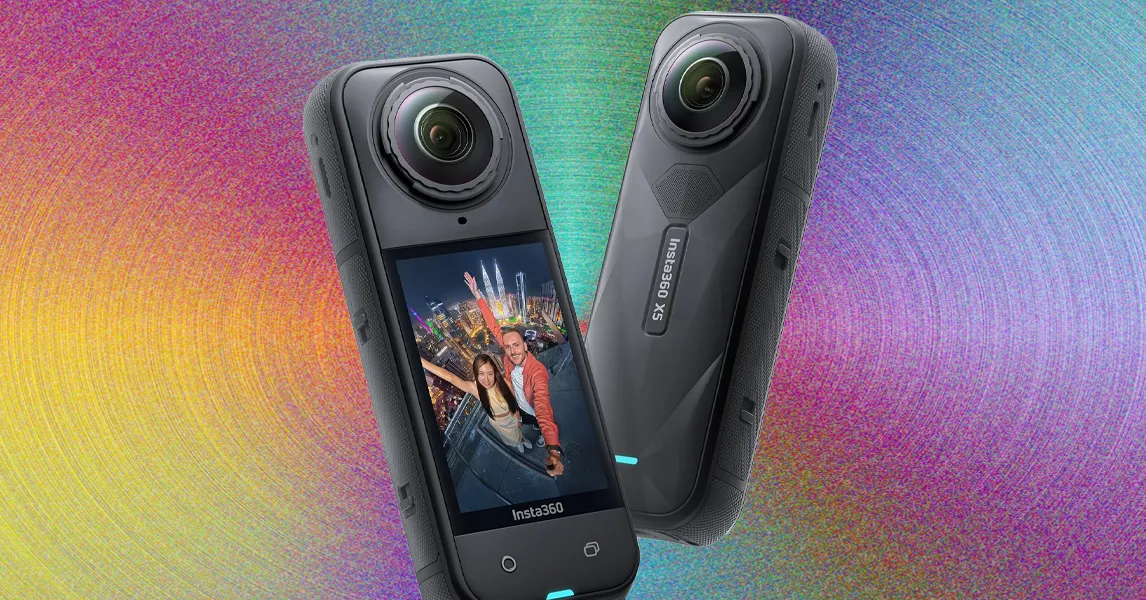
An Examination of the Five Leading 360-Degree Cameras
Noteworthy Contenders
Image Credit: Scott Gilbertson
Insta360 X4 for $340:It is advisable to bypass this particular model unless a discounted price below $300 can be secured. Typically, the X4 Air presents a more economical, compact, and proficient alternative; however, the X4 does feature a more expansive display and superior battery endurance (yet, its video fidelity remains inferior to the X4 Air). Should an exceptional offer below $300 materialize, acquiring the X4 would be worthwhile. Otherwise, it’s preferable to opt for the X4 Air.
Qoocam 3 Ultra for $539: This model is not extensively distributed, and we haven’t yet had the opportunity for a hands-on trial; nevertheless, Kandao’s Qoocam 3 Ultra appears to be another promising 8K 360-degree camera, theoretically. Its f/1.6 aperture is particularly noteworthy, given that the majority of comparable devices operate within the f/2 range or higher. We shall revise this review once we have had the opportunity to evaluate a Qoocam.
360-Degree Cameras to Steer Clear Of
Insta360 One RS:Insta360’s innovative concept of an interchangeable-lens action-camera and 360-camera hybrid failed to gain widespread adoption and is now somewhat antiquated. While its video capture quality falls short compared to other cameras featured herein, its primary advantage lies in the ability to quickly interchange lenses, transforming it into an action camera. My final advice is to forgo this model; acquire the X4 Air instead, and if you wish to operate it akin to a GoPro, simply utilize its single-lens mode.
GoPro Max:One might still encounter GoPro’s initial Max periodically, but superior alternatives are now available.
Insta360 One X3: Acquiring Insta360’s previous X3 model is currently not advisable.
Insta360 One RS 1 360 Edition:Despite my personal fondness for and continued use of this camera, it seems to have been phased out, with no successor evident. The X5 offers enhanced video fidelity within a more lightweight and robust casing, though I will lament the 1-inch sensors that excelled at capturing considerable detail, even if the maximum resolution for footage was 6K. While these units can still be found pre-owned, their cost is exorbitant. The X5 represents a more prudent acquisition.
Common Inquiries
Two primary motivations exist for desiring a 360-degree camera. The initial reason involves capturing virtual reality content, intended for ultimate display on a panoramic screen, such as VR head-mounted devices. To date, this domain is largely occupied by specialists employing costly 360 setups not addressed in this guide, although an increasing number of hobbyist creators are also emerging. Should this be your objective, opt for the camera offering the utmost resolution. Both of our leading selections would suffice.
However, for the majority, the principal draw of a 360 camera lies in its capacity to record all surrounding elements, subsequently allowing for editing or reframing to emphasize a desired portion of the scene, or for panning and following subjects within the 360 footage, ultimately yielding a standard, rectangular video for web dissemination. While the video resolution and picture clarity will not rival those of a top-tier DSLR, a DSLR might not always be aimed correctly at the opportune moment. A 360 camera requires no specific aiming; it merely needs to be active.
This represents the optimal application for the cameras presented here, which, when reframed, primarily generate high-definition (1080p) or superior video – though not 4K. I anticipate the emergence of 12K-capable consumer-grade 360 cameras within the coming one to two years (the necessary resolution for reframing to 4K), yet for the present, these constitute the finest cameras available for purchase.
Regardless of whether one is capturing virtual tours or a child’s birthday celebration, the fundamental principle behind a 360 camera remains consistent. Its fisheye lens system (typically comprising two ultra-wide-angle lenses) records the complete environment, ideally eliminating any selfie stick from the final imagery. Following the capture of your 360-degree perspective, this content can then be edited or reframed into a format suitable for uploading to platforms such as YouTube, TikTok, and other video-sharing venues.
Why Is Elevated Resolution Crucial in 360 Cameras?
For an extended period, camera manufacturers have emphasized increasingly higher video resolution, which often seems like a marketing ploy; however, this is not the case with 360-degree cameras. Since these cameras record an immense field of vision, the ‘canvas,’ so to speak, is exceedingly vast. To derive a traditional video from such recordings, cropping is essential, which magnifies a portion of the image; consequently, an 8K 360 capture reduces to just under 2.7K upon reframing.
How Does “Re-composition” Function?
Re-composition refers to the method of extracting a segment from the expansive, 360-degree global perspective recorded by your camera and magnifying it to convey your narrative. This adapts the 360 footage to conventional video aspect ratios (e.g., 16:9); however, as previously mentioned, it necessitates cropping, thus, a higher initial resolution results in a superior appearance for your reframed video. For content intended for VR headgear or comparable immersive devices, no reframing is required.
My experience with 360 cameras commenced following Insta360’s introduction of the X2 model in 2020. Initial 360 cameras were enjoyable, yet their video output lacked sufficient resolution to seamlessly integrate with recordings from other camera types, thereby constraining their utility. Fortunately, significant progress has been made over the past half-decade. The 360-camera sector has expanded, and the visuals these devices generate are now of adequate quality to blend smoothly with action camera and even premium mirrorless camera recordings.
For evaluating 360 cameras, I’ve segmented the assessment into various capture environments, particularly those with diverse illumination, to ascertain each device’s performance. As no camera is flawless, the ideal choice for you hinges on your specific filming requirements. Particular focus was placed on the user-friendliness of each camera (given that 360 cameras can perplex novices), in addition to the beneficial supplementary features provided, HDR capabilities, and compatibility with various peripherals.
The concluding aspect considered is the post-production process and the tools furnished for each camera. As the majority of users capture content for social media, the unedited 360 footage necessitates refinement prior to any public sharing. All aforementioned cameras are accompanied by software compatible with mobile devices, Windows, and macOS.
Enhance your experience with unrestricted entry toWIRED.Obtain top-tier journalism and member-exclusive material that is essential and cannot be overlooked. Enroll Now.
{content}
Source:{feed_title}