
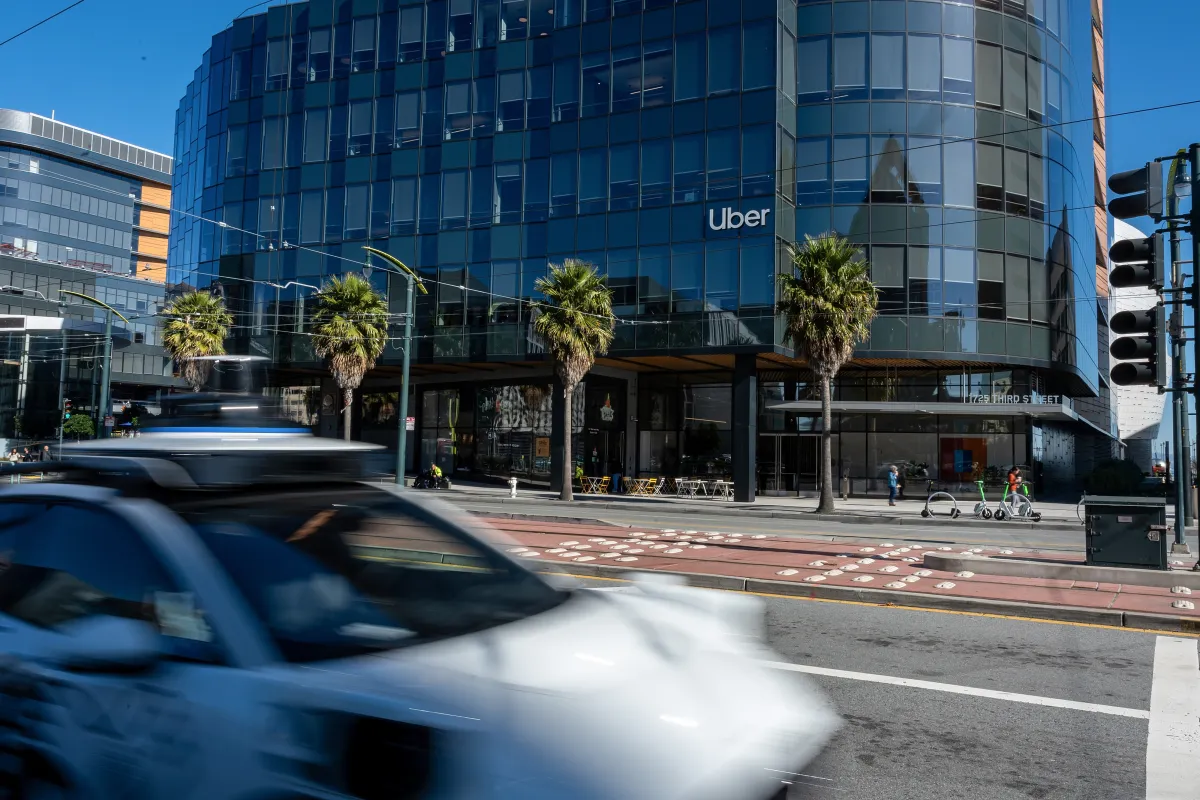
Uber has a long-term ambition that goes well beyond shuttling passengers: the company eventually wants to outfit its human drivers’ cars with sensors to soak up real-world data for autonomous vehicle (AV) companies — and potentially other companies training AI models on physical-world scenarios.
Praveen Neppalli Naga, Uber’s chief technology officer, revealed the plan in an interview at TechCrunch’s StrictlyVC event in San Francisco on Thursday night, describing it as a natural extension of a nascent program the company announced in late January called AV Labs.
“That is the direction we want to go eventually,” Naga said of equipping human drivers’ vehicles. “But first we need to get the understanding of the sensor kits and how they all work. There are some regulations — we have to make sure every state has [clarity on] what sensors mean, and what sharing it means.”
For now, AV Labs relies on a small, dedicated fleet of sensor-equipped cars that Uber operates itself, separate from its driver network. But the ambition is clearly much larger. Uber has millions of drivers globally, and if even a fraction of those cars could be transformed into rolling data-collection platforms, the scale of what Uber could offer the AV industry would dwarf what any individual AV company could assemble on its own.
The insight driving the program, Naga said, is that the limiting factor for AV development is no longer the underlying technology. “The bottleneck is data,” he said. “[Companies like Waymo] need to go around and collect the data, collect different scenarios. You may be able to say: in San Francisco, ‘At this school intersection, I want some data at this time of day so I can train my models.’ The problem for all these companies is access to that data, because they don’t have the capital to deploy the cars and go collect all this information.”
Becoming the data layer for the entire AV ecosystem is a pretty smart play, particularly considering Uber years ago abandoned its own ambitions to build self-driving cars (a move that co-founder Travis Kalanick has publicly lamented as a big mistake). Indeed, many industry observers have wondered if, without its own self-driving cars, Uber might one day be rendered irrelevant as AVs increasingly spring up around the globe.
The company currently has partnerships with 25 AV companies — including Wayve, which operates in London — and is building what Naga described as an “AV cloud”: a library of labeled sensor data that partner companies can query and use to train their models. Partners, which Uber plans to more aggressively invest in directly, can also use the system to run their trained models in “shadow mode” against real Uber trips, simulating how an AV would have performed without actually putting one on the road.
Techcrunch event
San Francisco, CA
|
October 13-15, 2026
“Our goal is not to make money out of this data,” Naga said. “We want to democratize it.”
Given the obvious commercial value of what Uber is building, that positioning may not last long. The company has already made equity investments in numerous AV players, and its ability to offer proprietary training data at scale could give it significant leverage over a sector that right now depends on Uber’s ride marketplace to reach customers.
Key Takeaways
- Uber’s Ambitious Pivot:The company plans to equip its vast network of human drivers’ cars with sensors, transforming them into a colossal real-world data collection platform for autonomous vehicle (AV) companies and other AI models.
- Solving the AV Data Bottleneck:Uber CTO Praveen Neppalli Naga asserts that data, not technology, is the primary hurdle for AV development. Uber aims to become the essential “data layer” for the entire AV ecosystem, providing granular, real-world scenarios at scale.
- Strategic Re-entry into AV Space:Having divested its own self-driving division, this move allows Uber to reclaim a pivotal role in the future of mobility, leveraging its unique operational scale and market reach without incurring the immense R&D costs of building AVs itself.
Uber’s Grand Data Play: Transforming Rideshare Cars into Roving AI Labs
In a significant strategic revelation at TechCrunch’s StrictlyVC event in San Francisco, Uber’s Chief Technology Officer, Praveen Neppalli Naga, unveiled a long-term vision that could fundamentally redefine the company’s role in the burgeoning autonomous vehicle (AV) industry. Beyond its immediate mission of connecting passengers with drivers, Uber harbors an ambition to outfit its human drivers’ cars with sophisticated sensors, creating an unprecedented, distributed network for soaking up real-world data vital for AV development and broader AI training.
From Dedicated Fleets to Ubiquitous Sensors: The Scalable Vision
The seeds of this ambitious plan were sown with the launch of AV Labs in late January, a nascent program that currently employs a small, dedicated fleet of sensor-equipped vehicles operated directly by Uber. However, Naga made it clear that this is merely a preliminary step. The ultimate goal is vastly more expansive: to integrate these data-gathering capabilities into the millions of vehicles driven by Uber’s global network of human drivers. Imagine the sheer scale: if even a fraction of these cars were to become mobile data collection platforms, Uber could potentially offer the AV industry a data trove that would eclipse anything individual AV companies could hope to assemble on their own. This move signifies a shift from a centralized data collection model to a massively distributed, real-time sensing network, leveraging existing infrastructure to unlock new frontiers in AI development.
The Data Dilemma: Fueling the Future of Autonomy
Naga’s insight into the current state of AV development is sharp and critical. He argues that the primary impediment to widespread autonomous vehicle deployment is no longer the underlying technology itself, which has seen remarkable advancements. Instead, “the bottleneck is data.” AV companies, from established giants like Waymo to nimble startups, desperately need vast quantities of diverse, real-world driving data to train and refine their complex AI models. This isn’t just about general streetscapes; it’s about specific, nuanced scenarios – a particular intersection at rush hour, varied weather conditions, unexpected pedestrian behavior, or the unique challenges of a school zone during pickup times.
The monumental challenge for these companies lies in the sheer capital expenditure and logistical complexity required to deploy sufficient fleets to collect this data themselves. Uber, with its pre-existing, massive global footprint, is uniquely positioned to address this bottleneck. By providing this critical data infrastructure, Uber aims to accelerate the entire industry, offering a comprehensive understanding of diverse driving environments and scenarios that would otherwise be prohibitively expensive and time-consuming to acquire.
Uber’s Strategic Pivot: A Second Act in Autonomy
This audacious strategy is particularly noteworthy given Uber’s past. Years ago, the company poured billions into developing its own self-driving car technology, only to ultimately divest its ATG (Advanced Technologies Group) division in 2020. This retreat from direct AV development was seen by some, including Uber co-founder Travis Kalanick, as a significant misstep, leading to speculation about Uber’s long-term relevance in a future dominated by autonomous mobility.
However, this new “data layer” approach represents a sophisticated and strategic pivot. Instead of competing directly in the costly and complex race to build self-driving cars, Uber aims to become an indispensable enabler for the entire ecosystem. By supplying the lifeblood of AV development – real-world data – Uber re-establishes itself as a central player. It leverages its core asset (its operational network) to create a new, high-value service, effectively turning a potential threat (AVs rendering human drivers obsolete) into a massive opportunity. This strategic repositioning ensures Uber remains deeply embedded in the future of transportation, regardless of who builds the actual self-driving vehicles.
Building the “AV Cloud”: A Collaborative Ecosystem
At the heart of this initiative is what Naga describes as an “AV cloud.” This is envisioned as a comprehensive library of meticulously labeled sensor data that partner companies can not only query but also actively use to train and validate their autonomous models. Uber currently boasts partnerships with 25 AV companies, including Wayve, which is actively operating in London, showcasing the global reach and diverse applications of this data offering.
Beyond raw data, the AV cloud will offer advanced functionalities. Partners will be able to run their trained models in a “shadow mode” against real Uber trip data, simulating how an AV would have performed in countless real-world scenarios without ever needing to deploy a physical autonomous vehicle. This virtual testing environment drastically reduces development costs and accelerates the iterative refinement process, offering a powerful tool for validation and improvement before expensive physical deployments. Uber also plans to deepen these relationships through direct equity investments, further aligning its success with that of its AV partners.
Commercial Value vs. “Democratization”: A Question of Leverage
Intriguingly, Naga stated, “Our goal is not to make money out of this data. We want to democratize it.” While the sentiment of democratization is appealing, the obvious commercial value and strategic leverage inherent in such a platform cannot be overlooked. Uber’s ability to provide proprietary training data at an unparalleled scale will undoubtedly be a potent asset. It could command premium pricing for access, secure advantageous equity stakes in partner companies, or even dictate terms for AVs operating on its ride-hailing marketplace in the future.
The journey from a “democratized” resource to a highly valuable, monetized service is a well-trodden path in the tech industry. As the AV sector matures, Uber’s position as the primary data provider could grant it significant influence over its partners, who may become increasingly reliant on Uber’s unique data streams to maintain their competitive edge. The regulatory landscape around data collection and privacy, particularly when leveraging human drivers’ vehicles, will also be a critical factor in how this vision unfolds, presenting complex ethical and legal considerations that Uber will need to navigate carefully across various jurisdictions.
Techcrunch event
San Francisco, CA
|
October 13-15, 2026
The Road Ahead: Challenges and Opportunities
Implementing this grand vision will not be without its challenges. Technical hurdles related to sensor integration, data processing, and cybersecurity will be significant. Even more complex will be navigating the intricate web of privacy regulations and obtaining consent from millions of drivers and passengers for widespread data collection. Incentivizing drivers to participate, ensuring data ownership, and maintaining trust will be paramount. However, if Uber can successfully overcome these obstacles, it stands to unlock an entirely new revenue stream and solidify its position as an indispensable architect of the future of mobility, regardless of whether that future is driven by humans or algorithms.
Bottom Line
Uber’s announcement marks a profound strategic evolution, positioning the company not merely as a facilitator of rides but as a foundational infrastructure provider for the autonomous future. By leveraging its unparalleled operational scale to become the critical data layer for the AV industry, Uber is making a clever, capital-efficient pivot that insulates it from direct AV development risks while guaranteeing its continued relevance and immense leverage. While the “democratization” of data is a noble stated goal, the sheer commercial value and strategic control Uber stands to gain suggest a future where this data becomes a powerful currency, shaping the competitive landscape of autonomous mobility for decades to come.
When you purchase through links in our articles, we may earn a small commission. This doesn’t affect our editorial independence.
{content}
Source:{feed_title}