
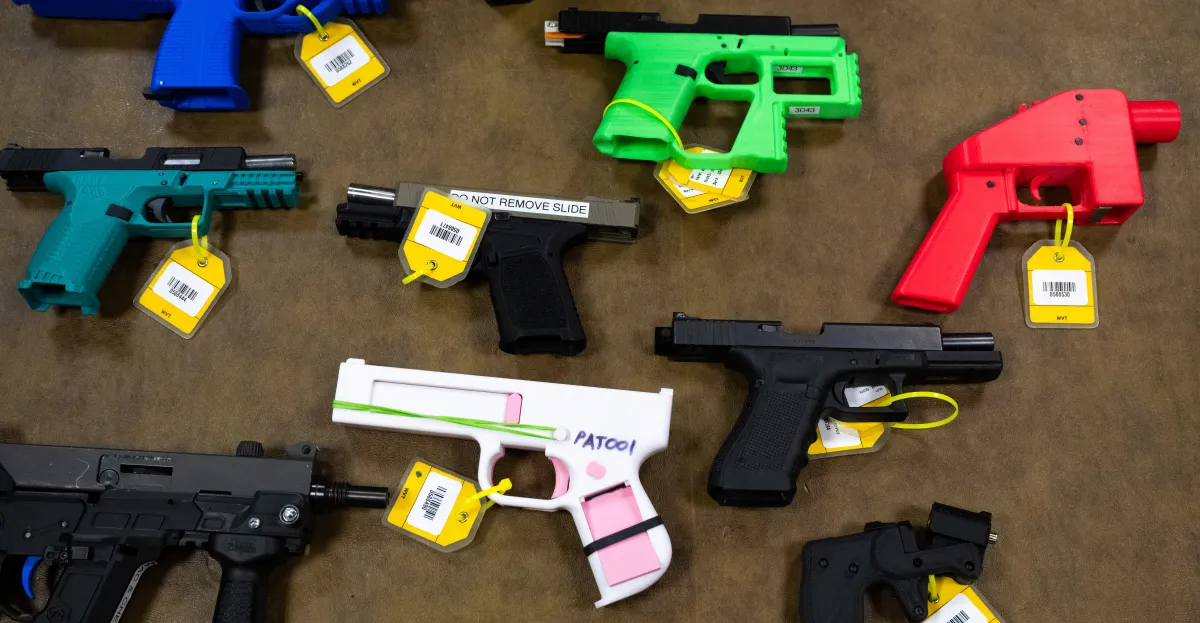
New York Governor Kathy Hochul, alongside fellow state legislators, is urging additive manufacturing firms to impede the fabrication of parts for “ghost weapons”—unserialized firearms which can be privately produced, thereby circumventing vetting procedures with ease.
During a press briefing held on Tuesday, Manhattan’s District Attorney, Alvin Bragg, announced that two additive manufacturing enterprises had willingly committed to implementing technology to prevent the production of weapons via their devices. Additionally, a separate digital design firm assented to taking down certain firearm computer-aided design (CAD) files (the manufacturing schematics) from its platforms, as noted by Bragg. Legislators have put forth bills that would criminalize the unlicensed sale or possession of weapon CAD files and mandate that 3D-printer manufacturers obstruct the fabrication of firearms. Similar prohibitions are either under consideration or already enacted in jurisdictions such as Colorado, New Jersey, and Washington.
“It is impermissible to fabricate counterfeit currency; such actions are prohibited,” Bragg remarked. “Therefore, why would we permit the production of deadly weaponry?”
The slaying of UnitedHealthcare CEO Brian Thompson in December 2024 redirected focus onto untraceable firearms. Luigi Mangione, currently undergoing trial for Thompson’s fatal shooting, allegedly possessed a 3D-fabricated weapon among his effects upon apprehension. During 2025,Wiredextensively illustrated the simplicity of researching, producing, and discharging the firearm Mangione is purportedly linked to in Thompson’s demise.
Bragg, along with Justin Wagner, Everytown for Gun Safety’s managing director, disclosed that they had also engaged with YouTube regarding platform content pertaining to 3D-fabricated weapons. (Wireditself constructed its weapon with assistance from a YouTube personality.) Both Bragg and Wagner noted that the platform had previously adjusted its algorithms and restricted certain material from underage viewers, though Bragg characterized the dialogue as “continuous.” In 2024, YouTube intensified its restrictions on specific gun-related content; Bragg conveyed his appreciation to the corporation for these modifications.
Nevertheless, uncertainties persist regarding the extent to which the advocated legislation would curb the spread of untraceable weapons. Fabricating firearms and their constituent parts remains straightforward and economical—a suitable printer can be acquired for mere hundreds of dollars—and weapon CAD files are readily obtainable on the internet. (California is presently pursuing legal action against two websites providing guidelines for weapon and accessory construction.)
Moreover, untraceable, privately manufactured weapons are not exclusively associated with prominent homicide cases. Contemporary studies indicated a rise in firearm suicide rates corresponding to every 20 untraceable guns located per 100,000 individuals.
{content}
Source:{feed_title}