

Transportation Secretary Sean Duffy launches a civility campaign, ‘Dress Better, Act Better, Fly Better,’ urging air travelers to dress with respect and practice courtesy.
Key Takeaways
- ULCC Model Under Scrutiny:Spirit Airlines’ sudden operational shutdown underscores the inherent vulnerabilities of the ultra-low-cost carrier (ULCC) business model, particularly its susceptibility to economic pressures, competitive forces, and debt burdens, prompting a re-evaluation of the sector’s long-term viability.
- Regulatory Impact on Competition:Transportation Secretary Sean Duffy’s pointed critique of the blocked Spirit-JetBlue merger highlights the significant and often controversial role of government antitrust intervention in shaping the airline industry landscape, with regulators balancing consumer choice against market stability and company resilience.
- Market Realignment & Opportunity:The immediate market response saw major legacy carriers’ stocks rise, signaling a potential consolidation of market share and pricing power, while other budget airlines face increased scrutiny, presenting both challenges and strategic opportunities for the remaining players.
WASHINGTON D.C. –The airline industry was rocked Saturday by the sudden cessation of all operations by Spirit Airlines (FLYYQ), an event that immediately triggered both consumer relief measures from the U.S. government and sharp political accusations regarding regulatory overreach. Transportation Secretary Sean Duffy, speaking from Newark Liberty International Airport, announced a series of relief initiatives for stranded Spirit customers and newly unemployed staff, while simultaneously lambasting the prior administration’s antitrust policies for what he claimed was the direct cause of Spirit’s collapse.
Spirit Airlines confirmed early Saturday morning that it would be “shutting down operations,” leaving thousands of passengers with canceled flights and effectively removing a significant player from the ultra-low-cost carrier (ULCC) segment. The abruptness of the announcement sent ripples through the travel sector and financial markets, immediately impacting related airline stocks.
“This morning at 3 a.m., Spirit Airlines ceased operations. So what that means is Spirit does not have airplanes in the air flying as of this morning. Also, their call centers are closed, and they don’t have staff at ticket counters. So if you have a flight scheduled with Spirit Airlines, don’t show up at the airport. There will be no one here to assist you,” Duffy warned in a Saturday morning press conference.
Industry Rallies to Assist Stranded Travelers
In an effort to mitigate the immediate fallout for consumers, Secretary Duffy confirmed that the four major U.S. airlines—United Airlines Holdings Inc. (UAL), Delta Air Lines Inc. (DAL), JetBlue Airways Corp. (JBLU), and Southwest Airlines Co. (LUV)—have agreed to cap rebooking prices for affected Spirit customers. These airlines will offer a one-way ticket costing approximately $200 for Spirit passengers who can validate their original booking. “I would recommend that if you have a ticket with Spirit that you actually try to book with these airlines as soon as possible, these offers are not going to be open forever,” Duffy advised, emphasizing the urgency.
Beyond the major carriers, other airlines have also stepped up. Allegiant Travel Co. (ALGT), another budget-friendly operator, announced a 50% discount on base fares until May 10, a move likely aimed at absorbing some of Spirit’s customer base while navigating the shifting competitive landscape. American Airlines and Delta are also reportedly reducing fares on high-volume Spirit routes and freezing prices on shared routes, indicating a strategic grab for market share previously held by the now-defunct ULCC.
Preferential Hiring for Former Spirit Employees
The human capital aspect of the shutdown was also addressed. Duffy announced additional relief measures for former Spirit employees, including a pathway for preferential employment interviews at other airlines. “There’s a demand for aviation workers. So, even American and United have drafted or crafted microsites for Spirit employees to potentially jump the line, jump the queue and get preferential treatment in the application process for the many airlines that are now hiring, whether it’s pilots, flight attendants, baggage workers, or even those who have worked in the call centers,” Duffy stated. This initiative highlights the ongoing labor shortage in the aviation sector, offering a silver lining for Spirit’s workforce amidst the company’s collapse.
| Ticker | Security | Last | Change | Change % |
|---|---|---|---|---|
| UAL | UNITED AIRLINES HOLDINGS INC. | 92.52 | +2.52 | +2.80% |
| JBLU | JETBLUE AIRWAYS CORP. | 4.86 | +0.20 | +4.40% |
| FLYYQ | SPIRIT AVIATION HOLDINGS INC | 1.045 | -0.35 | -25.36% |
| DAL | DELTA AIR LINES INC. | 68.98 | +0.99 | +1.46% |
| LUV | SOUTHWEST AIRLINES CO. | 38.76 | +0.84 | +2.22% |
| ALGT | ALLEGIANT TRAVEL CO. | 75.02 | -0.62 | -0.82% |
Political Blame Game: The Role of Antitrust
A significant portion of Duffy’s remarks focused on placing blame squarely on the previous Democratic administration, specifically targeting President Biden, former Transportation Secretary Pete Buttigieg, and the Department of Justice (DOJ), for blocking a proposed merger between Spirit and JetBlue. “Why are we here today?” Duffy asked rhetorically. “There was a proposed merger between JetBlue and Spirit, and Joe Biden and [Biden Transportation Secretary] Pete Buttigieg, along with the Biden DOJ, decided that they did not want that merger to take place.”
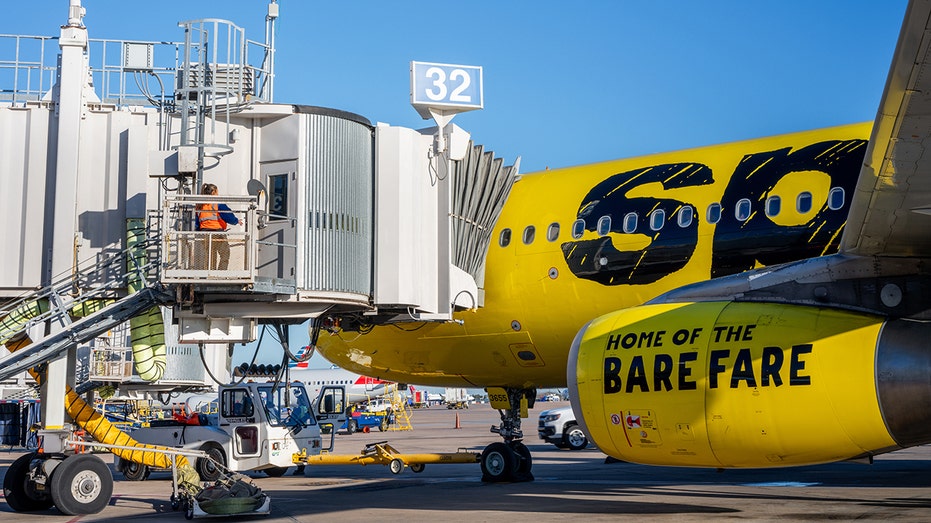
A Spirit Airlines aircraft undergoes operations in preparation for departure at the Austin-Bergstrom International Airport on Feb. 12, 2024, in Austin, Texas.(Brandon Bell/Getty Images / Getty Images)
Duffy argued that the blocked merger, which the Biden DOJ touted as a “victory for U.S. travelers who deserve lower prices and better choices,” ultimately led to Spirit’s demise. “This merger should have been allowed. And this, today would indicate this is not better for travelers. This is not better for pricing. This is not better for competition. Actually. It’s worse. We had an airline go down because the markets were trying to allow two airlines to merge, make them stronger and offer more competition for the American consumer,” he asserted. He further singled out Sen. Elizabeth Warren (D-Mass.) for championing the merger’s blocking. This narrative pits the philosophy of aggressive antitrust enforcement, aimed at preventing market concentration, against the argument that consolidation can sometimes create more resilient and competitive entities, especially for financially struggling companies.
Bailout Attempts and ULCC Sector Outlook
Duffy revealed that the Trump administration had explored various options to bail out Spirit, acknowledging the complexity and financial hurdles involved. “There was a number of ideas being floated on how the government could step in and be helpful to Spirit Airlines. The president was like a dog on a bone trying to figure out a way to keep Spirit afloat,” Duffy recalled. However, the inability to resolve “creditor issues” and the lack of readily available “half a billion dollars lying around” ultimately thwarted these efforts. This underscores the delicate balance between government intervention and market forces, particularly when large-scale financial commitments are required.
Addressing broader concerns for the budget airline sector, Duffy downplayed risks from the ongoing war in Iran, stating, “Spirit was in dire straits long before the war with Iran. Multiple times they had filed for bankruptcy. Their model wasn’t working. They couldn’t get the fiscal health.” This suggests Spirit’s failure was an isolated incident rooted in its specific financial structure and operational challenges inherent to the ULCC model—thin margins, intense price competition, and vulnerability to fuel price fluctuations and economic downturns—rather than a systemic issue for the entire industry. He also noted a recent request from other budget airlines for a $2.5 billion bailout but indicated he did not see it as necessary, encouraging airlines to seek private market financing first, reserving government assistance as a “lender of last resort.”
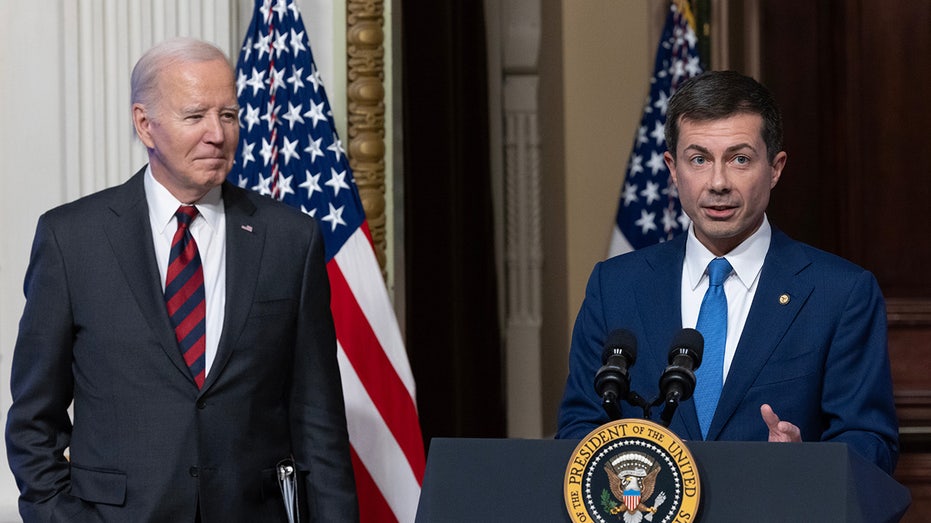
President Biden and Transportation Secretary Pete Buttigieg during an event at the White House in Washington, D.C., on Monday, Nov. 27, 2023.(Michael Reynolds/EPA/Bloomberg via Getty Images / Getty Images)
Market Impact
Spirit Airlines’ demise marks a significant, albeit arguably anticipated, realignment within the competitive U.S. airline market. The immediate beneficiary appears to be the legacy carriers and larger low-cost airlines, as evidenced by the positive movement in their stock prices (UAL +2.80%, JBLU +4.40%, DAL +1.46%, LUV +2.22%) following Spirit’s shutdown (FLYYQ -25.36%). This suggests that investors anticipate these larger players will absorb Spirit’s market share, potentially leading to increased load factors and, crucially, enhanced pricing power on routes where Spirit previously provided intense competition. While Allegiant’s stock saw a slight dip (-0.82%), potentially reflecting broader investor caution regarding the ULCC model, its aggressive discount offer indicates a strategic move to capture displaced demand. The long-term impact will likely include a reduction in ultra-low-cost options for consumers, potentially leading to higher average airfares on previously contested routes. Furthermore, the event intensifies the ongoing debate over the optimal level of airline industry consolidation and the role of antitrust enforcement in balancing consumer benefits with the long-term stability and resilience of aviation companies.
This is a developing story. Please check back for updates.