
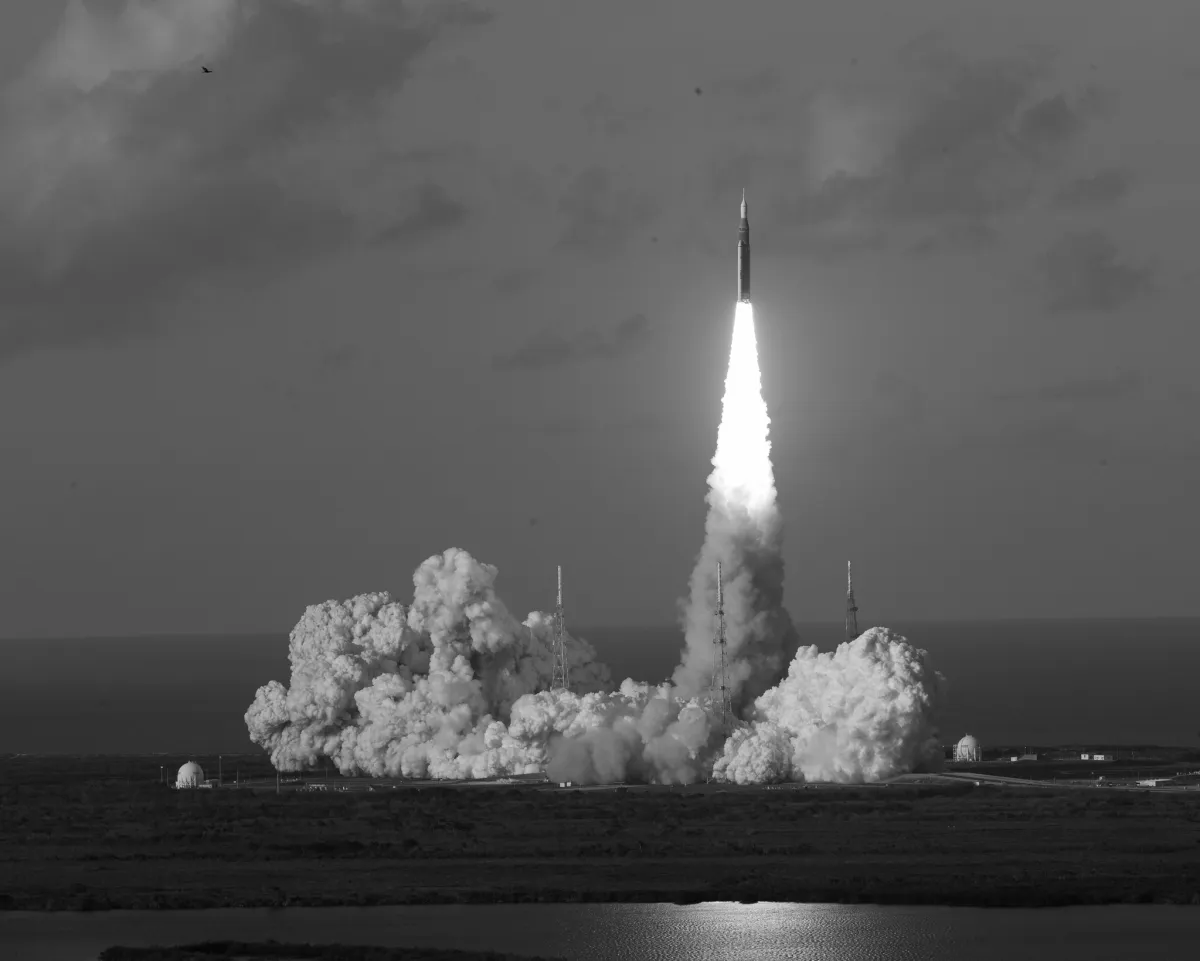
On the very day the United States dispatched astronauts to the Moon for the first time in 54 years, SpaceX initiated its initial public offering. This timing appears highly fitting: It is probably the final instance NASA will attempt to send humans into deep space without substantial aid from an enterprise born out of the privately financed technology sector.
The genesis of NASA’s present lunar endeavor can be traced along an intricate trajectory back to the era of the second Bush administration. During this period, efforts began to devise a colossal launch vehicle and a spacecraft named Orion, intended for a return to the Moon. However, by 2010, the project had exceeded its financial allocation and was subsequently scaled down—and coupled with a fresh initiative designed to support commercial entities constructing novel orbital rockets.
This pivotal decision not only yielded a crucial agreement for SpaceX’s survival but also spurred an influx of private equity into cosmic technologies. It also paved the way for the Space Launch System (SLS) rocket, which is presently transporting four American and one Canadian individual on a journey around the Moon and back.
Currently, the SLS stands as the preeminent functioning launch vehicle globally. It had undertaken a single prior flight, during which it propelled an uncrewed Orion vessel on a demonstration journey around the Moon. This served as a precursor to this week’s momentous undertaking, poised to establish a benchmark for the greatest distance humanity has traversed within the solar system.
On the subsequent occasion, however, the onus will fall upon either SpaceX or Jeff Bezos’ Blue Origin. These two enterprises are currently vying to be the first to land personnel on the lunar regolith.
The SLS and Orion were constructed by NASA’s traditional partners, Boeing and Lockheed Martin, with a contribution from Europe’s Airbus Defense and Space. These projects proved expensive, encountered delays, and were fiscally challenged. In stark contrast, SpaceX was then operating an array of economical, recoverable launch vehicles, thereby initiating a substantial wave of funding into commercial space ventures.
In 2019, when NASA resolved to revisit the Moon, the agency believed it was compelled to retain the SLS and Orion.
Techcrunch gathering
San Francisco, CA
|
October 13-15, 2026
However, a crucial component remained absent: a craft for conveying space travelers from orbit directly onto the lunar terrain. This, NASA determined, would be sourced from the emerging cohort of privately funded aerospace enterprises. Furthermore, the agency sought assistance from several commercial space entities, including Firefly Aerospace and Intuitive Machines, to launch automated probes for exploratory missions and validation purposes.
SpaceX proposed employing its Starship rocket as a lunar lander and, in 2021, secured the contract. This proved to be a contentious choice. Transporting the colossal craft to the Moon will necessitate numerous launches to saturate it with adequate fuel for the journey. Following years of anticipation for the spacecraft, NASA decided to postpone an endeavor to land on the Moon and subsequently reconfigure its program.
“This is a structural design that no NASA chief I’m aware of would have opted for, given the choice,” former NASA administrator Jim Bridenstine informed Congress last year, pointing out that the determination was reached in the absence of an agency head approved by the Senate.
In 2023, Blue Origin was included on the list, tasked with developing its proprietary crewed landing apparatus.
Presently, the agency is seemingly orchestrating a competitive assessment: In 2027, NASA will evaluate Orion’s capacity to link up with one or both landers in orbit, prior to two prospective lunar descents in 2028. This will intensify examination of SpaceX’s forthcoming Starship test, which might happen within the current month, and Blue Origin’s intentions to conduct lunar trials of its lander sometime within the year.
This year has witnessed a significant restructuring of the initiative under the incoming head of NASA, wealthy financial technology magnate Jared Isaacman. Isaacman, who funded two space flights with SpaceX and was endorsed by Musk as the suitable nominee for administrator, experienced a complex path to the role. After being proposed for the position by President Donald Trump, having his candidacy withdrawn, and then being proposed again, he finally assumed his role in late 2025, confronted with a range of challenging decisions regarding the methodology for lunar re-engagement.
In March, Isaacman discarded schemes, widely perceived as extravagant or politically driven by external commentators, to construct an orbital lunar outpost named Gateway and to allocate funds for costly enhancements to the SLS. Presently, he is entirely focused on the emerging cohort of commercial aerospace enterprises.
With China, however, pursuing its methodical trajectory to land one of its nationals on the lunar surface by 2030, any postponements or errors will be interpreted through a geopolitical lens. Silicon Valley has hitherto not surpassed Chinese companies in the tangible sectors of electric cars or robotics. SpaceX has emerged as the enterprise entrepreneurs across the Pacific aspire to replicate, but by venturing to the Moon, Silicon Valley will get an opportunity to demonstrate its continued dominance of the technological forefront.
{content}
Source:{feed_title}