
Prior to his recent meeting with Chinese President Xi Jinping in Beijing, Marco Rubio, now President Trump’s Secretary of State and National Security Adviser, had been designated an “official enemy” by the Chinese state.
During his tenure as a senator representing Florida, Mr. Rubio was recognized as one of President Xi’s most vocal critics in Washington. He had publicly accused the Chinese leader of “crimes against humanity” and asserted that China was actively “plotting to weaken the United States.” As a consequence of these criticisms, Mr. Xi’s government imposed sanctions on Mr. Rubio in 2020, effectively banning him from entering the country.
This prior designation presented a diplomatic challenge in anticipation of President Trump’s first state visit to China in his second term. However, the Chinese government facilitated Mr. Rubio’s entry and participation in the delegation, allowing him to accompany his principal and meet with the Chinese leader.
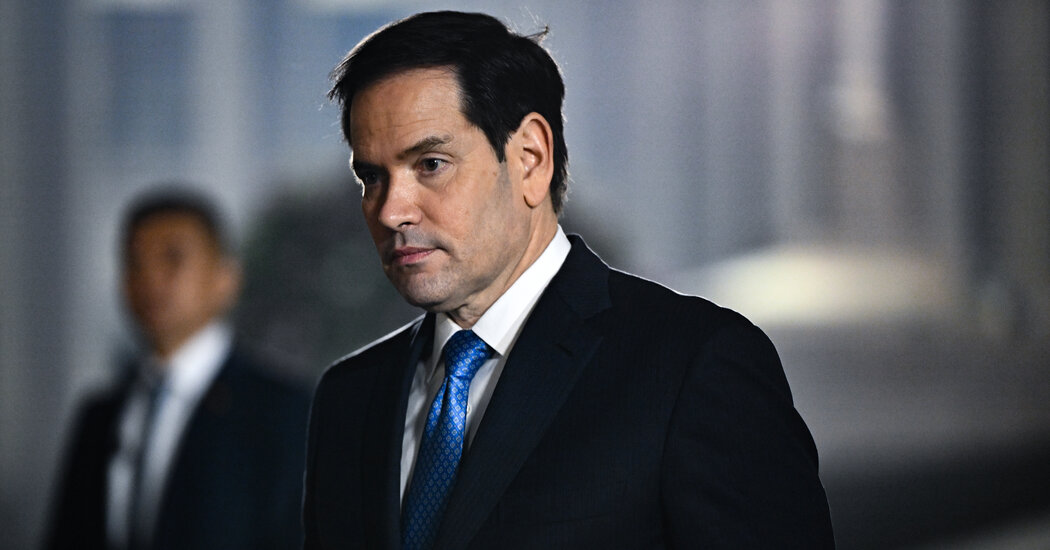
As President Xi greeted the line of U.S. officials outside the Great Hall of the People, Mr. Rubio offered a cordial greeting, maintaining a reserved expression. Later, however, Mr. Rubio was observed to show appreciation for the architectural grandeur of the government buildings, which he had less than 18 months prior denounced as representing “the most potent and dangerous near-peer adversary this nation has ever confronted.”
Inside the Great Hall, while standing with his U.S. counterparts at a long wooden table awaiting the commencement of their meeting with Chinese officials, Mr. Rubio appeared to observe the grand interior with interest, smiling as he gestured repeatedly toward the high ceiling.
Mr. Rubio, who entered the Trump administration with a reputation as a prominent advocate for a confrontational approach to China, has since adopted a more conciliatory tone toward Beijing. He has publicly emphasized the potential for areas of cooperation, a notable shift from his previous years of primarily highlighting the Chinese Communist Party’s human rights abuses.
Explaining this evolution, he stated in an interview with NBC News that his role had changed. “I’m the chief diplomat of the country, and I execute on the president’s foreign policy,” Mr. Rubio remarked.
President Trump, known for his admiration of President Xi, has consistently advocated for the importance of building strong relations between the two nations.
President Trump’s positive assessment of U.S.-China relations was a recurring theme throughout his two-day trip. On Friday, during a tea ceremony with President Xi, he expressed his satisfaction, stating: “This has been an incredible visit.”
“I think a lot of good has come of it,” President Trump said. “We’ve made some fantastic trade deals, great, for both countries.” He also reiterated his customary praise for President Xi, stating: “He’s a man I respect greatly. We’ve become really friendly.”
Despite the more accommodating public posture, Mr. Rubio articulated a more nuanced perspective on China policy in the NBC interview. He emphasized the necessity for the United States to rebuild its industrial manufacturing base, acknowledging that “the Chinese are not going to like it, because they want to dominate those industries, but that’s what’s good for the American people.” He further advocated against the sale of certain advanced semiconductor chips to China and insisted that the U.S. government would not accept “any forced change in the status quo” regarding Taiwan, the de facto independent island that Beijing claims as its territory.
Under Mr. Rubio’s leadership, the State Department has continued to undertake assertive actions targeting China. These include the imposition of sanctions on various Chinese companies for their activities globally. The agency’s specialized office, commonly referred to as “China House,” remains actively engaged in formulating China policy designed to challenge the Chinese Communist Party.
However, in his public statements, Mr. Rubio has consistently highlighted the potential for cooperation with China, aligning with President Trump’s expressed views.
“Areas where we can find mutual cooperation, I think we can,” Mr. Rubio affirmed. “There’s probably virtually no problem in the world that we can’t solve if we work together on it.” Regarding existing tensions, he acknowledged: “There’s always going to be irritants.”
Concerning Taiwan, the State Department announced an $11 billion weapons sale package for the island in December, a move that elicited strong disapproval from China. Nevertheless, in the period leading up to the recent summit, the department has not proceeded with a separate $13 billion arms package that had received congressional approval. U.S. lawmakers have urged the administration to finalize these sales.
When asked whether Mr. Rubio’s stance on China had become more conciliatory since his time in the Senate, the State Department issued a statement enumerating various initiatives undertaken by the Trump administration to assert strength in the bilateral relationship. The statement asserted: “Under President Trump’s leadership, U.S.-China relations have been refocused on what matters most: rebuilding the safety, security and prosperity of Americans.”
Upon becoming a senator in 2011, Mr. Rubio quickly established himself as a prominent critic of China’s government. He frequently expressed concerns regarding the country’s economic and trade practices, as well as its human rights record and democratic deficits. He characterized China as a rapidly growing threat to U.S. national security.
During his campaign for the 2016 Republican presidential nomination, Mr. Rubio delivered a notable speech in August 2015, in which he condemned President Barack Obama’s China policy as a failure of appeasement.
“We can no longer succumb to the illusion that more dialogue with China’s current rulers will narrow the gap in values and interests that separates us,” he declared, promising that, as president, he would challenge Beijing on economic, security, and political fronts. Mr. Rubio even alluded to a desire for political change within China, stating: “Freedom for the people of China must be our goal,” and characterizing it as the “moral duty” of the United States.
With President Obama scheduled to host President Xi in Washington the following month, Mr. Rubio argued against extending a formal welcome to the autocratic leader. “This is an opportunity to speak bluntly to this authoritarian ruler, not to treat him to a state dinner,” he advised.
In contrast to his earlier pronouncements, both President Trump and Mr. Rubio attended a state banquet in Beijing. They are also anticipated to host President Xi during a reciprocal visit to Washington scheduled for late September.
Although Mr. Rubio’s aforementioned speech was delivered more than a decade ago, his actions and statements throughout his Senate career generally remained consistent with its principles.
For instance, when large-scale anti-government demonstrations erupted in Hong Kong in 2019, Mr. Rubio emerged as a vocal proponent of the protesters.
In June of that year, Mr. Rubio sponsored legislation aimed at imposing sanctions on Chinese officials deemed responsible for human rights abuses in Hong Kong, a bill that subsequently received overwhelming approval from Congress. President Trump later threatened to veto a separate but related measure.
Why This Matters
The evolving stance of a high-ranking U.S. diplomat like Secretary of State Marco Rubio toward China carries significant implications for global diplomacy, economic relations, and regional stability. This shift from a consistently hawkish position to a more accommodating one under President Trump underscores the complex interplay between individual political ideology and the demands of executive foreign policy. It highlights the inherent tension between advocating for human rights and democratic values on one hand, and pursuing pragmatic cooperation and economic interests with a major global power on the other.
From a geopolitical perspective, the U.S. Secretary of State’s willingness to engage with Chinese leadership, despite prior sanctions and accusations, signals a potential recalibration in U.S.-China relations. This could influence how other nations perceive the U.S. approach to China, potentially encouraging either greater engagement or caution, depending on their own strategic interests. The ability of the two largest economies to find areas of cooperation is crucial for addressing global challenges such as climate change, pandemics, and nuclear proliferation, yet the underlying ideological and geopolitical competition remains.
Economically, the U.S. administration’s pursuit of “fantastic trade deals” while simultaneously advocating for the rebuilding of American industrial manufacturing and restricting advanced technology sales to China, reflects a multifaceted economic strategy. This approach aims to secure U.S. economic interests and national security, but it could lead to continued trade frictions and impact global supply chains. The balance between competitive assertiveness and cooperative trade frameworks will define the future of the bilateral economic relationship.
Moreover, the subtle yet firm articulation of U.S. red lines, particularly regarding Taiwan and human rights, despite a generally more conciliatory tone, is critical. The U.S. commitment to preventing “any forced change in the status quo” for Taiwan, coupled with continued arms sales, directly challenges China’s territorial claims and is a significant factor in maintaining regional stability in the Indo-Pacific. The perceived consistency of U.S. policy on these sensitive issues will be closely watched by allies and adversaries alike.
Ultimately, the narrative surrounding Mr. Rubio’s policy evolution illustrates the dynamic nature of U.S. foreign policy, often shaped by presidential directives and the exigencies of international relations. It also raises questions about the long-term consistency of U.S. diplomatic messaging and its impact on the nation’s credibility and influence on the world stage, especially concerning its commitment to human rights and democratic principles when faced with strategic imperatives.
Washington D.C. – U.S. Secretary of State Marco Rubio, once a leading congressional critic of China, has adopted a markedly different tone since assuming his current role, emphasizing cooperation and strategic stability with Beijing. This shift in approach has become particularly evident as a diplomatic solution was found regarding Chinese sanctions previously imposed on him.
Before his appointment as Secretary of State in the Trump administration, Mr. Rubio, then a U.S. Senator, was widely recognized as a “China hawk” due to his consistent and vocal criticism of Beijing’s human rights record, trade practices, and regional assertiveness.
During his tenure in the Senate, Mr. Rubio played a significant role in shaping U.S. policy toward China. He was a primary proponent of the Hong Kong Human Rights and Democracy Act, legislation designed to support human rights and democratic freedoms in Hong Kong. The act became law in 2019, despite initial considerations by then-President Trump to veto the measure due to concerns it could jeopardize trade negotiations with Chinese President Xi Jinping. President Trump ultimately signed the bill into law.
Mr. Rubio also actively championed Taiwan, advocating for strengthened U.S. ties with the island and sponsoring legislation aimed at expediting U.S. arms sales. His vigilance regarding U.S. support for Taiwan was evident in a 2018 Senate hearing, where he questioned a senior State Department official about the disappearance of the Taiwanese flag from a specific page on the department’s website, a flag China considers illegitimate.
A prominent critic of Beijing’s treatment of Uyghur Muslims, Mr. Rubio frequently condemned China’s policies in the Xinjiang region. He publicly characterized the documented practices of forced labor and “re-education” in Xinjiang as grave human rights violations. In June 2020, he spearheaded the passage of legislation, the Uyghur Human Rights Policy Act, which mandated the U.S. government to impose sanctions on Chinese officials implicated in these policies. The Trump administration subsequently implemented these sanctions.
Beijing responded to these actions by imposing retaliatory sanctions on Mr. Rubio and other U.S. officials perceived as critical of China. Later that summer, China enacted additional sanctions on these individuals in response to further U.S. sanctions targeting Hong Kong officials.
However, less than six months into his term as Secretary of State, Mr. Rubio’s public statements began to reflect a shift towards the necessity of cooperation with China. This period coincided with the Trump administration’s renewed efforts to forge a partnership with President Xi, following an initial phase of tariffs on Chinese exports.
Following a meeting in July 2025 in Malaysia with Wang Yi, China’s top diplomat, Secretary Rubio articulated a new perspective. He stated that both men perceived an “opportunity here to achieve some strategic stability and identify areas where we can cooperate together on and build better communications and working trust.” This language represented a noticeable departure from his earlier, more confrontational stance.
Since that meeting, summaries of occasional talks released by the State Department have consistently included similar phrasing, emphasizing dialogue, communication, and cooperation. This sustained diplomatic tone suggests a deliberate effort to manage and stabilize the complex U.S.-China relationship.
As planning for a high-level summit intensified this year, the lingering Chinese sanctions on Mr. Rubio presented a unique diplomatic challenge. For over a decade, Chinese state media had referred to him by variations of his name, 卢比奥 and 鲁比奥 (“lubiao”). Beijing ultimately offered a diplomatic resolution to this predicament: Chinese officials stated that the sanctions had been imposed on Mr. Rubio in his capacity as a U.S. senator, not as a member of the Trump administration.
Liu Pengyu, the spokesman for the Chinese embassy in Washington, addressed the issue in a statement to The New York Times on Thursday. He clarified, “The sanctions are aimed at Mr. Rubio’s actions and rhetoric on China when he served as a U.S. senator.” Mr. Liu did not, however, confirm whether China had formally lifted the sanctions.
Ruoxin Zhang contributed research.
Why This Matters
The evolution of Secretary of State Marco Rubio’s stance on China, from a prominent “hawk” in the Senate to an advocate for “strategic stability” and cooperation in the executive branch, reflects the intricate and often contradictory nature of U.S.-China relations. This shift is significant for several reasons:
- Policy Realignment:It demonstrates a pragmatic adjustment in foreign policy when an individual transitions from a legislative oversight role to an executive implementation position. As Secretary of State, Mr. Rubio is tasked with managing the totality of U.S. foreign policy, which often necessitates diplomatic engagement even with adversaries, rather than solely advocating for specific legislative actions.
- U.S.-China Relations Trajectory:This change in rhetoric and approach signals a potential desire by the U.S. administration to de-escalate tensions and seek areas of common ground with China, even amidst ongoing competition. It suggests a move away from purely confrontational tactics towards a more nuanced strategy that incorporates both competition and cooperation. Such a shift could influence global trade, climate change efforts, and regional stability in the Indo-Pacific.
- Human Rights Implications:For advocates of human rights, particularly those concerned with China’s treatment of Uyghur Muslims and the situation in Hong Kong, a more conciliatory tone from the U.S. Secretary of State could be seen as a de-prioritization of these issues in favor of broader diplomatic stability. While the U.S. may continue to raise these concerns, the emphasis on “cooperation” might dilute the perceived urgency or strength of their advocacy.
- Diplomatic Ingenuity and Precedent:The resolution of the sanctions dilemma, with China distinguishing between “Senator Rubio” and “Secretary of State Rubio,” highlights the creative and often circuitous routes diplomacy can take to overcome obstacles. This specific explanation, while perhaps semantic, allowed both sides to save face and proceed with high-level engagements without a formal repeal of sanctions, potentially setting a precedent for future diplomatic impasses involving sanctioned officials.
- Domestic Political Dynamics:Mr. Rubio’s shift could have implications for domestic U.S. politics, particularly among the Republican Party’s conservative base, which traditionally favors a tough stance on China. It might illustrate the tension between political rhetoric and the realities of governing and international diplomacy.
In essence, Secretary Rubio’s evolving position underscores the complex dance of U.S.-China diplomacy, where hardline stances can yield to pragmatic engagement when national interests demand it. The manner in which the sanctions issue was handled provides a clear example of how diplomatic flexibility can pave the way for continued, albeit cautious, dialogue between two global powers.