
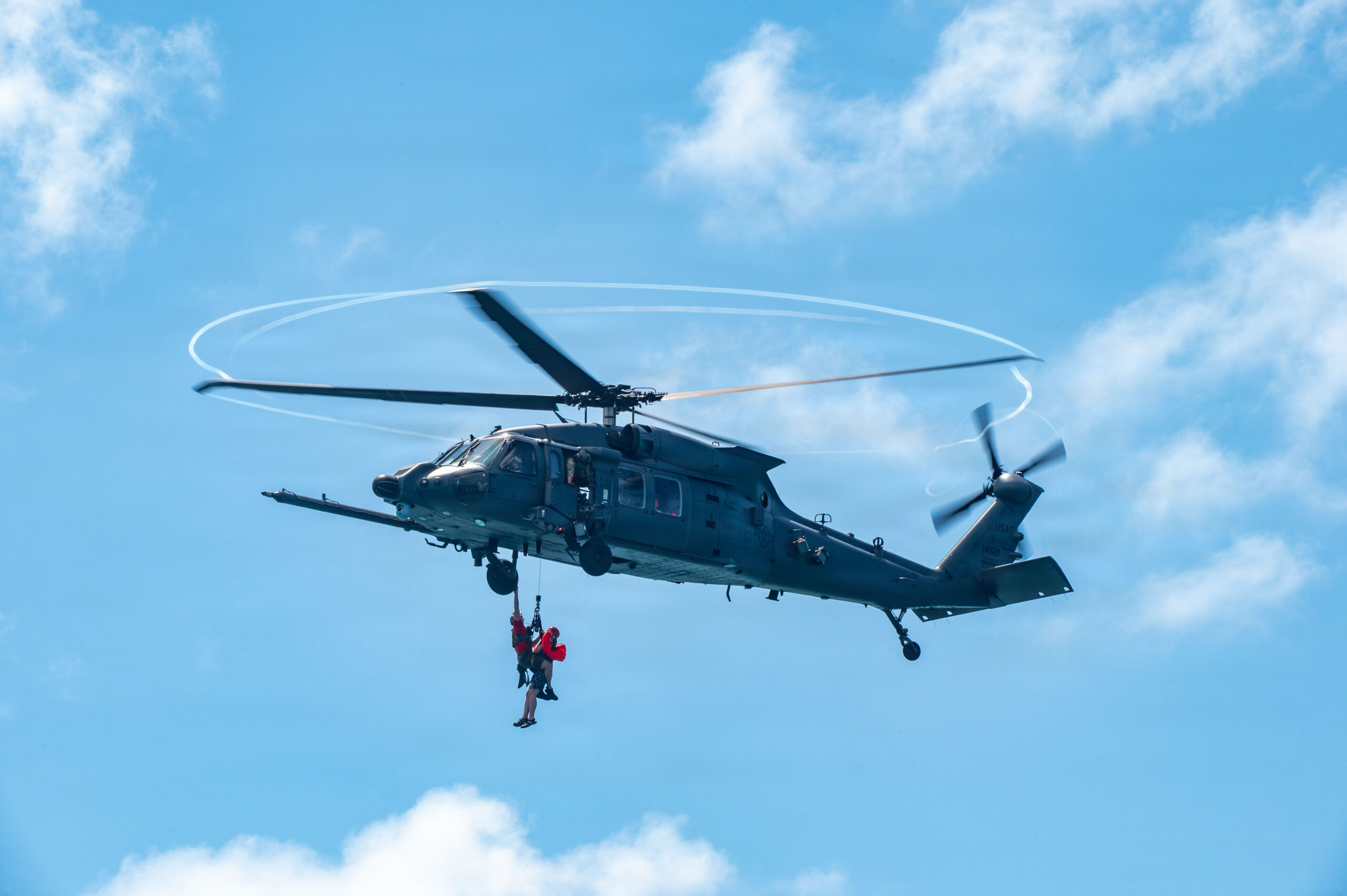
May 16, 2026– Air Force Reserve personnel from the 920th Rescue Wing successfully rescued 11 survivors of a civilian aircraft crash off the coast of Florida on May 12, after their routine training mission was diverted by a distress call. The operation, conducted approximately 80 miles offshore, involved specialized combat search and rescue aircraft and personnel in challenging maritime conditions.
The incident began on the morning of May 12 when a twin-engine turboprop aircraft, en route from Marsh Harbour, Bahamas, to Freeport, Florida, issued a distress signal. The U.S. Coast Guard responded by dispatching its own search aircraft and contacting the 920th Rescue Wing, based at Patrick Space Force Base, Florida, to provide critical air support.
At the time of the distress call, Reserve Airmen were conducting a routine training flight aboard an HC-130J Combat King II transport aircraft and an HH-60W Jolly Green II helicopter. Their mission was immediately redirected to the last known position of the downed aircraft.
Upon arrival at the search area, the crew of the HC-130J Combat King II, utilizing sophisticated onboard search equipment, located the 11 survivors. They were found huddled together in a single life raft, having endured approximately five hours in turbulent 3- to 5-foot seas. No fatalities were reported from the crash, which Maj. Elizabeth Piowaty, commander of the HC-130J’s seven-Airman crew from the 39th Rescue Squadron, described as “nothing short of miraculous” for a ditching at sea.
Once the life raft was sighted, the Combat King II crew deployed a survival bundle, which included additional rafts, to provide immediate aid to the stranded individuals. Concurrently, they relayed the precise location to the approaching HH-60W Jolly Green II helicopter.
Lt. Col. Matt Johnson, commander of the HH-60W, known colloquially as “the Whiskey,” maneuvered the helicopter to a hover about 10 feet above the water. Capt. Rory Whipple, a combat rescue officer aboard the Jolly Green II, then oversaw the hoisting operation.
“Once the basket was in the water we started working,” Whipple stated during a May 13 press conference at Patrick Space Force Base. He detailed how one pararescueman (PJ) managed the hoist, lifting survivors into the helicopter’s cabin, while another PJ assessed and treated any potential injuries among those rescued. The specialized team conducted approximately nine hoists to bring all 11 individuals safely aboard the helicopter.
The rescue presented additional challenges for the helicopter crew. They had initially been informed to expect six to eight survivors, meaning the actual number of 11 required on-the-spot recalculations. Lt. Col. Johnson and his team had to quickly reassess the aircraft’s weight, remaining flight time, and whether they would need to dump fuel to ensure a safe return to base, all while operating close to their “bingo time”—the point at which an aircraft has just enough fuel to return without refueling. Fortunately, no fuel dump was required.
Following the successful recovery, the helicopter crew transported the survivors to Melbourne International Airport for medical evaluation and further assistance. The rescue operation showcased the seamless coordination between military branches and the readiness of specialized search and rescue units.
Col. Chadd Bloomstine, commander of the 920th Operations Group, commended the efforts, stating, “This rescue highlights the readiness, professionalism, and interoperability our Airmen train for every day. We are proud to have played a role in bringing 11 people home safely.” Master Chief Petty Officer Omar Colon, a command duty officer with the Southeast Coast Guard District, echoed this sentiment, emphasizing that “The outstanding support from Patrick Space Force Base and the seamless coordination among all responding agencies directly contributed to the successful rescue of 11 survivors from the downed aircraft.”
The search efforts were also supported by a Coast Guard Air Station Clearwater C-27 Spartan aircraft. Bahamian officials are expected to lead the investigation into the cause of the civilian aircraft’s crash, given its origin and destination within Bahamian airspace and U.S. territory.
The 920th Rescue Wing and the Jolly Green II
The 920th Rescue Wing holds a distinctive position within the Air Force Reserve as its sole combat search and rescue unit operating the HH-60W Jolly Green II. The wing boasts a long history of critical rescue missions, including being the first Air Force Reserve unit to conduct a rescue operation in January 1957, when it saved Airmen from a collision of two B-47 bombers off the coast of Cuba.
The HH-60W represents a significant upgrade to the Air Force’s combat search and rescue capabilities, replacing the aging HH-60G Pave Hawk, which had been in service since the 1980s. The 920th Rescue Wing received its first HH-60W in February 2024, and currently, five Jolly Greens are assigned to the 301st Rescue Squadron at Patrick Space Force Base. Lt. Col. Johnson noted the opportunity to use the new systems during this rescue, stating, “It was cool to use those systems and maybe bring something back for debrief for new tactics, techniques, and procedures as far as how we can be even better next time when this call comes.”
The wing’s capabilities were also demonstrated in a complex 2024 mission, which involved airlifting a critically ill passenger from a cruise ship 350 miles off the U.S. coast. That eight-hour operation required two Pave Hawks, two Combat Kings, and three air-to-air refuelings to cover over 1,000 miles, underscoring the unit’s long-range rescue proficiency. More recently, the Jolly Green II played a prominent role in the early April rescue of downed U.S. pilots during Operation Epic Fury in Iran, highlighting its combat utility.
Manufactured by Lockheed Martin/Sikorsky, the HH-60W is derived from the robust Black Hawk airframe, incorporating advanced avionics, defensive systems, and enhanced fuel capacity tailored for combat search and rescue missions.
The procurement history of the HH-60W has seen several adjustments since it achieved initial operational capability in 2022. Original Air Force plans for 113 “Whiskeys” were scaled back to 85 in 2023, only to be subsequently increased to 102 following later funding changes. The fiscal year 2026 enacted budget accounts for the procurement of two additional aircraft, bringing the total close to the revised target. However, the fiscal year 2027 budget proposal currently allocates no funds for procuring further HH-60W aircraft, although significant investments in modifications and improvements are still planned. The Air Force is requesting $100 million in its 2027 budget specifically for upgrading the Whiskey fleet, including the integration of counter-rocket lasers for its combat role and modifications to facilitate VIP transport missions in the Washington D.C. area, reflecting the multi-faceted strategic value of these helicopters.
Why This Matters
The successful rescue of 11 individuals from a downed civilian aircraft by the U.S. Air Force Reserve’s 920th Rescue Wing underscores several critical aspects of national and international emergency response and defense capabilities. Firstly, it highlights the indispensable value of military readiness and specialized training for humanitarian missions. The Airmen involved were on a routine training flight, demonstrating that military assets and personnel are often prepared for immediate deployment in unexpected civilian emergencies. This capability provides a vital layer of public safety, extending rescue operations far beyond the reach of standard civilian emergency services, particularly in challenging maritime environments.
Secondly, the operation exemplifies effective inter-agency cooperation. The seamless coordination between the U.S. Coast Guard, which initiated the call, and the Air Force Reserve unit, which executed the complex rescue, is crucial for maximizing efficiency and saving lives in time-sensitive situations. Such interoperability is a testament to established protocols and ongoing joint training exercises that ensure different branches of government can work together cohesively.
Thirdly, the rescue showcases the significant investment in advanced search and rescue technology, particularly the HH-60W Jolly Green II helicopter. As a newer platform, the “Whiskey” offers enhanced capabilities over its predecessors, including improved range, survivability, and mission systems. Its deployment in this rescue, coupled with the HC-130J Combat King II, validates the ongoing efforts to modernize military fleets. The detailed discussion around the HH-60W’s procurement and planned upgrades—from counter-rocket lasers for combat to VIP transport modifications—reveals the strategic versatility and long-term planning associated with these assets, influencing budget decisions and defense policy. These helicopters are not just for combat, but are foundational to global humanitarian assistance and disaster relief efforts, projecting U.S. capabilities in life-saving missions worldwide.
Finally, this incident, while originating from a civilian aircraft distress, reinforces the importance of international cooperation in aviation safety. The investigation led by Bahamian officials signifies shared responsibilities across borders for air travel safety and emergency response, demonstrating a global commitment to preventing future accidents and ensuring accountability. The successful outcome of this particular mission not only saved lives but also served as a powerful reminder of the dedication and expertise of military personnel who stand ready to respond to crises, regardless of their origin.