
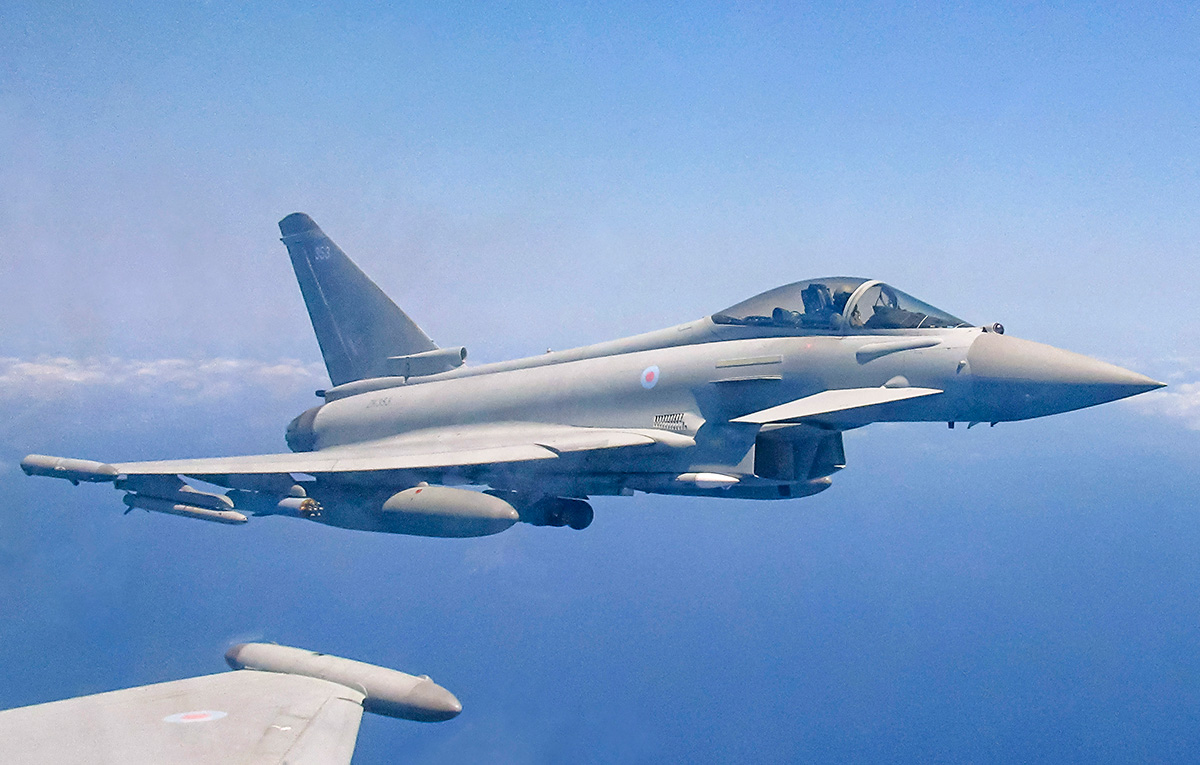
UK Bolsters Typhoon Fleet with Rapid Anti-Drone Missile Deployment Following Welsh Trials
In a significant move to counter evolving aerial threats, the United Kingdom has swiftly integrated and deployed a new low-cost anti-drone missile system onto its Royal Air Force (RAF) Typhoon fighter jets. This rapid enhancement of defensive capabilities was significantly accelerated by a series of critical trials conducted at the Ministry of Defence (MOD) Aberporth range in West Wales, a facility managed by QinetiQ under its long-standing partnership with the Ministry of Defence.
The weapon in question, the Advanced Precision Kill Weapon System (APKWS), developed by BAE Systems, underwent rigorous testing earlier this year at the Welsh range. These trials were instrumental in clearing the system for immediate operational deployment, with RAF 9 Squadron Typhoons now flying sorties in the Middle East as part of ongoing defensive missions in the region. The APKWS is a laser-guided rocket that transforms unguided 70mm rockets into precision-guided munitions, offering a cost-effective solution for engaging small, fast-moving targets such as drones, which have become an increasingly prevalent threat in modern conflict zones.
QinetiQ, a global defence technology company, played a multifaceted role in this accelerated deployment. Beyond operating the Aberporth test range, the company provided crucial engineering integration support for the weapon system with the Typhoon ahead of the trials. This involved ensuring seamless compatibility between the new missile and the sophisticated avionics and weapon systems of the fighter jet. Furthermore, QinetiQ was responsible for establishing and maintaining a comprehensive safety zone at the range, a critical prerequisite for live-fire exercises. Crucially, the company also supplied realistic aerial targets, allowing RAF pilots to train against scenarios mirroring real-world threats.
Among the sophisticated targets utilized during these pivotal trials was QinetiQ’s Banshee Whirlwind. Manufactured in Ashford, Kent, this uncrewed aerial vehicle (UAV) training target is capable of reaching speeds of approximately 350 mph. Its high performance and realistic flight characteristics make it an ideal stand-in for various aerial threats, including advanced drones. The Banshee Whirlwind system is a testament to the importance of realistic training environments, being employed by over 30 countries worldwide to simulate hostile aerial threats during live firing exercises and weapon system evaluations.
Steve Wadey, Group Chief Executive Officer of QinetiQ, highlighted the significance of this rapid capability delivery, stating that the trials work underscored the company’s vital role in supporting urgent defence requirements.“From engineering expertise to live trials, our teams are providing the fundamental support needed by our armed forces, to deliver the urgent capabilities that ensure the UK and its allies remain safe and warfighting ready,”Wadey remarked, emphasizing the collaborative effort between industry and the military.
QinetiQ’s involvement in this rapid integration was facilitated through two established contractual frameworks, demonstrating the efficacy of long-term strategic partnerships in defence procurement. The engineering integration work was executed under the Engineering Delivery Partnership (EDP) contract, through which QinetiQ delivers a broad spectrum of specialist engineering services essential for the ongoing maintenance and development of the RAF’s Typhoon fleet. This contract provides a flexible and readily available pool of expertise for complex tasks.
Concurrently, the critical range activity at Aberporth was conducted under the Long Term Partnering Agreement (LTPA). This strategic framework, originally signed in 2003 for a 25-year duration, covers comprehensive test, trials, training, and evaluation services across 16 Ministry of Defence-owned sites spanning England, Scotland, and Wales. The LTPA ensures that the UK military has consistent access to world-class testing facilities and expertise. Reflecting its continued importance, a five-year, £1.54 billion extension to the LTPA was announced in May 2025, solidifying the partnership’s future through 2033.
A key enabler of the unusually rapid timeline for the APKWS deployment was the ability to conduct live firing trials at a domestic UK range against realistic targets. This avoided the logistical complexities, time delays, and potential security concerns associated with relying on overseas facilities. MOD Aberporth, strategically located on the Cardigan Bay coast, has a rich history spanning decades in weapons trials and unmanned systems testing. It stands as one of the few ranges in the United Kingdom uniquely capable of supporting live air-to-air missile firings over the sea, making it an invaluable national asset for maintaining and advancing the UK’s air defence capabilities.
The successful and swift integration of the APKWS onto the Typhoon fleet underscores a proactive approach by the UK military and its industry partners to adapt to the changing landscape of modern warfare, where drone threats are increasingly sophisticated and prevalent.
Why This Matters
The rapid integration and deployment of the Advanced Precision Kill Weapon System (APKWS) on RAF Typhoon jets represent a critical development with several significant implications for global security and military strategy. Firstly, it directly addresses the escalating threat posed by Unmanned Aerial Vehicles (UAVs) or drones, which have emerged as formidable and cost-effective tools for both state and non-state actors in contemporary conflicts. By equipping its premier fighter jets with a dedicated, low-cost anti-drone missile, the UK enhances its defensive capabilities against a pervasive modern challenge, ensuring its forces are better prepared for evolving aerial threats in contested regions like the Middle East.
Secondly, this achievement highlights the strategic advantage of sovereign defence capabilities and robust industry partnerships. The ability to conduct complex live-firing trials domestically at MOD Aberporth, supported by QinetiQ’s engineering expertise and test range management, dramatically accelerated the deployment timeline. This contrasts sharply with the logistical challenges, costs, and potential delays often associated with relying on international facilities. It underscores the UK’s commitment to maintaining independent test, evaluation, and training infrastructure, which is vital for rapid innovation and operational readiness.
Thirdly, the use of the APKWS, which transforms existing unguided rockets into precision munitions, exemplifies a cost-effective approach to modern warfare. This “smart weapon” strategy allows for enhanced precision without the prohibitive cost of entirely new missile systems, making it a sustainable solution for countering numerous drone threats. This approach is likely to influence other nations as they seek to balance advanced defence capabilities with budgetary realities.
Finally, this development signals the UK’s proactive posture in adapting to the future of warfare. As drones become more sophisticated and proliferate, nations capable of rapidly developing, testing, and deploying effective countermeasures will gain a significant strategic edge. The successful integration on the Typhoon not only boosts the RAF’s immediate operational effectiveness but also sets a precedent for agile defence procurement and technological adaptation in an increasingly complex global security environment.