
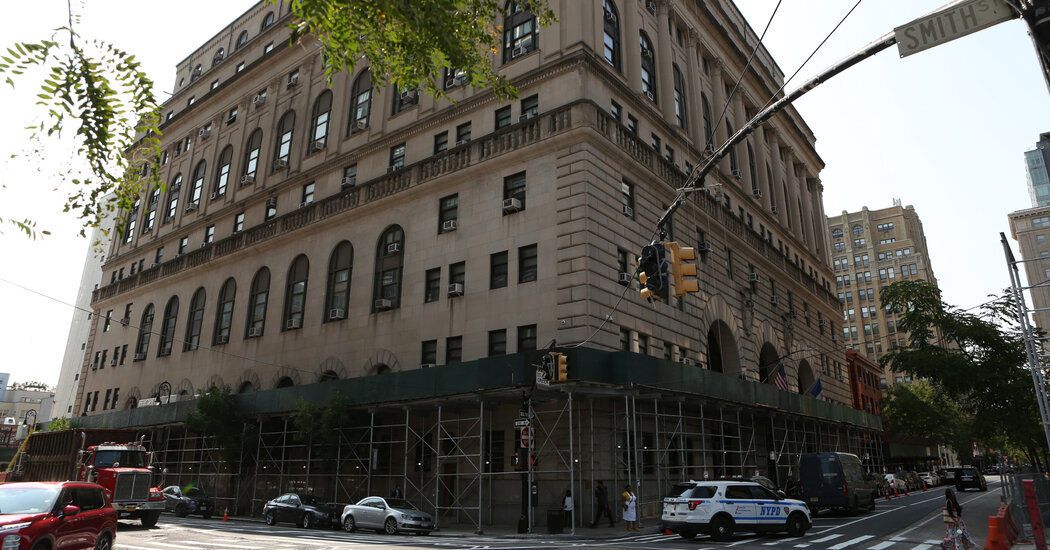
On a Friday evening in a Brooklyn criminal court, an unexpected medical emergency unfolded when a 33-year-old woman, nine months pregnant, went into labor while awaiting her arraignment on low-level charges. The incident occurred shortly before midnight, transforming a routine judicial setting into an impromptu delivery room.
Samantha Randazzo, the defendant, was seated on a bench in the courtroom when, around 11:30 p.m., she visibly slumped. Her attorney, Wynton Sharpe, observed her condition and recognized that her water had broken, indicating imminent childbirth. “We saw it,” Mr. Sharpe stated, conveying the immediate realization of the situation. “She didn’t have to say anything. We were like, oh OK, this is happening, like, now.”
Responding swiftly to the unfolding situation, court officers immediately mobilized. Some rushed to assist Ms. Randazzo directly, while others, alongside the presiding judge, facilitated the clearing of the courtroom to ensure privacy and safety. The space, moments before a venue for legal proceedings, rapidly adapted to accommodate the urgent medical event, with court personnel taking on an unexpected role in a medical emergency.
Minutes before midnight, Ms. Randazzo successfully delivered a baby boy. Mr. Sharpe described the newborn as a “bouncing baby boy,” though he was not aware if the child had yet been named. The birth, while a joyous event in itself, occurred under complex and challenging circumstances, prompting reflection on the broader context of Ms. Randazzo’s presence in court.
Mr. Sharpe characterized the moment as a “joyful and sad situation, given the circumstances,” reflecting the dual emotions evoked by a birth occurring within the confines of a criminal court. While New York City has seen other unconventional births—such as Zenovia Remy Legette, born on discarded furniture in the Bronx, and “Baby W,” born on a moving subway train in Manhattan last year—sources interviewed by The Times on Saturday indicated no recollection of a child being born inside a city courtroom, marking this event as highly unusual.
The incident has prompted significant criticism regarding systemic protocols, particularly concerning the treatment of pregnant individuals within the justice system. Justine Luongo, the chief attorney of the Legal Aid Society’s criminal defense practice, voiced strong concerns. She emphasized the necessity for officials to provide explanations regarding why Ms. Randazzo was not offered an alternative to arrest, why she was discharged from the hospital approximately 30 hours prior to the birth, and why her case was not dismissed immediately upon her initial detention given her advanced pregnancy.
Ms. Luongo asserted, “This is a horrific example of many, many system failures,” adding that individuals like Ms. Randazzo are those for whom “we should be thinking about services and treatment, and not incarceration and arrest.” Her comments underscore a broader debate about the appropriate handling of vulnerable individuals, particularly pregnant women, within the criminal justice system and the potential for existing procedures to exacerbate, rather than alleviate, difficult personal circumstances.
Ms. Randazzo’s arrest occurred on Thursday on charges of drug possession and trespassing. According to police reports, she was found on the roof of her building in the Nostrand Houses, a public-housing complex located in the Sheepshead Bay neighborhood of Brooklyn, without proper authorization. During a subsequent search, officers reportedly discovered a small quantity of heroin and cocaine in her possession, leading to the drug possession charge.
A law enforcement official, who spoke on the condition of anonymity due to not being authorized to discuss the specifics of the case, clarified that Ms. Randazzo was ineligible for a desk-appearance ticket. A desk-appearance ticket typically allows an individual arrested for certain low-level offenses to be released from the police station and appear in court at a later scheduled date, rather than being held in custody for immediate arraignment. Her ineligibility was attributed to an existing open arrest warrant, which under standard protocol, necessitated her detention and brought her to court for arraignment in custody.
Following her arrest, police transported Ms. Randazzo to a hospital for medical evaluation due to her pregnancy. She was discharged roughly 30 hours later, after which officers took her to the criminal court in Brooklyn for her formal arraignment. Mr. Sharpe commented that the medical professionals at the hospital had apparently not recognized how close Ms. Randazzo was to giving birth at the time of her discharge, a point that has drawn scrutiny from legal advocates and public health observers alike regarding the thoroughness of medical assessments for pregnant detainees.
Despite the challenging circumstances, Mr. Sharpe commended the prompt and effective actions of the court officers involved in the delivery, specifically recognizing Officer Robert Winckler, who assisted directly in the birth. Mr. Winckler reportedly informed Mr. Sharpe that he had been present for the births of his own children, which Mr. Sharpe noted “was clear” in his adept and calm response during the emergency. Al Baker, a spokesman for the Office of Court Administration, echoed this sentiment, stating that the officers’ actions “personified the everyday virtues of their sworn service” and expressed delight that “both mother and baby are well.”
The Fire Department confirmed receiving a call at 11:58 p.m. reporting that a “civilian gave birth” at the Brooklyn criminal court. An ambulance arrived approximately 10 minutes later, transporting Ms. Randazzo and her newborn son to the Brooklyn Hospital Center for further medical care and postnatal observation. Following these dramatic events, Ms. Randazzo’s arraignment proceeded in her absence. Her attorney, Mr. Sharpe, indicated that he anticipated the case against her, stemming from the drug possession and trespassing charges, would ultimately be dismissed, reflecting a potential acknowledgement of the extraordinary circumstances and the disproportionate impact of continued prosecution.
Why This Matters
The birth of a baby in a Brooklyn courtroom underscores critical issues concerning the treatment of vulnerable individuals within the criminal justice system, particularly pregnant women. This incident highlights several potential systemic failures, ranging from initial arrest protocols to medical screening and the conditions under which individuals are held pre-arraignment. It prompts a broader societal discussion about the intersection of health, justice, and humanity.
Firstly, the case raises serious questions about the appropriateness of arresting and detaining a heavily pregnant woman for low-level, non-violent offenses, even in the presence of an open warrant. Legal advocates argue that alternatives to incarceration, such as pre-arraignment release, bail reform, or immediate referral to social services and treatment programs, should be prioritized for vulnerable populations. The detention of Ms. Randazzo, which led to her laboring in a courtroom, exemplifies the potential for existing legal mechanisms to create inhumane conditions rather than effectively address underlying issues or ensure public safety or judicial efficiency. It compels a reevaluation of when and how pre-trial detention is applied.
Secondly, the fact that Ms. Randazzo was discharged from a hospital approximately 30 hours before giving birth, without medical staff apparently recognizing the imminence of her labor, points to potential gaps in medical assessment protocols for detainees. This aspect of the case necessitates a thorough review of how medical evaluations are conducted for pregnant individuals in custody, and whether adequate communication and care coordination exist between law enforcement agencies, medical facilities, and the courts. Ensuring comprehensive, appropriate, and timely medical care for pregnant detainees is not merely a procedural matter but a fundamental human rights issue, impacting both the health and dignity of the mother and the wellbeing of the unborn child.
Finally, the incident brings into focus the broader intersection of public health challenges, poverty, and the criminal justice system. Ms. Randazzo’s charges involved drug possession and trespassing in a public housing complex—offenses often linked to underlying social and economic distress. Critics argue that individuals facing such complex challenges frequently require social services, substance abuse treatment, housing support, and mental health care rather than punitive legal action. The event serves as a stark reminder that the justice system often encounters individuals with multifaceted needs that extend far beyond legal culpability, and that a more holistic, compassionate, and health-informed approach could prevent such avoidable crises. The expected dismissal of her case, after such an ordeal, further highlights the potential for unnecessary detention and the resulting strain on both individuals and public resources. This unique and dramatic event may catalyze discussions on policy reforms aimed at expanding diversion programs, improving medical protocols for incarcerated pregnant individuals, and a reevaluation of criteria for pre-trial detention to ensure justice is served with humanity.