
Audio of this article is brought to you by the Air & Space Forces Association, honoring and supporting our Airmen, Guardians, and their families. Find out more at afa.org
The United States Air Force is preparing to acquire thousands of advanced new handheld radios beginning in 2027. These devices, known as the Next-Generation Survivor Radio (NGSR), are designed to enhance communication capabilities for downed aircrew members with search-and-rescue forces. The criticality of such technology was underscored earlier this year during the successful recovery of two aviators who were shot down in Iran.
The NGSR is slated to replace the Combat Survivor Evader Locator (CSEL) radio, which has been in service since 2006. The development of the NGSR program commenced with an initial investment in 2025, gaining significant momentum with $51.7 million in research and development (R&D) funding allocated in the 2026 defense budget.
For the fiscal year 2027, the Air Force has requested $96 million for the NGSR program. Of this amount, $80 million is earmarked for the procurement of 6,868 radios, along with associated spares and support equipment. While the Air Force is leading the development and acquisition effort, the NGSR units are intended for distribution to aviators across all U.S. military branches, including the Army, Navy, and Marine Corps, ensuring broad interoperability for joint personnel recovery operations.
According to official budget documents, the NGSR will upgrade the existing radio’s “legacy satellite communication and encryption methods.” Key features of the new system include “secure, over-the-horizon, two-way data communications and precise geo-positioning information.” Furthermore, the device is designed to be approved by the National Reconnaissance Office (NRO) for its low probability of detection or interception, a crucial attribute for personnel operating in contested environments. It will also incorporate “modern encryption technology” certified by the National Security Agency (NSA), ensuring the highest level of communication security.
The NGSR functions as a critical “node” within a comprehensive personnel recovery network. This network encompasses multiple on-orbit satellite constellations, geographically dispersed satellite ground stations, various joint service Combat Search and Rescue (CSAR) communication devices, and a cloud-based web application managed by the Joint Personnel Recovery Center. This integrated approach aims to provide a robust and resilient framework for locating and recovering isolated personnel.
In 2026, the Air Force’s primary focus for the NGSR program involves extensive testing and integration of the new radio within this broader personnel recovery network. The subsequent year, 2027, is slated for the transition to rapid fielding, facilitating the swift deployment of these crucial devices to operational units.
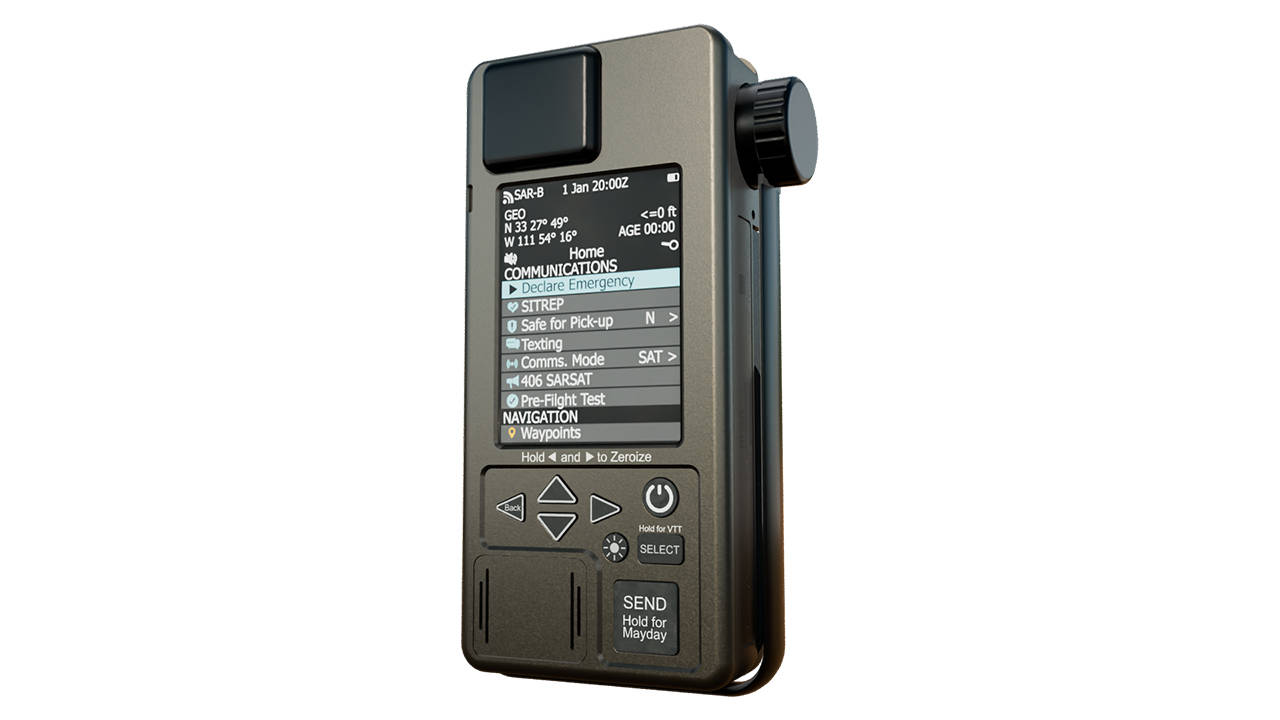
General Dynamics is the prime contractor responsible for manufacturing the NGSR. The company reports that the new radio will be notably lighter, smaller, and more power-efficient compared to its predecessor. Its design is described as having a “cell phone-like form factor,” making it more manageable for aviators to carry and operate. While similar in size to a large smartphone, it is designed with greater thickness to accommodate its specialized components and ruggedization for military use.
A significant technological advancement of the NGSR is its software-defined architecture. This allows the radio to be reprogrammed and upgraded digitally to adapt to future waveforms and communication standards, providing a flexible and future-proof system. It supports both secure voice and text messages, offering multiple communication modalities. Additionally, the NGSR is compatible with the more advanced and secure M-code GPS signal, which offers enhanced accuracy and anti-jamming capabilities compared to civilian GPS signals, further bolstering precise location determination in challenging conditions.
The existing CSEL radio, while having been in service since 2006, has undergone multiple upgrades over its operational life. It provides secure voice and data transmissions across a variety of frequencies and satellite constellations, proving its worth in numerous recovery operations over the years.
The effectiveness of such personnel recovery radios was prominently demonstrated in early April during the rescue operation for a downed F-15E pilot and weapon systems officer, identified by the call sign “DUDE 44.” President Donald Trump confirmed on April 6 that one of the aviators successfully used his radio to transmit his precise location, enabling the rapid and effective rescue mission.
President Trump stated at the time, “They have a very sophisticated beeper-type apparatus that is on them at all times. When they go out on these missions, they make sure they have lots of battery space and they’re in good shape, and this one worked really well, amazingly, saved his life.” An Air Force official subsequently confirmed to Bloomberg that the President was referring to the CSEL radio, underscoring its vital role in the recovery.
Boeing, the manufacturer of the CSEL, has produced over 50,000 units for the U.S. military. While the Air Force’s current budget documents do not specify the total number of NGSRs planned for acquisition over time, and projected procurement funding shows a decrease in 2028, the service has indicated that it will certify its long-term spending plans in future budgets, suggesting that additional funding and procurement may be added in the coming years as the program matures and expands.
Why This Matters
The development and fielding of the Next-Generation Survivor Radio (NGSR) represent a significant advancement in U.S. military capabilities, with profound implications for personnel safety, national security, and strategic deterrence. The primary importance lies in its direct impact on the lives of service members. Aviators and other personnel operating in high-risk environments, particularly those in contested or hostile territories, face inherent dangers. The ability to quickly and securely communicate their location and status after an incident dramatically increases their chances of survival and successful recovery. This not only reassures service members and their families but also upholds the military’s core principle of leaving no one behind.
From a national security perspective, the NGSR enhances operational readiness and enables the U.S. to conduct missions with greater confidence. The knowledge that advanced recovery capabilities exist allows commanders to deploy forces into more challenging areas, knowing that if an incident occurs, there is a robust system in place to retrieve personnel. This capability also serves as a deterrent to adversaries, signaling that targeting U.S. personnel will not prevent their recovery and may instead provoke a determined response. The secure, low-probability-of-detection communications and precise geo-positioning features are critical in an era of sophisticated electronic warfare and increasingly contested operational domains, where traditional communication methods might be jammed or intercepted.
Technologically, the NGSR signifies a commitment to staying ahead of evolving threats. By replacing “legacy” systems with modern encryption and satellite communication methods, the U.S. ensures its personnel recovery network remains resilient against adversarial attempts to disrupt or exploit communications. The software-defined nature of the radio provides flexibility, allowing for future upgrades and adaptability to new communication waveforms without requiring a complete hardware overhaul. This ensures long-term cost-effectiveness and sustained technological relevance. The integration with M-code GPS further strengthens its utility, offering superior accuracy and resistance to interference.
Finally, the joint-service nature of the NGSR program underscores the importance of interoperability across the U.S. armed forces. By standardizing advanced personnel recovery radios for aviators in the Air Force, Army, Navy, and Marine Corps, the program ensures seamless communication and coordination during joint recovery operations, which are increasingly common in modern warfare. This collective approach to personnel recovery technology strengthens the overall effectiveness and cohesion of U.s. military efforts globally.
Audio of this article is brought to you by the Air & Space Forces Association, honoring and supporting our Airmen, Guardians, and their families. Find out more at afa.org