
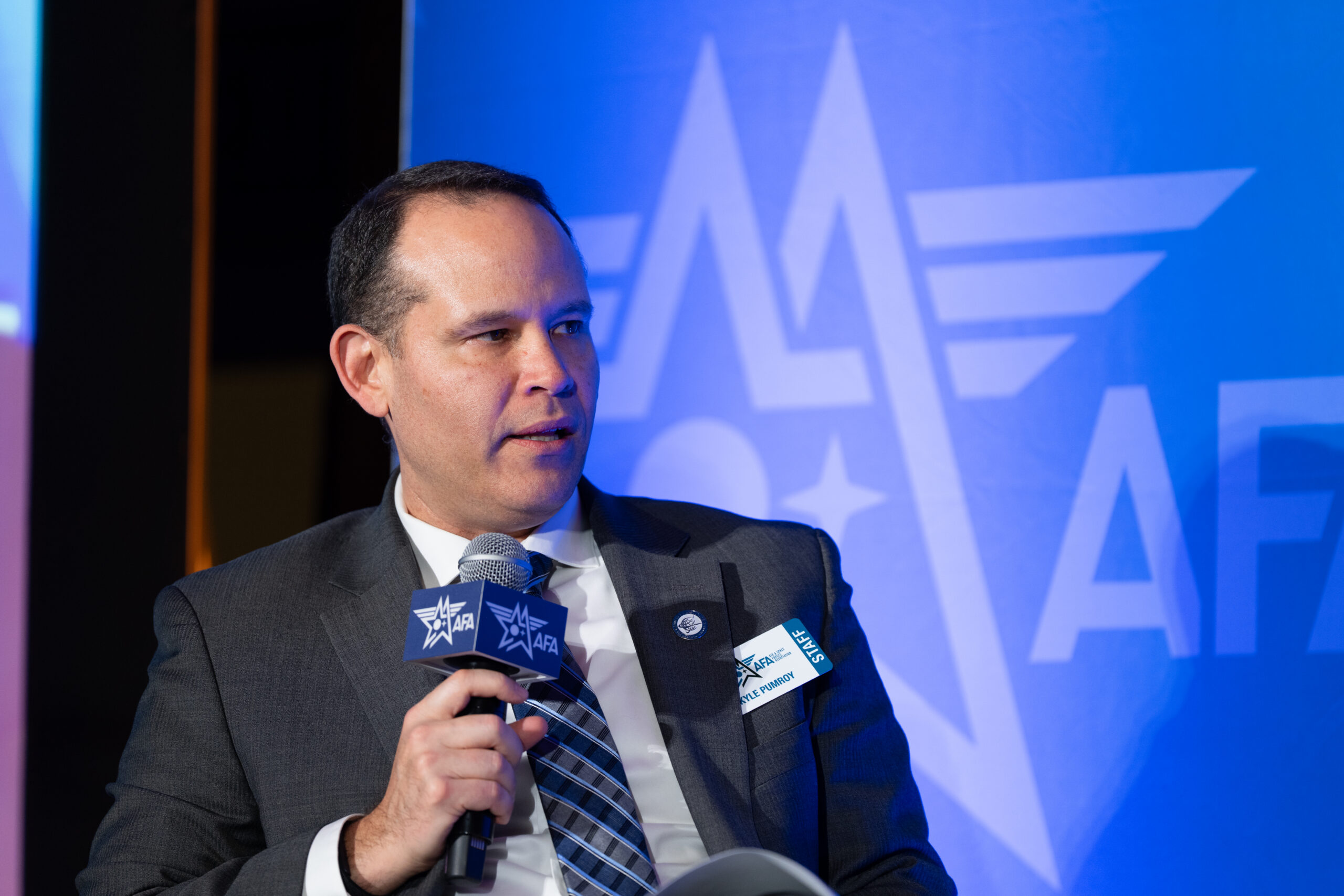
A new report from the Air & Space Forces Association’s Mitchell Institute for Aerospace Studies argues that the U.S. Space Force must begin preparations immediately to establish a human presence in orbit and on the moon. This initiative, the report contends, is critical for countering the expanding ambitions of China in space, which are increasingly seen as a direct challenge to U.S. interests and leadership in the domain.
Authored by retired Col. Kyle Pumroy, a senior resident fellow at the Mitchell Institute, the comprehensive paper details specific threats posed by China’s integrated military and civilian manned spaceflight program. It also proposes concrete steps that the Space Force, the National Aeronautics and Space Administration (NASA), and private industry can undertake to bolster American capabilities and address potential future conflicts in space.
During a May 21 press roundtable, Colonel Pumroy emphasized the urgency of the situation, stating that without a serious commitment to initiating a military human spaceflight program, the United States risks ceding vital ground in what many observers now characterize as a new space race. Pumroy clarified that the objective is not to establish a vast, science-fiction-esque presence immediately, but rather to strategically “plant seeds” with a small contingent of personnel. This initial group would gradually expand into dozens, potentially forming a future force of 100 or more Guardians with the necessary Title 10 authorities—the legal framework that allows the U.S. military to operate with humans in space.
“We’re not talking about building rovers with lasers to put on the moon in the next few years,” Pumroy stated. “It’s to begin developing the skills, tools, and concepts necessary for future Title 10 missions now using low-Earth orbit as a proving ground for a small number of Guardians.” These Guardians, he suggested, could undergo advanced training as a follow-on course to the existing Space Test Course, a rigorous 12-month graduate program at the Air Force Test Pilot School located at Edwards Air Force Base, California. Such a program would equip military personnel with the unique skill sets required for human operations in the space domain.
The U.S. Space Force itself has outlined ambitious growth plans, aiming to double its personnel to 20,000 Guardians over the next five years. This expansion is deemed essential by service leaders to manage a rapidly expanding mission portfolio, which includes critical functions such as satellite communications, targeting, precise position, navigation, and timing (PNT), intelligence, surveillance, and reconnaissance (ISR), and space control capabilities. The question of whether this growth and these evolving missions necessitate placing Guardians directly into space has been a recurring topic of discussion, garnering support from various external experts.
While the idea of military human spaceflight has gained traction, particularly in recent years, Space Force leadership has largely maintained a more reserved public stance. In January, Vice Chief of Space Operations Gen. Shawn Bratton acknowledged the concept as being on the fledgling service’s “long to-do list” during a conference, though he offered no further specifics. Similarly, in February, at the AFA’s Warfare Symposium, Maj. Gen. Robert W. Claude, who directs Task Force-Futures on the Space Staff, stated, “I can’t sit here today and tell you that we will or we won’t have Guardians in space at any point in the future,” reflecting the ongoing internal deliberation and strategic assessment.
The Evolving Threat from China
The new Mitchell report underscores its primary argument by highlighting China’s distinctive approach to space development. It asserts that China’s integrated military and civilian space program, coupled with its historical pattern of disregarding international territorial norms—evident in regions such as the South China Sea and the Arctic—serves as a clear indicator of potential competition rather than cooperation with the United States in space. Retired Col. Charles Galbreath, director of Mitchell’s Spacepower Center of Excellence, voiced skepticism regarding China’s adherence to established norms. “We’ve seen year in and year out that here terrestrially China has violated existing norms, and so even if we establish them, would they adhere to them?” he questioned.
The report cites China’s remarkable progress as evidence of this growing threat. Between 1992 and 2022, China successfully achieved nearly all of its ambitious spaceflight objectives. A key milestone is the continuous presence of Taikonauts—the Chinese term for astronauts, who are exclusively military members—aboard the Tiangong space station since June 2022. This sustained human presence in low-Earth orbit provides China with invaluable experience in long-duration space operations and demonstrates a robust capability in manned spaceflight.
Colonel Pumroy warns that with continued advancements in human spaceflight, China could establish what he terms a “Space Silk Road.” This network would extend China’s control over critical space assets and logistics, ranging from communication and surveillance satellites to potential future resources on the moon, such as rare minerals. Such a development would not only confer significant economic advantages but also present a formidable strategic and military challenge to nations reliant on a free and open space domain.
To counter this multifaceted threat, Pumroy’s report offers several key recommendations:
- The National Security Adviser should direct the creation of a comprehensive strategy for a military human spaceflight program. This strategy would aim to bridge the existing civil-military gap in space operations and firmly establish a national security imperative for human presence in space.
- The Space Force should be designated as the lead entity for this military human spaceflight program, integrating it fully into its forthcoming objective force document, which outlines the service’s future operational requirements and capabilities.
- The Space Force should establish a specialized follow-on course to the current Space Test Course, designed to provide advanced training for military personnel intended for human spaceflight missions.
- Concurrently, the Space Force should commit to expanding the infrastructure and resources of the Space Test Course to significantly increase its capacity and produce a greater number of qualified graduates.
- The Space Force should actively pursue and expand career-broadening opportunities for its personnel, fostering collaborations with NASA and emerging commercial space station and spaceflight industries to build expertise and interoperability.
- Congress should provide dedicated funding to support NASA’s collaboration with the military human spaceflight program, facilitate the expansion of the Space Test Course, and create opportunities for Guardians to gain practical experience on orbiting space stations.
The Indispensable Human Element in Space
China has declared its intention to establish a fully operational, manned lunar station by 2040, a goal that underscores its long-term strategic vision for human presence beyond Earth orbit. Colonel Pumroy argues forcefully that if China achieves a sustained human presence in deep space, the United States must also deploy humans to effectively counter their capabilities, rather than relying solely on unmanned robotic systems. The nature of future space operations, particularly in a potentially contested domain, will demand the unique attributes that only humans can provide.
“Space security will likely require both unmanned and manned systems and missions,” Pumroy stated. “Humans bring adaptability, persistence, judgment, credibility, and deterrent value that machines alone cannot fully replicate.” While robotic systems excel in precision and repetitive tasks, humans possess unparalleled cognitive abilities for real-time problem-solving, complex decision-making in unforeseen circumstances, and the capacity for on-site repair and improvisation. Furthermore, a visible human presence, especially military personnel, can project national resolve and act as a deterrent, signaling a nation’s commitment to defending its interests in space.
The proposed approach for developing this future manned space mission envisions Guardians partnering extensively with NASA and the burgeoning commercial space industry. This collaborative model is intended to leverage the expertise and technological innovations of both civil and private sectors, effectively countering China’s centrally controlled, government-led integration of industry, space, and military programs. This could entail a more frequent and institutionalized presence of Guardians alongside NASA astronauts on space station missions, fostering joint operational experience and knowledge transfer.
While U.S. military personnel have previously served on the International Space Station—such as Brig. Gen. Nick Hague, who spent six months on the ISS as a NASA astronaut in 2024-2025, and Col. Nick Hopkins, who joined the USSF while in orbit on the station in 2020—these instances have been primarily under NASA’s civilian astronaut program. Both individuals have since retired from NASA. The Mitchell report advocates for a dedicated military human spaceflight program, distinct from, yet collaborative with, NASA’s exploration efforts, ensuring that the U.S. military is equipped with its own capabilities and personnel prepared for the unique challenges of operating in space.
Why This Matters
The growing discourse surrounding the militarization of space and the potential for a U.S. military human presence beyond Earth carries profound implications across geopolitical, economic, and security spheres. As space transitions from a domain primarily for scientific exploration and commercial applications to a contested strategic frontier, the ability of nations to operate, defend, and even control key orbital and lunar assets becomes paramount.
Geopolitical and National Security Stakes:A primary driver behind these discussions is the strategic competition with China. The report highlights China’s rapid advancements and integrated civil-military approach to space, including its deployment of military Taikonauts and stated ambitions for a lunar base. Should China establish a dominant human presence in space, it could gain a significant strategic advantage, potentially controlling critical infrastructure, surveillance capabilities, and access to valuable resources. For the United States, maintaining parity or superiority in this domain is essential for safeguarding national interests, projecting power, and ensuring the resilience of its global communications, navigation, and intelligence networks that are increasingly reliant on space-based assets. A military human presence could offer enhanced capabilities for on-orbit servicing, repairs, surveillance, and potentially even defensive operations, providing a level of adaptability and judgment that autonomous systems currently lack.
Economic Implications:Beyond military considerations, the future of space holds immense economic potential. The concept of a “Space Silk Road” suggests control over lunar resources, orbital logistics, and even space-based manufacturing. Whichever nation or consortium establishes a strong foothold in these areas stands to gain significant economic leverage. Ensuring U.S. access and freedom of operation in space is therefore crucial for protecting its vast commercial space industry, fostering innovation, and securing future economic opportunities. The development of military human spaceflight capabilities could also spur technological advancements with spillover benefits for civilian space exploration and commercial applications, from advanced life support systems to propulsion technologies.
International Norms and Deterrence:The debate also touches upon the establishment and enforcement of international norms in space. With China’s alleged history of disregarding territorial norms on Earth, there is concern about similar actions in space, an environment currently governed by treaties like the Outer Space Treaty, which prohibits national appropriation of celestial bodies and weapons of mass destruction in orbit. A U.S. military human presence could serve as a deterrent against aggressive actions and provide a credible means to uphold international agreements and ensure freedom of navigation and access in space. It would signal a clear commitment to defending U.S. and allied interests in this critical domain, potentially shaping the future rules of engagement and behavior in the cosmos.
In essence, the recommendations in the Mitchell Institute report underscore a growing recognition that the future of global power and security will increasingly be intertwined with a nation’s capabilities and presence in space. The decision to commit to a military human spaceflight program is not merely a technological or logistical challenge, but a fundamental strategic choice with long-term consequences for the balance of power on Earth and beyond.