
Editor’s Note: This is the second in a two-part series on Air Education & Training Command’s new aircraft simulators. Part 1, on Detachment 24, is available here.
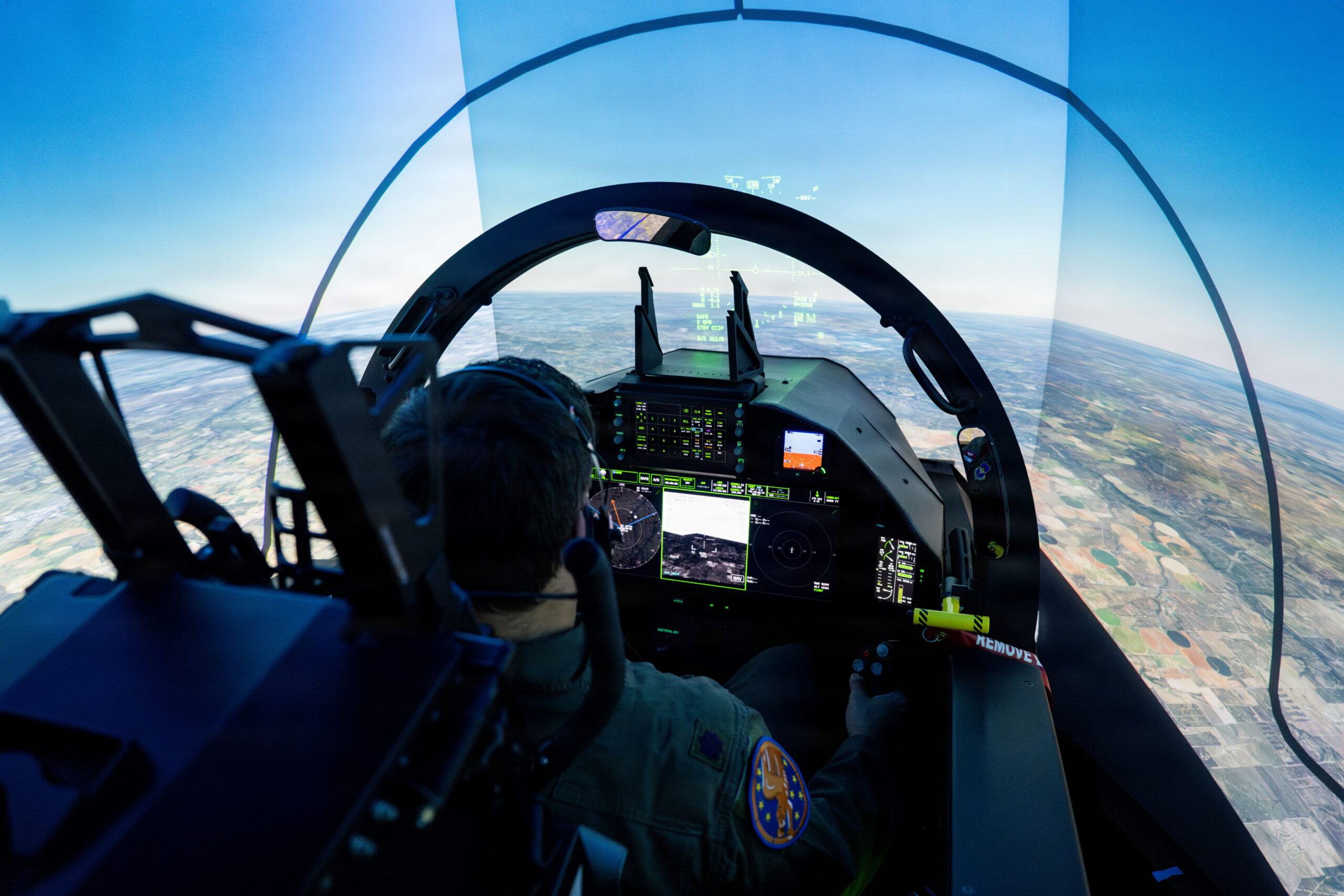
JOINT BASE SAN ANTONIO-RANDOLPH, Texas—The arrival of the first T-7A Red Hawk aircraft at Joint Base San Antonio-Randolph in late December marked a significant advancement in the U.S. Air Force’s pilot training modernization efforts. While the initial T-7A jets represent a tangible step forward, a complementary and equally critical development is unfolding in a nearby facility: the integration of the T-7’s Ground-Based Training System (GBTS).
This sophisticated GBTS is engineered to bridge the gap between simulated and actual flight, introducing a new era in flight simulation technology. Air & Space Forces Magazine visited the site in January as the initial GBTS units underwent testing by the 99th Flying Training Squadron, with support from contractor Boeing.
Lt. Col. Michael “Hyde” Trott, commander of the 99th Flying Training Squadron, highlighted the technological leap represented by the new system. Comparing it to the older T-38 program, Trott stated, “The quality of the simulator, between the hardware and the operational flight program, is leaps and bounds better in the T-7.” He further noted that the transition from simulator to actual flight in the T-7 is considerably smoother than with the T-38, citing a “much smaller gap and leap from sim to jet in the T-7 than the T-38.”
The GBTS is not a monolithic system but rather a comprehensive suite comprising several distinct training devices, explained Steven “Stein” Dobrinski, a Boeing flight simulator design engineer. The most fundamental component is the “Part Task Trainer,” which consists of a desktop computer equipped with a flight stick and throttle. This device is designed to familiarize new pilots with the T-7’s central Large Area Display, allowing them to learn basic interface navigation, menu functions, and display configuration at a minimal cost.
The T-7’s Large Area Display consolidates the multiple screens and controls found in the T-38 into a single, adaptable interface. This display can be configured to show varying amounts of information based on pilot preference or mission requirements. Examples of configurations include the “snowman” layout—an Attitude Director Indicator positioned above a Horizontal Situation Indicator—and a four-“portal” arrangement, each capable of displaying up to two smaller “insets,” potentially monitoring up to 12 distinct functions simultaneously, as described by Lt. Col. Trott.
The second level of T-7 training is provided by the Unit Training Device. This system features a high-fidelity cockpit replica, a large video monitor for visual feedback, and an instructor operator station. Students utilize this simulator to practice checklists, basic systems operation, and “switchology,” while instructors can monitor performance and inject scenario alerts.
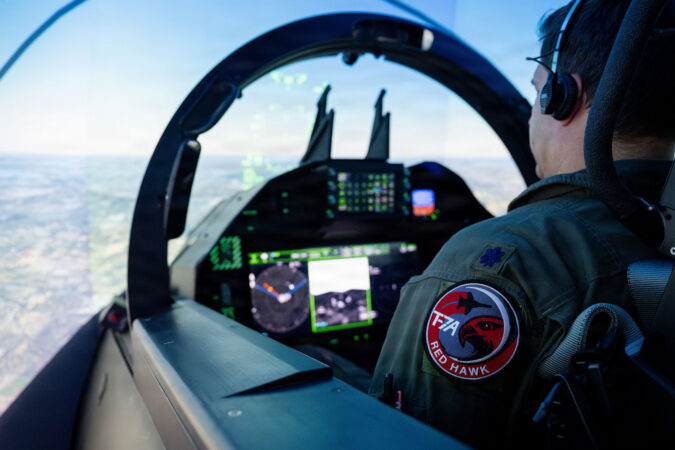
The third component, the Operational Flight Trainer (OFT), is intended for foundational flight training. It boasts a 300-degree field-of-view display, a functional canopy latching mechanism, and a motion-capable seat that responds to user inputs. Additionally, it integrates with an associated G-suit system. As Dobrinski explained, “If I’m pulling G’s, it will apply pressure into your suit,” simulating the physiological effects of high-G maneuvers. This feature aims to condition pilots to the physical demands of combat aircraft, encouraging subconscious straining even before G-forces fully manifest.
At the apex of the T-7 trainer hierarchy is the Weapons System Trainer (WST). This advanced simulator is designed to support both basic and complex fighter maneuvers, including air combat tactics. Encased within an egg-shaped structure, the WST offers a full 360-degree field of view.
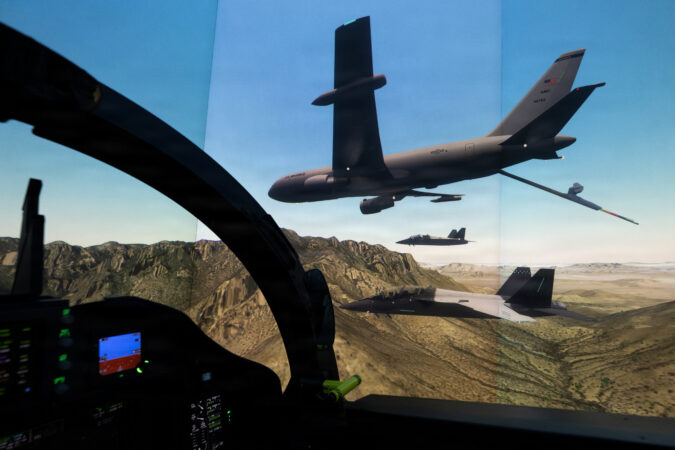
Dobrinski elaborated on its capabilities, stating, “The concept is that we’re going to be able to pull some of these more advanced training tasks into the sim.” He emphasized the WST’s ability to render opponent aircraft with sufficient fidelity to allow pilots to accurately gauge aspect angles in dogfighting scenarios, a significant improvement over previous simulators where distant aircraft often appeared as mere dots. “Our models and our imagery allow people to make decisions based on a perceived aspect angle, and we should be able to see it farther out in this than any of the other sims that are out there,” Dobrinski added.
The WST also enables student pilots to practice advanced tasks such as air-to-air refueling and close formation flying. The simulator’s motion platform simulates turbulence, while its high-resolution visuals provide precise details of other aircraft and accurate depth perception. Lt. Col. Trott affirmed the WST’s uniqueness in this regard: “The T-38 sim—even the F-15 sim—the physics of it and the resolution wasn’t such that I could gauge range and line of sight rate of the other aircraft to fly close formation. This is the only one I’ve ever been in where it can do that.”
Both the flight stick and throttle in the WST incorporate back-driven flight controls, utilizing electric motors to replicate the exact feel and resistance of the actual T-7 aircraft. Dobrinski noted, “We’re going to get the data from the jet … and we’ll fine tune the gains to match what the aircraft is really doing.” Furthermore, the simulators are built using the T-7’s Operational Flight Program (OFP), ensuring that as the OFP evolves, the simulators will update concurrently, maintaining fidelity with the aircraft.
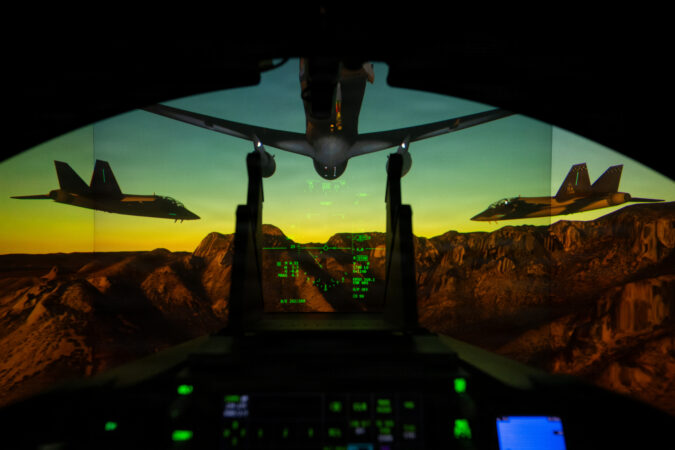
A core ambition of the T-7 training program is its capability for Live, Virtual, and Constructive (LVC) Training. LVC allows simulators to connect and operate with any T-7 jet in real-time, creating a unified training environment. Dobrinski described this as a “gaming area” where “all the entities, the sims and the airplanes, that are all talking to each other in the same gaming area.”
Through LVC, simulators and actual aircraft can engage in scenarios as if equipped with various armaments or external pods. When a pilot employs a virtual weapon from either a simulator or a jet, other participants in the LVC network will observe the simulated effects on their displays. Boeing has already conducted tests successfully linking airborne T-7s with ground-based simulators. These tests validated communications, weapons interaction, the generation of constructive entities by the jet, and their visibility and engagement within the simulator environment.
While the immediate focus for the Air Force is on configuring and testing the foundational aspects of the training system, the LVC framework holds significant future potential. Dobrinski anticipates that eventually, up to eight manned entities—a combination of simulators and actual jets—could fly together in a blended formation, engaging with as many as 64 constructive entities (computer-generated adversaries or allies).
This capability extends far beyond traditional flight simulators. It promises a future where new pilots gain proficiency not only in aircraft operation but also in managing complex battlespace scenarios and effectively employing the advanced tools characteristic of fifth- and sixth-generation combat jets. Dobrinski summarized the expanded capabilities by likening the T-7 GBTS to a “four-drawer Craftsman toolbox” compared to the “one-drawer” of the T-38, emphasizing the significantly increased range of tactical skills that can be taught.
Part 1 of the series on AETC’s simulator training is now available.
Why This Matters
The implementation of the T-7A Red Hawk’s Ground-Based Training System (GBTS) represents a pivotal shift in military pilot education and readiness. This advanced simulation technology carries profound implications for the U.S. Air Force, national security, and the future of air combat:
- Enhanced Pilot Readiness and Proficiency:The T-7A GBTS introduces an unprecedented level of realism, enabling student pilots to master complex maneuvers, systems operation, and tactical decision-making in a highly immersive environment. Features like the G-suit integration, accurate motion simulation, and high-fidelity visuals mean pilots are better prepared physically and mentally for the demands of real flight, reducing the learning curve and improving performance once they enter actual cockpits. This closer fidelity between simulation and reality ensures pilots are more proficient faster, which is critical for maintaining an edge in modern air warfare.
- Cost Efficiency and Resource Optimization:By allowing a greater portion of training to occur in simulators, the GBTS reduces reliance on expensive actual flight hours. Operating an aircraft, even for training, incurs significant costs related to fuel, maintenance, wear and tear, and logistical support. Shifting training tasks from live aircraft to simulators saves substantial financial resources, extends the operational life of existing aircraft fleets, and minimizes environmental impact. These savings can then be redirected to other critical defense priorities.
- Accelerated Pilot Production:The Air Force faces a continuous challenge in producing enough qualified pilots to meet operational demands. The GBTS, with its varied “flavors” of trainers and the ability to conduct diverse tasks, can streamline the training pipeline. Students can progress through different stages of learning more efficiently, practicing complex scenarios repeatedly without logistical constraints, potentially shortening the overall time required to qualify a combat-ready pilot.
- Preparation for Future Conflicts (5th and 6th Generation Warfare):Modern air combat involves highly complex, data-rich environments where pilots must manage advanced sensor suites, networked systems, and sophisticated weapons. The T-7A’s Large Area Display and the GBTS’s ability to simulate advanced tactical scenarios, including air-to-air refueling and combat maneuvers with intelligent constructive entities, directly prepares pilots for the realities of 5th-generation aircraft like the F-22 and F-35, and anticipates the even more integrated demands of future 6th-generation systems. It enables training in complex battlespace management that is impractical or impossible to replicate in live flight.
- Live, Virtual, and Constructive (LVC) Training Capability:The LVC framework is a game-changer. The ability to seamlessly link simulators with actual aircraft in a shared virtual battlespace allows for unprecedented realism in large-scale exercises. This means pilots in a simulator can fly alongside real jets, engage virtual threats, and collaborate in complex multi-entity scenarios. This interoperability is crucial for training in multi-domain operations and developing the integrated tactics required for future peer-on-peer conflicts.
- Technological Leadership and Acquisition Model:The T-7A program, including its GBTS, represents a modern approach to defense acquisition, emphasizing digital design and integrated training from the outset. Its success can serve as a blueprint for future military procurements, demonstrating how advanced simulation and digital engineering can deliver more capable systems and training solutions faster and more affordably.
In essence, the T-7A Red Hawk GBTS is not merely a collection of advanced simulators; it is a fundamental pillar of the U.S. Air Force’s strategy to maintain air superiority in an evolving global threat landscape. By cultivating a new generation of pilots who are more skilled, adaptable, and cost-effectively trained, this system directly contributes to the nation’s defense capabilities and strategic advantage.