
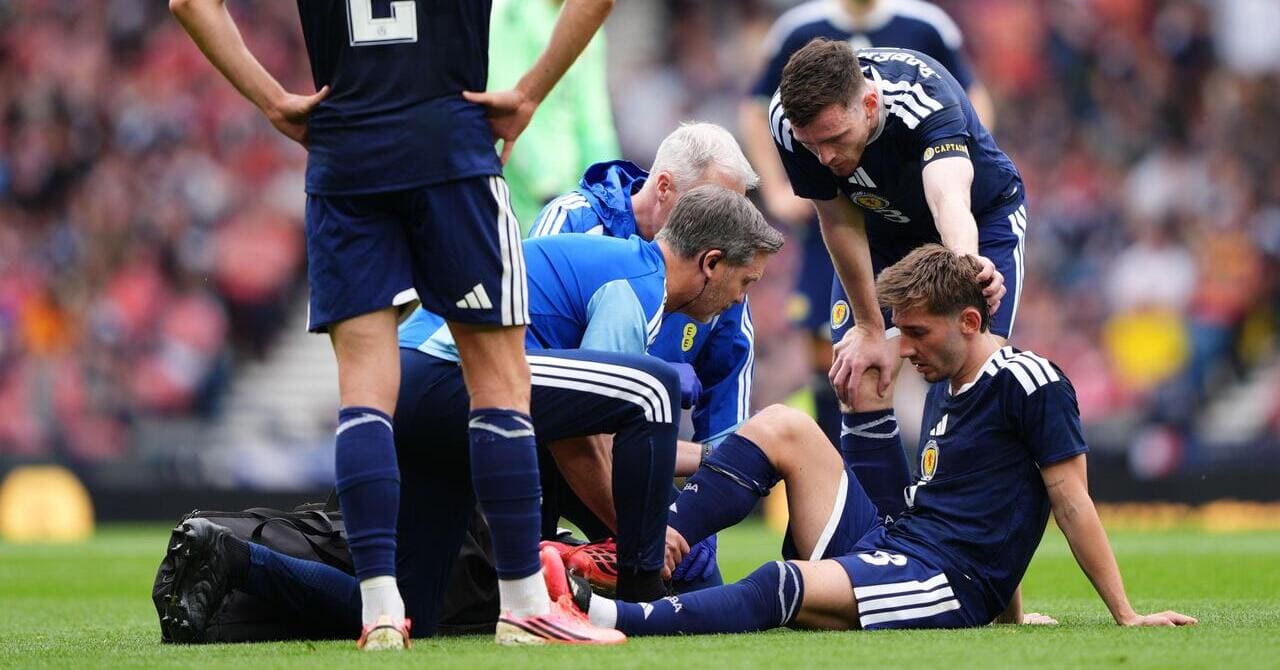
A seismic shockwave has ripped through Scotland’s World Cup dreams, just weeks before their grand unveiling on football’s biggest stage. The Tartan Army, still buzzing from a dominant qualification campaign, awoke to the crushing news that their midfield maestro, Billy Gilmour, will play no part in the quest for glory.
The former Chelsea prodigy, now a pivotal figure for Napoli, has been officially ruled out of the FIFA World Cup 2026. Scans tragically confirmed the severity of a knee injury sustained during Saturday’s hard-fought 4-1 victory over Curaçao, delivering a gut-wrenching blow to Steve Clarke’s meticulously crafted plans.
The Scottish FA wasted no time in confirming the devastating update on Saturday evening. The 24-year-old lynchpin will not board the eagerly anticipated flight to the United States on Sunday. Instead, his journey takes him back to Italy, where a grueling recovery process awaits. This isn’t just an absence; it’s a gaping void in the heart of the national team.
A poignant statement on the Scottish FA’s official website encapsulated the collective sorrow: “We regret to announce that the knee injury sustained by Billy Gilmour in today’s win over Curaçao will rule him out of participation in FIFA World Cup 2026. Everyone involved with the Scotland Men’s National Team wishes Billy a speedy recovery. He will now return to his club, SSC Napoli, to commence rehabilitation.”
Gilmour isn’t merely a squad player; he’s the engine room, the architect, the calm presence amidst the storm. His vision, exquisite passing range, and uncanny ability to dictate the tempo of a game are irreplaceable assets. Losing a player of his caliber – a deep-lying playmaker equally adept at shielding the defense and launching incisive attacks – is a tactical nightmare for any manager, let alone just weeks before a global showpiece.
Game Highlights: Scotland Dominates, But At What Cost?
Before the somber news broke, Scotland’s warm-up fixture against Curaçao was a vibrant affair, showcasing both attacking flair and a worrying vulnerability. The Hampden faithful witnessed a rollercoaster of emotions, culminating in a resounding 4-1 victory that now feels bittersweet.
- Early Setback (15th Minute):Curaçao, defying expectations, stunned the home crowd by taking an early lead. A swift counter-attack caught Scotland flat-footed, with their pacy winger cutting inside and unleashing a powerful shot past Angus Gunn. The Tartan Army held its breath.
- Curtis’s Instant Impact (32nd Minute):The spark Scotland needed came from an unlikely source. Following Gilmour’s unfortunate departure due to injury, substitute Findlay Curtis was thrown into the fray. With his first significant touch, Curtis surged into the box, latching onto a sublime cut-back from Andy Robertson and calmly slotting home the equalizer. The relief was palpable, the energy infectious.
- McTominay’s Masterclass (48th Minute):Scotland emerged from the break with renewed intent. Scott McTominay, ever the midfield powerhouse, soared highest from a corner kick, bulleting a header into the net to give Scotland a deserved lead. His aerial dominance and sheer will to win were on full display.
- Ramsay’s Rocket (67th Minute):The floodgates opened further as young Calvin Ramsay, marauding down the right flank, unleashed a thunderous strike from outside the box. The ball swerved, dipped, and found the top corner, leaving the Curaçao goalkeeper grasping at thin air. A goal of pure quality.
- Adams Seals the Deal (81st Minute):Che Adams, tireless in his pursuit, capitalised on a defensive mix-up, coolly rounding the keeper and tapping into an empty net. The 4-1 scoreline reflected Scotland’s superiority, but the memory of Gilmour limping off cast a long shadow over the celebrations.
Clarke Left ‘Devastated’ by Timing of Blow
The euphoria of victory quickly evaporated for Steve Clarke. The news strips the astute manager of one of his most trusted midfield generals just over two weeks before Scotland open their Group C campaign against Haiti in Foxborough on June 13. Gilmour was not just a player; he was a tactical fulcrum, a guaranteed starter whose absence necessitates a fundamental restructuring.
Speaking immediately after the match, a visibly concerned Clarke had admitted he had “fingers crossed that the wee man is fine.” But the grim reality of the post-match scan left the national team boss utterly heartbroken for the former Chelsea and Brighton man, whose burgeoning career was reaching new heights.
Reacting to the official diagnosis, Steve Clarke’s voice was heavy with emotion: “I am devastated for Billy because he has been an integral part of our World Cup qualifying campaign. The timing of this injury is so, so cruel and we all feel for him. He’s a special talent, and to miss out on a World Cup at the peak of his powers is just gut-wrenching.”
“He knows what we all think of him as a footballer and a person and while no words will give him any comfort tonight, I am certain Billy will have many major tournaments ahead of him in the future. Our focus now must shift to how we adapt, but the emotional impact of this loss cannot be understated.”
Tactical Rethink Ahead of Bolivia: The Midfield Conundrum
While the squad must now process the emotional weight of losing a key figure, Clarke has to quickly pivot to a major tactical rethink before next Saturday’s final warm-up fixture against Bolivia in New Jersey. Gilmour’s absence isn’t just about replacing a player; it’s about rebalancing an entire midfield dynamic.
The immediate impact of Gilmour’s replacement on Saturday, Findlay Curtis, was undeniable. His goal provided a crucial equalizer and offered a glimpse into his potential. Curtis, a box-to-box midfielder with a keen eye for goal, brings a different energy but perhaps lacks Gilmour’s deep-lying orchestration. Then there’s Manchester United teenager Tyler Fletcher, who made a highly impressive international debut off the bench. Fletcher displayed remarkable composure for his age, dictating play with maturity beyond his years, offering a tantalizing, albeit raw, option.
Clarke now faces a genuine conundrum. Does he opt for a like-for-like deep-lying playmaker, perhaps testing the mettle of a less experienced individual like Fletcher or even shifting a seasoned veteran into that role? Or does he fundamentally alter his system, perhaps employing a more combative midfield pivot with two holding players, allowing greater freedom for attacking midfielders like McTominay or John McGinn? The upcoming Bolivia clash becomes an invaluable proving ground, a high-stakes audition for those vying to fill the colossal void.
Prediction: Resilience Will Define Scotland’s World Cup Fate
The loss of Billy Gilmour is undoubtedly a hammer blow, casting a dark cloud over Scotland’s World Cup aspirations. It deprives them of their primary tempo-setter and a crucial link between defense and attack. However, to underestimate Steve Clarke and the Tartan Army would be a mistake. This is a squad built on grit, unity, and an unyielding spirit. They navigated a demanding qualification campaign, demonstrating a resilience that will be severely tested now.
While Group C opponents Haiti and Bolivia may offer opportunities, Gilmour’s absence significantly complicates their path. Clarke’s tactical acumen will be paramount. He will demand even greater collective effort, pushing his remaining midfielders to step up and embrace the challenge. Expect to see Findlay Curtis and Tyler Fletcher given significant opportunities, and potentially a slight shift towards a more direct, pragmatic approach, leaning on the power of McTominay and the experience of McGinn.
Scotland will fight, they always do. They will adapt, as Clarke is a master strategist. While the dream of a deep run might now seem more arduous, I predict that Scotland, fueled by the desire to honor Gilmour’s absence, will navigate their way out of Group C. Their journey beyond that, however, will be a testament to how effectively they can collectively shoulder the immense responsibility left by their fallen maestro. The quarterfinals might be a bridge too far without their orchestrator, but the knockout stages are certainly within their reach if their famed resilience holds strong.