
Chipmaker AMD is taking aim at competitor Nvidia with its latest hardware release: a rack-scale system designed to power computing needs of the world’s largest AI labs.
Key Takeaways
- AMD has officially launched its Helios rack-scale system, a powerful new hardware solution designed to challenge Nvidia’s long-standing dominance in the high-performance AI computing market.
- The company has already secured major customers, including Microsoft, OpenAI, and Anthropic, with significant deployment plans underscoring strong early adoption and strategic partnerships.
- CEO Dr. Lisa Su projects the AI accelerator market will explode to $1.4 trillion by 2030, driven by the demands of agentic AI, positioning GPUs at the core of this massive industry expansion.
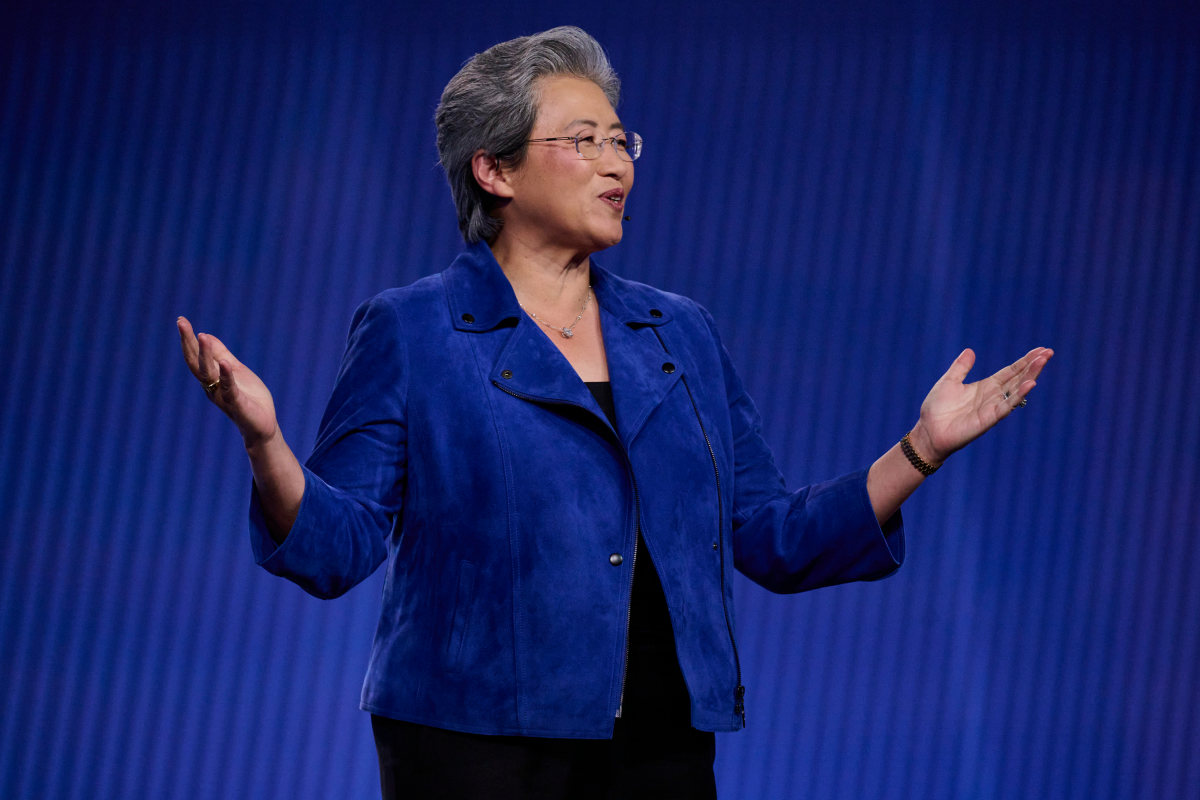
The air in San Francisco crackled with ambition on Thursday as AMD (NASDAQ: AMD) hosted its sold-out Advancing AI conference, a pivotal event that saw Chair and CEO Dr. Lisa Su unveil the company’s most aggressive play yet for the burgeoning artificial intelligence market. With a clear aim at competitor Nvidia, AMD introduced Helios – a formidable rack-scale system engineered to power the insatiable computing needs of the world’s largest AI labs and data centers. This isn’t just another chip release; it’s a full-frontal assault on a market segment historically dominated by a single player, signaling a new era of intense competition at the very top echelon of AI infrastructure.
The Helios System: AMD’s AI Powerhouse Takes Center Stage
At the heart of AMD’s audacious strategy lies Helios, a meticulously designed rack system that combines numerous cutting-edge processors into a single, high-powered unit. These systems are the backbone of modern data centers, serving as the crucibles where complex AI models are trained, refined, and deployed for real-world applications. Dr. Su didn’t mince words, touting Helios as the tech industry’s “highest-performance AI rack,” purpose-built to “train and run the most demanding frontier models in the world at massive scale.” This isn’t hyperbole; the company revealed that Helios is destined for deployment by leading AI companies at gigawatt-scale, a testament to its raw power and scalability.
For years, Nvidia has held an almost unassailable lead in this specialized market with its Vera Rubin and Grace Blackwell rack-scale systems. AMD, however, is now positioning Helios as a direct and superior alternative. Early performance metrics, as reported by industry publications like *The Register*, indicate that Helios is indeed making good on its promises, reportedly outperforming Vera Rubin in several critical benchmarks. This head-to-head performance advantage is crucial for AMD as it seeks to carve out significant market share and challenge the incumbent’s technological supremacy, offering a compelling choice for AI developers and infrastructure providers seeking cutting-edge capabilities and potentially greater vendor diversity.
Widespread Adoption and Strategic Alliances Underpinning Helios
While the official unveiling on Thursday generated significant buzz, Helios is no stranger to the industry. First revealed in 2025 and prominently showcased onstage at CES 2026, the system has already garnered impressive traction among the titans of AI and cloud computing. A growing roster of well-known customers, including OpenAI, Meta, Oracle, Anthropic, and Microsoft, have all declared their intent to deploy the system, providing a powerful endorsement of AMD’s capabilities and the system’s readiness for large-scale integration.
The scale of this adoption is particularly noteworthy. Microsoft CEO Satya Nadella, speaking just days before the Advancing AI conference, confirmed the company’s plans to significantly expand its Azure infrastructure with Helios. This commitment from a hyperscale cloud provider underscores the system’s readiness for enterprise-grade deployment and its potential to underpin a vast array of cloud-based AI services, from generative AI applications to advanced analytics. Even more striking is the strategic partnership announced just Wednesday between Anthropic and AMD, which will see the frontier AI research company deploy up to two gigawatts of GPUs via the new rack system. Such a massive-scale commitment from a leader in AI safety and research like Anthropic signals not only profound confidence in Helios’s performance but also a long-term strategic alignment that could reshape the AI hardware landscape. With Helios set to ship later this year, these early customer wins are laying a robust foundation for AMD’s ambitious market push.
Beyond Helios: Expanding the AI Portfolio with Venice-X and More
AMD’s AI ambitions extend beyond the immediate impact of Helios. The Advancing AI conference also served as a platform to showcase other critical components of the company’s expanding AI hardware ecosystem. Among these was the introduction of the Venice-X CPU, a new central processing unit specifically designed for the demanding environments of data centers and high-computing workloads. Slated for launch in 2027, the Venice-X promises to complement AMD’s GPU offerings, providing a balanced and powerful compute platform for the next generation of AI infrastructure. This holistic approach, combining high-performance GPUs like those within Helios with robust CPUs, ensures that AMD can offer comprehensive solutions capable of handling the diverse and evolving computational requirements of AI, from model training to inference and beyond, solidifying its position as a full-stack AI hardware provider.
Dr. Lisa Su’s Trillion-Dollar Vision for the AI Future
Perhaps the most captivating element of Dr. Lisa Su’s keynote was her profound vision for the future trajectory of the chip industry, specifically its intersection with artificial intelligence. Her projection was nothing short of seismic: by the year 2030, chips that power AI are not merely going to be a significant part of the overall computing market – they are poised to become the dominant force, shaping the very definition of technological progress. This dramatic shift, she argued, is driven by an unprecedented “step change in compute demand,” a phenomenon largely fueled by the rapid emergence and evolution of “agentic AI.”
Su elaborated on the nature of agentic AI, describing it as a paradigm where an AI agent, when tasked with a problem, doesn’t just execute a single command. Instead, it engages in a complex, multi-stage process involving “dozens of steps.” This includes sophisticated reasoning, the ability to call upon and integrate various tools, access and process vast amounts of data, and iteratively refine its approach “over and over until it solves the problem.” Each of these intricate steps demands immense computational power, translating directly into a monumental need for powerful GPUs to handle the parallel processing and data throughput required.
This escalating demand underpins her astounding market forecast: “We’re now expecting that by 2030, the AI accelerator market is going to reach about $1.4 trillion,” Su declared. To put this staggering figure into perspective, she added, “What that means is, by the end of the decade, the AI accelerator market is going to approach the size of the entire semiconductor market today.” Furthermore, within this colossal market, GPUs are anticipated to command the lion’s share. Su explained, “We do expect that GPUs are going to make up the vast majority of that market because the algorithms are still very much in their infancy, and we’re still continuing to see the workloads change, and that favors programmability in the overall silicon ecosystem.” This emphasizes the dynamic nature of AI development, where flexible, programmable hardware like GPUs will remain critical for adapting to rapidly evolving models and applications, securing their central role in the AI compute landscape.
Bottom Line
AMD’s Advancing AI conference marks a pivotal moment for the company and the broader AI industry. With the launch of Helios, buttressed by significant early customer adoption and a clear performance advantage over key competitors, AMD is no longer just a challenger but a formidable force in the high-stakes battle for AI infrastructure dominance. Dr. Lisa Su’s vision of a trillion-dollar AI accelerator market by 2030, largely driven by the complexities of agentic AI and powered by GPUs, positions AMD at the forefront of this technological revolution. While Nvidia’s stronghold is considerable, AMD’s aggressive strategy, robust product pipeline, and strategic partnerships suggest that the landscape of AI computing is poised for a significant and exciting shift, promising intensified innovation and competition for years to come.
When you purchase through links in our articles, we may earn a small commission. This doesn’t affect our editorial independence.
{content}
Source:{feed_title}