
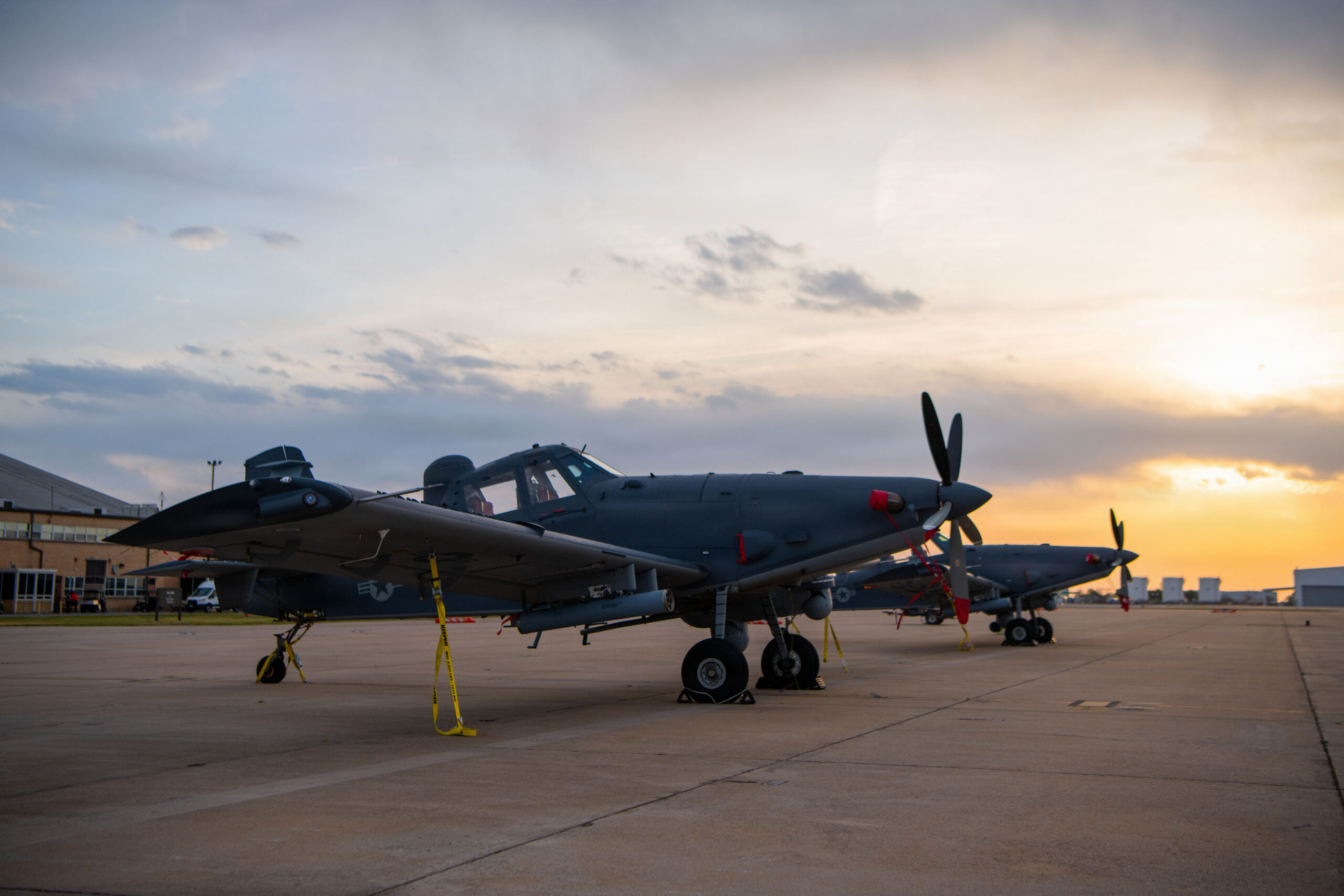
The L3Harris OA-1K Skyraider II, a specialized operations aircraft derived from the Air Tractor prop plane, is gaining significant momentum following successful demonstrations of advanced capabilities and a substantial endorsement from a key congressional committee. These developments signal a potential acceleration in the program to field the aircraft for U.S. Special Operations Command (SOCOM).
Recent demonstrations, detailed by a company executive to Air & Space Forces Magazine, have showcased the OA-1K’s ability to integrate both signals intelligence (SIGINT) sensors and electronic attack (EA) weapons. Concurrently, the House Armed Services Committee (HASC) has recommended a four-fold increase in funding for the Skyraider program in its version of the 2027 National Defense Authorization Act (NDAA), proposing an allocation of $279.9 million, up from the initial $59.9 million requested. While the NDAA sets policy and priorities rather than directly appropriating funds, it serves as a strong indicator of congressional intent and support.
SOCOM initially selected the heavily modified cropduster for its Armed Overwatch program in 2022, a initiative designed to provide persistent, cost-effective intelligence, surveillance, and reconnaissance (ISR) and precision strike capabilities in permissive environments, particularly for counterinsurgency (COIN) operations. The original plan called for fielding 75 of these aircraft. However, the program has encountered challenges, including budget constraints and an increasing strategic emphasis on unmanned aircraft systems (UAS), which led to a reduction in the planned acquisition quantity to 53 airframes.
Despite these past adjustments, officials at Air Force Special Operations Command (AFSOC), which will operate the OA-1K, continue to express a desire for the full complement of 75 aircraft. Sean Ling, vice president and general manager for modernization and modifications for L3Harris, echoed this sentiment, stating, “[It’s a] hot production line, we are executing on the program right now, delivering aircraft, and our anticipation is that that they will need and they will order the full quantity of aircraft.” This confidence is bolstered by the HASC’s recommendation, which, if adopted in final legislation and subsequently funded through appropriations, could significantly expand the program’s scope and accelerate deliveries. The exact number of aircraft that could be acquired with nearly $280 million would depend on individual unit costs, ancillary equipment, and support packages.
The OA-1K was initially conceived for low-intensity conflict scenarios, providing a discreet and persistent presence in airspace where advanced adversary air defenses are not a primary concern. Its design prioritizes endurance, cost-efficiency, and the ability to operate from austere locations. However, Air Force officials are actively exploring avenues to broaden its mission set beyond its original counterinsurgency focus. AFSOC Commander Lt. Gen. Michael Conley recently highlighted the aircraft’s potential for expanded intelligence roles. “It could do exquisite [signals intelligence], collect intel, and also be armed with up to 6,000 pounds of payload,” he informed lawmakers, “whether that’s Hellfires, rockets, maybe some small cruise missiles that we’re working on.”
Ling confirmed that L3Harris is actively pursuing the integration of enhanced SIGINT capabilities. He noted, “We’ve already demonstrated for them the capability to integrate additional signals intelligence capabilities. It was the pod that’s actually on that aircraft that we essentially modified to incorporate signal capability.” The OA-1K already comes equipped with two electro-optical infrared (EO/IR) sensors, providing foundational ISR capabilities. The addition of advanced SIGINT expands its ability to detect, intercept, and process electronic signals, offering critical insights into adversary communications and electronic systems.
Further enhancing its versatility, L3Harris has also made progress in integrating its family of air-launched vehicles with the Skyraider. This includes the Red Wolf, a low-cost cruise missile designed for various strike missions, and the Green Wolf, an electronic attack weapon. While the Red Wolf integration was publicly announced in February, the successful integration of the Green Wolf had not been previously disclosed. Electronic attack capabilities are crucial for disrupting enemy communications, radar, and command and control networks. Ling clarified that neither weapon has yet completed a flight test on the Skyraider platform, but added, “that would not be a difficult challenge,” indicating a high degree of confidence in the modularity and adaptability of the airframe.
Beyond its commitment to AFSOC, L3Harris is actively pursuing international sales for the OA-1K. While Ling refrained from naming specific countries, he indicated that the company is “very aggressively involved in discussions with more than three potential customers.” Foreign military sales (FMS) are strategically important for several reasons: they can help sustain the production line in Waco, Texas, ensuring cost efficiencies through increased volume; they provide allies with a proven, capable platform for their own special operations and low-intensity conflict requirements; and a robust U.S. investment in the program often serves as a significant catalyst, encouraging international partners to commit to acquisitions. Ling emphasized the progress made at the production facility: “We scaled from, frankly, zero at Waco to standing that production line up. It is running. It is efficient. But there is further scaling that can be done to increase orders and throughput.”
Why This Matters
The evolving story of the L3Harris OA-1K Skyraider II holds significant implications for U.S. special operations capabilities, defense procurement, and international security partnerships:
- Enhanced Special Operations Capabilities:The Skyraider, with its expanded SIGINT and electronic attack capabilities, offers SOCOM a more versatile tool for missions in complex environments. While not designed for high-end conflict against peer adversaries, its ability to collect intelligence and disrupt enemy systems in “gray zone” conflicts, counterterrorism, and irregular warfare scenarios is invaluable. This aircraft provides a persistent, cost-effective presence that bridges the gap between high-end conventional assets and less capable platforms.
- Congressional Influence on Defense Strategy:The House Armed Services Committee’s recommendation for a substantial funding increase underscores congressional support for specific defense programs and reflects a priority for certain capabilities. This legislative endorsement can significantly influence the Pentagon’s budget decisions and signals to industry and allies the long-term viability of the program, potentially reversing previous budget-driven cuts and ensuring the program’s full realization.
- Adaptability of Platforms:The ability to integrate advanced sensors (SIGINT) and diverse weaponry (cruise missiles, electronic attack) onto an existing, robust platform like the modified Air Tractor demonstrates a flexible approach to military acquisition. This modularity allows for rapid adaptation to changing threats and mission requirements without the extensive time and cost associated with developing entirely new airframes, highlighting a trend towards multi-mission capable assets.
- The Future of Manned vs. Unmanned Systems:While there is a growing emphasis on unmanned aircraft, the Skyraider’s continued development indicates that manned platforms still hold a critical role, especially for missions requiring human decision-making, direct observation, and the ability to operate in complex operational environments. It represents a balanced approach in the ongoing debate about the optimal mix of manned and unmanned assets.
- Strengthening International Partnerships:L3Harris’s active pursuit of international customers signals the potential for the OA-1K to become a critical asset for allied nations with similar needs in special operations, border security, and low-intensity conflict. U.S. investment in the program serves as an endorsement, potentially encouraging foreign military sales that can foster interoperability, strengthen alliances, and support the U.S. defense industrial base.
The trajectory of the OA-1K Skyraider II program, therefore, is not merely about a single aircraft; it reflects broader strategic shifts, technological advancements, and the intricate interplay between military requirements, industrial innovation, and political will in shaping future defense capabilities.