

Key Takeaways:
- **Significant Financial Jeopardy:** Clover Hill Dairy faces immense financial strain from a comprehensive product recall, license suspension, potential litigation, and severe reputational damage, jeopardizing its operational future and potentially forcing a market exit.
- **Heightened Regulatory Scrutiny:** The incident underscores the critical importance of stringent food safety protocols and regulatory compliance, likely leading to increased oversight and higher operational costs for regional food producers across the dairy sector.
- **Supply Chain & Consumer Confidence Ripples:** The recall’s expansion and associated health risks could trigger broader supply chain adjustments, impact consumer purchasing behavior towards artisanal products, and pressure retailers to enhance supplier vetting processes, impacting market dynamics for specialty foods.
In a development sending ripples through the regional food supply chain and underscoring the critical stakes of food safety, Maryland’s Clover Hill Dairy has initiated a sweeping recall of all its cheese products. This drastic measure comes after health officials linked the Mechanicsville, Maryland, dairy to a severe listeria outbreak, which has reportedly resulted in eight infections and one tragic fatality. The incident not only places Clover Hill Dairy in profound financial jeopardy but also highlights systemic vulnerabilities within the broader food production ecosystem, from farm to consumer, prompting a re-evaluation of risk and compliance across the industry.
The Maryland Department of Health (MDH) announced the voluntary recall, encompassing a full spectrum of Clover Hill’s cheese offerings, including ricotta, cheddar, Monterey Jack, and pepper jack varieties. This expansion follows an earlier, narrower recall focused solely on soft ricotta cheese sold between May 4 and May 30 across a multi-state region including North Carolina, New York, Virginia, Maryland, New Jersey, and Washington, D.C. The widening scope of the recall significantly amplifies the operational and financial burden on the dairy, requiring the retrieval of a much larger inventory from diverse distribution channels, incurring substantial costs for logistics, storage, and eventual destruction of product.
Ricotta cheese is shown in a bowl with basil and tomatoes. Clover Hill Dairy recalled certain soft ricotta cheese products over possible listeria contamination, federal health officials said.(iStock / iStock)
Operational Halt and Regulatory Fallout
The MDH’s decisive action to suspend Clover Hill Dairy’s license on May 30 underscores the severity of the perceived public health risk. For any food producer, a license suspension equates to an immediate cessation of revenue generation, while fixed costs—such as rent, equipment leases, and essential personnel salaries—continue to accrue. This operational halt creates an existential threat, particularly for smaller, privately-held entities like Clover Hill, which may lack the deep financial reserves or lines of credit to weather prolonged periods of inactivity. The direct cost of retrieving contaminated products, managing inventory write-offs, and potentially destroying vast quantities of product will weigh heavily on the company’s balance sheet, potentially exhausting its working capital.
The financial implications extend far beyond immediate losses. Investigations into the source of the contamination will incur significant legal and consulting fees. Should negligence be proven, the dairy could face substantial fines from regulatory bodies, alongside devastating civil litigation from affected individuals and their families. The reported death and multiple infections associated with the outbreak significantly raise the stakes for potential wrongful death and personal injury lawsuits, which could result in multi-million dollar liabilities. Such financial pressures could force the company into bankruptcy, an asset fire sale, or a complete dissolution of its operations, impacting local employment and agricultural supply chains.
Supply Chain Contamination and Brand Erosion
The recall’s complexity is further exacerbated by the distribution network. While some products were sold directly and through retail stores, a substantial portion was distributed in bulk (5-gallon and 2-gallon buckets) and subsequently repackaged under various other brand names, including KESSO, QUESOS LA RICURA, IZALCO, DE MI PUEBLO, and RIO LINDO. This “private label” aspect introduces a ripple effect across the supply chain, potentially tarnishing the brand equity of other businesses that unknowingly distributed or resold the contaminated product. Retailers and bulk distributors now face the logistical nightmare of identifying, segregating, and returning these products, incurring their own operational costs, potential inventory losses, and reputational damage by association. Such incidents compel retailers to tighten their vendor scrutiny, increasing the barrier to entry for smaller producers.
The reputational damage to Clover Hill Dairy is likely to be profound and long-lasting. In the highly competitive and trust-dependent food industry, an association with severe foodborne illness can be devastating, eroding consumer confidence built over years. Rebuilding that trust, even if the dairy eventually resumes operations with enhanced safety protocols, will require significant marketing investment, a prolonged period of flawless execution, and a clear demonstration of rectified processes – a challenging and costly endeavor that few small businesses successfully navigate after such a severe blow to their brand integrity.
Broader Industry Implications and Regulatory Outlook
This incident serves as a stark reminder for the entire dairy and specialty food sector of the stringent demands of food safety and quality control. Listeria monocytogenes, the pathogen identified, is particularly insidious due to its ability to thrive in refrigerated environments and its severe impact on vulnerable populations, including pregnant women, young children, and the elderly. The Food and Drug Administration (FDA) actively monitors such outbreaks, and its involvement, alongside state health departments, signals a coordinated regulatory response that will likely scrutinize processing, sanitation, and quality control standards across the industry more broadly.
For other regional and artisanal dairy producers, this recall may necessitate a re-evaluation of their own Hazard Analysis and Critical Control Points (HACCP) plans, supplier vetting processes, and insurance coverages. Increased regulatory pressure and the potential for heightened liability could translate into higher compliance costs, tighter operating margins, and potentially consolidate market share towards larger players with more robust and centralized quality control systems. Investors in the food processing sector, especially those with exposure to smaller, independent producers or diversified portfolios involving private label manufacturing, will likely review their risk assessments in light of this event, potentially favoring companies with superior track records in food safety and regulatory compliance.
Clover Hill Dairy’s public statement, “Clover Hill Dairy board and staff members sincerely apologize for any inconvenience and hardships caused by this recall, and we sincerely hope to correct this problem as soon as it is safely possible,” reflects the immediate crisis management. However, the pathway to “safely possible” resumption of operations remains fraught with financial and logistical hurdles. The commitment to offering full refunds, while ethically sound and a necessary step for consumer trust, further depletes immediate cash reserves at a time when they are most critically needed for remediation, legal defense, and potential operational overhauls.
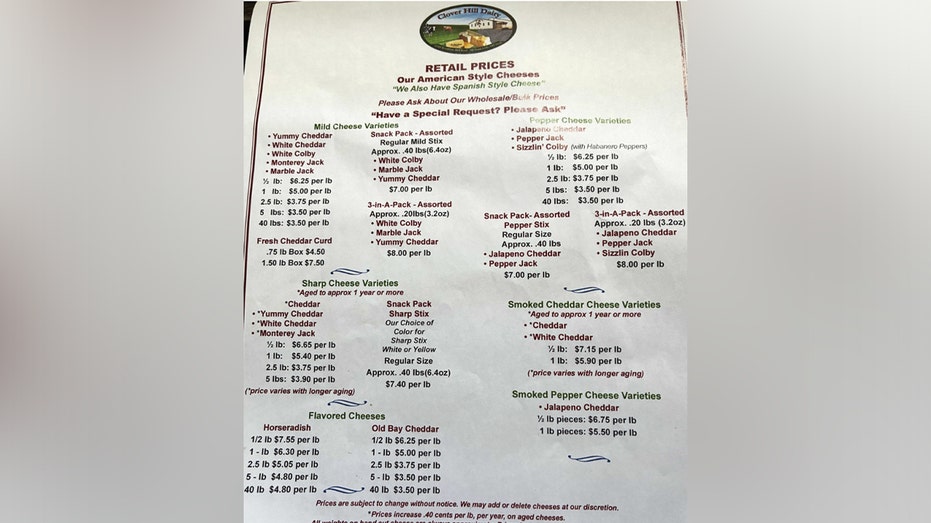
A Clover Hill Dairy retail price list shows several cheese varieties sold by the Maryland dairy.(Maryland Department of Health)
GET FOX BUSINESS ON THE GO BY CLICKING HERE
Market Impact:
The Clover Hill Dairy recall, while specific to a regional producer, resonates through the broader food industry by underscoring persistent challenges in supply chain integrity and food safety compliance. Immediate market impact includes increased scrutiny on small to medium-sized food processors, potentially driving up their operational costs for enhanced quality control measures and increased insurance premiums. Distributors and retailers are likely to re-evaluate their vendor selection processes, favoring suppliers with demonstrably robust safety records, which could contribute to market share consolidation among larger, more established food corporations. Consumer confidence in artisanal and local dairy products may experience a temporary dip, prompting a flight to perceived safer, mass-produced alternatives. For investors, this event highlights the significant regulatory, reputational, and litigation risks inherent in the food sector, particularly for companies operating with thinner margins or less sophisticated quality assurance frameworks, serving as a critical cautionary tale for due diligence in food-related ventures.