
Unlock the White House Watch newsletter for free
Your guide to what Trump’s second term means for Washington, business and the world
Key Takeaways
- Escalating tensions in the Gulf of Oman, marked by direct military action against a commercial vessel, significantly amplify geopolitical risk and threaten global energy supply chains.
- The incident fuels an already substantial risk premium in crude oil markets, with Brent crude up over 20% since the conflict began, signaling continued inflationary pressures.
- Disruptions to the Strait of Hormuz, a critical maritime choke point, pose an immediate threat to global trade flows, leading to increased shipping costs, insurance premiums, and potential supply shortages across various commodities.
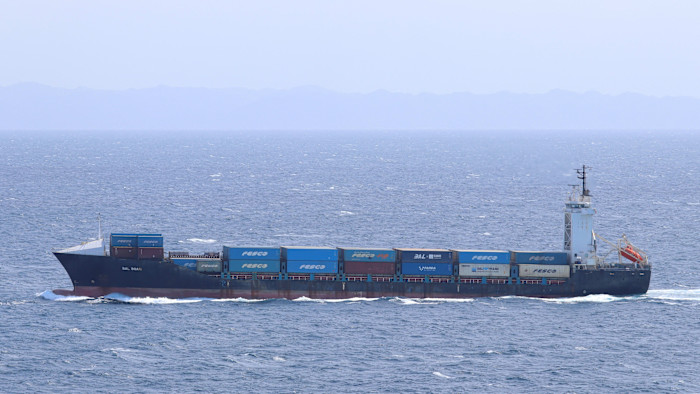
The strategic waters of the Gulf of Oman once again became a flashpoint for international trade and geopolitical tension on Tuesday, as the US military fired upon a Panama-flagged container ship attempting to breach a US naval blockade on Iran. This aggressive interdiction marks a significant escalation in the ongoing conflict, sending ripples of uncertainty through global commodity markets and significantly elevating the risk profile of maritime transit in one of the world’s most critical shipping lanes.
According to a statement from Central Command, which oversees American forces in the Middle East, a US Navy helicopter launched two Hellfire missiles into the engine room of the Vela Nova, effectively disabling its rudder. The military action, which took place after the civilian crew “ignored repeated warnings” from US forces, targeted a vessel attempting to transit the Gulf of Oman en route to an Iranian port. The statement underscored US resolve, noting that American forces have redirected 55 vessels, boarded two, and “disabled” three others in their efforts to enforce the blockade since its re-imposition.
This incident, occurring 71 nautical miles off the coast of Pakistan, directly underpins the volatile geopolitical landscape impacting global energy prices and supply chain resilience. The US military initially reimposed its blockade on Iran’s ports in July, a measure designed to economically pressure Tehran following a resurgence of Iranian attacks on shipping in the Strait of Hormuz. While thankfully no injuries were reported among the 17 crew members of the Vela Nova, the use of lethal force against a commercial vessel immediately resonated with traders and analysts scrutinizing the stability of Middle Eastern crude supplies.
The Strait of Hormuz, a narrow waterway through which a staggering one-fifth of the world’s total oil supply flowed prior to the ongoing US-Iran conflict, remains central to these tensions. Iran’s renewed aggression against shipping in the strait, which commenced shortly after the US and Israel initiated strikes against the country in February, has served as a potent lever in ongoing peace negotiations. This strategy of weaponizing the strait’s strategic importance has successfully driven up global energy prices, creating a significant point of leverage for Tehran in the stalled peace talks.
The market’s sensitivity to these developments is palpable. Brent crude, the international benchmark for oil prices, has surged more than 20 per cent since the conflict intensified at the end of February. On Tuesday, following news of the Vela Nova incident, it settled 1.4 per cent higher at $88.91 a barrel, indicating that the market is rapidly pricing in an increased geopolitical risk premium. This premium reflects fears of supply disruptions, higher transit costs, and the potential for a wider regional conflagration that could severely impede oil flows.
Further exacerbating market jitters were comments earlier on Tuesday from Mohsen Rezaei, the newly appointed secretary of Iran’s Supreme National Security Council. Rezaei, quoted by the semi-official Tasnim news agency, declared that the Strait of Hormuz would remain closed unless the US alters its behavior and accedes to Tehran’s conditions. This stark warning directly contradicts reports from last week, where Iranian diplomats hinted at being close to a deal with Oman to manage the critical waterway, adding another layer of uncertainty to an already opaque diplomatic process.
The history of the blockade itself is fraught with stop-starts and tragic consequences. The US first imposed a naval blockade in April after initial peace talks in Islamabad collapsed. This period saw severe repercussions, including the deaths of three Indian sailors in June when US forces struck a Palau-flagged ship also accused of violating the blockade. The blockade was temporarily lifted in June as part of a memorandum of understanding (MoU) aimed at de-escalating hostilities and restarting negotiations for a comprehensive peace settlement. However, the subsequent reimposition in July, triggered by renewed Iranian attacks on shipping, underscores the fragility of any peace efforts and the enduring volatility of the region.
For global businesses, the implications extend beyond just oil prices. Shipping giants face escalating insurance premiums for vessels traversing the Gulf of Oman and the Strait of Hormuz. Rerouting vessels around the Arabian Peninsula, a costly and time-consuming alternative, could lead to significant delays and increased freight rates, impacting supply chains for everything from manufactured goods to agricultural commodities. This rise in logistics costs inevitably translates into higher consumer prices, fueling inflationary pressures in economies already grappling with post-pandemic recovery and existing supply chain fragilities.
Market Impact
The direct military action in the Gulf of Oman immediately injects a heightened level of uncertainty into global markets. Crude oil prices are expected to remain elevated and volatile, with a significant geopolitical risk premium embedded, potentially pushing Brent crude well above the $90 mark. Shipping and logistics companies will face increased operational costs due to higher insurance premiums and potential rerouting, impacting global trade flows and consumer goods prices. Investor sentiment will likely shift towards safe-haven assets, such as gold and US Treasuries, while equity markets, particularly those sensitive to energy costs and supply chain disruptions, could experience increased selling pressure. The incident also risks stoking global inflation, prompting central banks to maintain or even tighten monetary policies, thereby influencing interest rate trajectories and overall macroeconomic stability.