
Unlock the Editor’s Digest for free
Roula Khalaf, Editor of the FT, selects her favourite stories in this weekly newsletter.
**Key Takeaways:**
1. **Elevated Political Risk:** Widespread protests against both government and opposition elite signal deep-seated governance issues and systemic corruption, significantly increasing political risk for foreign direct investment (FDI) and potentially deterring responsible capital.
2. **ESG Concerns Intensify:** The “Flamingo Revolution” highlights critical environmental (nature reserve) and social (public unrest, cronyism) governance (corruption allegations) issues, posing significant Environmental, Social, and Governance (ESG) challenges for investors and raising red flags for international financial institutions.
3. **Impact on FDI Quality & Volume:** While high-profile projects like the proposed $4bn resort may attract headlines, the surrounding allegations of land fraud and political interference risk attracting opportunistic capital rather than long-term, sustainable investment, potentially undermining Albania’s broader economic development and EU integration aspirations.
***
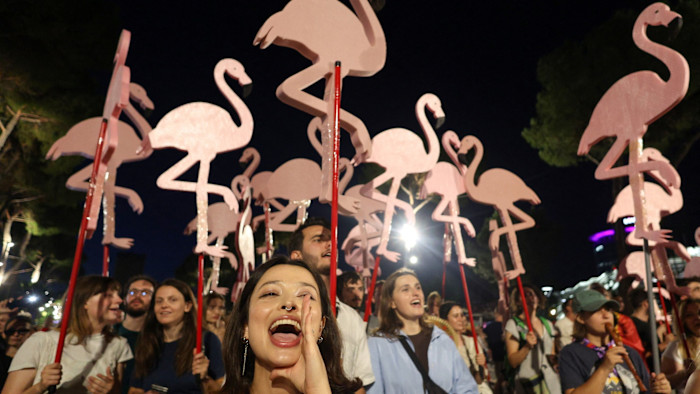
Tirana, Albania – The vibrant scene of paper flamingos and Albanian flags that filled Tirana on Saturday was more than just a colourful display; it was a potent symbol of escalating political risk and deep-seated governance concerns reverberating through Albania’s nascent economy. Tens of thousands of Albanians, spanning the diaspora and domestic populace, united in a powerful protest against perceived government corruption and, specifically, Jared Kushner’s proposed $4bn coastal resort development. This demonstration, among the largest in Albania in years, serves as a stark warning to international investors about the complexities and pitfalls of operating in a market grappling with institutional fragilities.
The rare display of unity, bringing together families, football fans, nationalists, and even a caravan of cars from London, underscored a profound societal disillusionment. The unified cry, “Rama to prison, Berisha to prison,” transcends partisan divides, pointing to a systemic crisis of confidence in Albania’s political and economic elite, a critical factor for sovereign risk assessments and investor due diligence.
Jared Kushner, former President Donald Trump’s son-in-law, has outlined ambitious plans for a luxury development on Sazan, Albania’s only significant island in the Adriatic, alongside a nearby coastal area adjacent to a vital nature reserve, home to the very flamingos that have become the emblem of this burgeoning protest movement. Dubbed the “Flamingo Revolution,” this opposition movement crystallises a confluence of environmental, social, and governance (ESG) concerns that are increasingly scrutinised by global capital.
“What started as a reaction against corrupt developers has now grown into a movement,” explained Ervin Kaciu, a sociologist at the Albanian Academy of Sciences. “It has synthesised everything that is wrong in Albania: political corruption, the power of oligarchs, police and mainstream media overlooking criminal acts. People now fight the whole regime.” This sentiment suggests that the issue is not merely about a single development project, but rather a perceived pervasive lack of rule of law and transparency, which deters reputable foreign direct investment (FDI) and increases the risk premium for all capital entering the country.
For three successive weeks, thousands have gathered in Tirana at night, with marches spreading to other towns around the country as well as 30 cities worldwide. The sustained nature and geographic spread of these protests indicate a deeply embedded frustration that could translate into prolonged social instability, impacting economic activity and investor sentiment.
The arrival of a caravan of vehicles from London, amplified by drivers across Europe, was a powerful visual testament to the global reach of Albanian discontent. The continuous hooting and flag-draped cars, eliciting cheers from passers-by, underscored the emotional intensity and widespread support for the movement. “We are one nation united against the oligarchs and the political elite,” stated Artur Bregu, a shopkeeper from northern Tirana who temporarily closed his business to join the protest. His statement reflects a pervasive belief that a small group of politically connected individuals disproportionately controls Albania’s economic levers, stifling competition and fair market practices.
By early evening, tens of thousands of people had filled the main avenue outside the prime minister’s office, their whistles, horns, and vuvuzelas creating a cacophony that signals widespread disaffection. The protest’s core grievance revolves around the perceived cosy relations between Albania’s political elite and a handful of wealthy families, whose outsized influence in business and media is seen as a barrier to equitable economic development. The protesters’ brandishing of American flags is a nuanced message; it seeks to distinguish their opposition to corrupt practices from any anti-Western sentiment, instead framing their struggle as a demand for the transparent, rules-based capitalism that Western nations advocate.
Fatos Lubonja, a writer and longtime dissident who has clashed with Rama over graft accusations for decades, echoed these concerns, stating, “These people have held power in Tirana politics, the business world and the media for decades. To them, international ties and deals are just another way to justify their hold on power.” This perspective highlights a fundamental challenge for Albania: how to attract legitimate international investment without it being co-opted or perceived as enabling entrenched interests. For investors, this translates into elevated reputational risk and the potential for public backlash if projects are perceived to be linked to opaque dealings.
Prime Minister Edi Rama’s response to the protests has been dismissive, denouncing the demonstrators as extremists and accusing them of resisting a project in Albania’s national interest. His accusations of foreign agents, including from Iran, stoking unrest are likely to be viewed critically by international observers and could further erode trust in the government’s willingness to engage constructively with civil society concerns. Rama’s Facebook post, comparing protesters to “crows and ravens” misinforming “flamingos,” does little to alleviate concerns about transparency or democratic accountability.
The dual rallying cry, “Rama to prison, Berisha to prison,” is particularly telling for market analysts. It suggests that the problem of corruption is perceived as deeply embedded within the entire political establishment, rather than limited to a single party or leader. While publicly bitter enemies, both Prime Minister Rama and opposition leader Sali Berisha have been central figures in Albanian politics for decades, leading many to view them as equally culpable for the current state of affairs. This lack of a credible, untainted political alternative complicates the outlook for long-term political stability and effective governance reform.
Further complicating the investment landscape for the proposed resort, Albania’s special prosecution agency (SPAK) has launched investigations into land deals connected to the project, following allegations of forged titles and other irregularities. Such investigations directly inject legal and regulatory uncertainty into the project, increasing execution risk for developers and financial institutions. Rama has also come under scrutiny, including from the European Parliament, for allegedly lifting environmental restrictions in the area to ease high-end tourism development. While Rama argues such investments will improve environmental quality, the perception of regulatory shortcuts for politically connected projects raises serious questions about environmental protection and the integrity of the permitting process.
**Market Impact:**
The escalating protests and the underlying allegations of corruption and land deal irregularities send a strong negative signal to the international investment community. The pervasive distrust in Albania’s political and economic institutions significantly raises the perceived risk premium for capital, potentially deterring legitimate foreign direct investment (FDI) seeking stable, transparent, and predictable regulatory environments. While a $4bn luxury resort may promise economic benefits, the controversy surrounding it risks attracting opportunistic capital rather than long-term, sustainable investors committed to ESG principles. This situation could undermine Albania’s efforts to align with EU standards for governance and rule of law, impacting its accession prospects and broader macroeconomic stability. The sustained social unrest and legal challenges will likely lead to project delays, increased compliance costs, and potential reputational damage for all parties involved, ultimately affecting investor confidence in Albania’s ability to host major international projects responsibly and transparently.